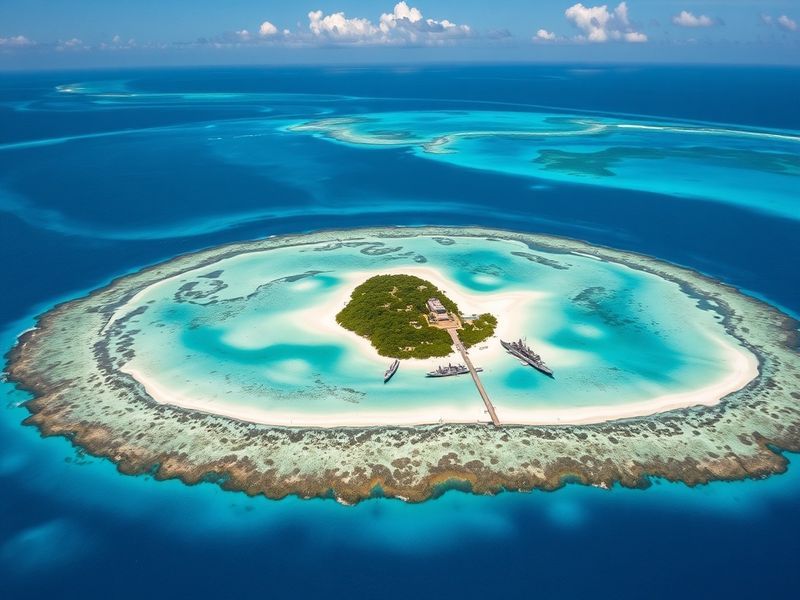
The Indian Ocean is home to some of the world’s most isolated and strategically significant locations. Among them, Diego Garcia stands out—not for its size, but for its outsized role in geopolitics. The atoll is a British overseas territory, leased to the United States for military purposes, and has been a silent witness to decades of global power shifts. Its location, roughly 1,000 miles south of the Maldives, places it in one of the most contested maritime regions on Earth.
Understanding Diego Garcia requires more than a map. It demands a look at its history, its military importance, and the controversies that have shadowed its existence. This is not just another remote island—it is a linchpin in modern military strategy and a point of contention in international law.
The Geography and Strategic Importance of Diego Garcia
Diego Garcia is the largest of the Chagos Archipelago’s 60-plus islands, stretching just 38 square miles across a coral atoll. Despite its small size, its location in the central Indian Ocean makes it a critical outpost. The atoll sits along one of the world’s busiest shipping lanes, connecting the Middle East, Africa, and Asia. For military planners, that proximity is invaluable.
The island’s lagoon, one of the largest in the world, can accommodate aircraft carriers and nuclear submarines. Its airstrip, capable of handling long-range bombers like the B-52 and B-2, has been used extensively since the Cold War. The U.S. Navy and Air Force have maintained a continuous presence since the early 1970s, transforming Diego Garcia into what some analysts call “the unsinkable aircraft carrier.”
This strategic positioning has made Diego Garcia a key node in U.S. military operations across the Middle East. During the Gulf War, Afghanistan invasion, and Iraq War, the island served as a logistics hub, refueling point, and staging ground for long-range strikes. Its isolation also means it is far less vulnerable to surprise attacks than bases in Europe or Asia.
A History of Displacement and Controversy
Diego Garcia’s modern story begins not with military strategy, but with human displacement. In the 1960s and 1970s, the British government forcibly removed nearly 2,000 Chagossians—Indigenous people of African and Malay descent who had lived on the islands for generations—under a secret agreement with the U.S. The evictions were carried out to make way for a military base, part of a Cold War-era deal that included a population transfer and a land lease for 50 years.
The Chagossians were relocated to Mauritius and the Seychelles, often in appalling conditions. Their appeals for return were ignored for decades. It wasn’t until 2000 that a British court ruled the expulsion illegal, though full reparations and repatriation have yet to materialize. In 2019, the United Nations General Assembly demanded that the UK end its administration of the Chagos Archipelago, calling for the islands’ return to Mauritius. The vote was 116–6, with the U.S. among the dissenting nations.
The controversy extends beyond human rights. The legality of the U.S.-UK agreement has been challenged under international law. The International Court of Justice ruled in 2019 that the continued occupation of Diego Garcia violates the UN Charter, and the UN General Assembly upheld that advisory opinion. Yet, geopolitical realities have so far outweighed legal and moral arguments.
Key Points: The Chagos Dispute in Brief
- The Chagossians were forcibly removed from Diego Garcia between 1967 and 1973 to make way for a U.S. military base.
- The evictions were part of a secret deal between the U.S. and UK during the Cold War.
- A British court ruled the expulsion illegal in 2000, but no full repatriation has occurred.
- The UN has repeatedly called for the return of the islands to Mauritius, most recently in 2019.
- The U.S. continues to lease the island under a 1966 agreement, with a 2016 extension through 2036.
Military Use and Modern Geopolitical Role
Today, Diego Garcia hosts one of the U.S. military’s most important overseas installations. Known as Naval Support Facility Diego Garcia, it supports about 1,000 military personnel and 2,000 contractors. The base includes a deep-water port, a 12,000-foot runway, fuel storage, and housing. It is operated by the U.S. Navy and falls under U.S. Central Command.
Its role in modern conflicts has been significant. During the 2001 invasion of Afghanistan, B-1 and B-2 bombers flew combat missions from Diego Garcia. In 2003, B-52s launched strikes during the Iraq War. The island has also been used for drone operations and intelligence gathering. Its remote location makes it ideal for sensitive missions that require minimal public scrutiny.
Diego Garcia’s strategic value has only increased amid rising tensions between the U.S., China, and Russia in the Indo-Pacific. The U.S. has expanded its military footprint in the region, including agreements with India, Australia, and Japan. Yet Diego Garcia remains one of the few fixed, large-scale bases under U.S. control in the Indian Ocean—a critical advantage in a rapidly shifting power balance.
China, in particular, has shown growing interest in the Indian Ocean, investing in ports in Sri Lanka, Pakistan, and Djibouti. The U.S. has responded by reinforcing Diego Garcia’s infrastructure and increasing rotational deployments. Some analysts suggest that the base could become a hub for countering Chinese naval expansion in the region.
Environmental and Human Rights Concerns
Despite its strategic value, Diego Garcia faces criticism on environmental and ethical grounds. The island’s ecosystem, once pristine, has been altered by military construction, waste disposal, and the introduction of invasive species. The U.S. military has acknowledged past environmental violations, including the dumping of hazardous materials and the destruction of coral reefs during base construction.
In 2021, a report by the U.S. Defense Department noted ongoing environmental challenges, including groundwater contamination and unexploded ordnance. The Pentagon has committed to cleanup efforts, but progress has been slow. Environmentalists warn that further militarization could worsen ecological damage in a region already vulnerable to climate change.
On the human rights front, the Chagossian community continues to fight for justice. In 2022, a group of exiled Chagossians filed a new lawsuit in U.S. federal court, seeking reparations and the right to return. Their struggle has gained international support, including from the African Union and several Caribbean nations. Yet, with no immediate sign of political resolution, many fear their claims will remain unanswered.
The moral cost of Diego Garcia’s existence is not abstract. It is etched into the lives of people who were uprooted, denied basic rights, and erased from the narrative of a place that now serves as a silent fortress of power.
Conclusion: A Relic of Power with Unresolved Questions
Diego Garcia is more than a dot on a map. It is a testament to the intersection of colonial legacy, military necessity, and human cost. Its strategic value is undeniable, yet so too are the ethical and legal questions it raises. The island remains a British territory in all but name, leased to the U.S. in a deal that has outlasted empires and outlived its original Cold War purpose.
As geopolitical tensions rise in the Indo-Pacific, Diego Garcia’s role is likely to grow. But so too may the pressure to address its troubled past. The U.S. and UK may find that their continued control over the island comes at a moral and diplomatic price—one that future generations may not be willing to pay.
For now, Diego Garcia stands as a reminder: in the pursuit of security, the world’s most powerful nations have often left human dignity in the wake of progress. The question is not just where Diego Garcia is—but what it represents.
For more on military and geopolitical issues, visit our News and Analysis sections.