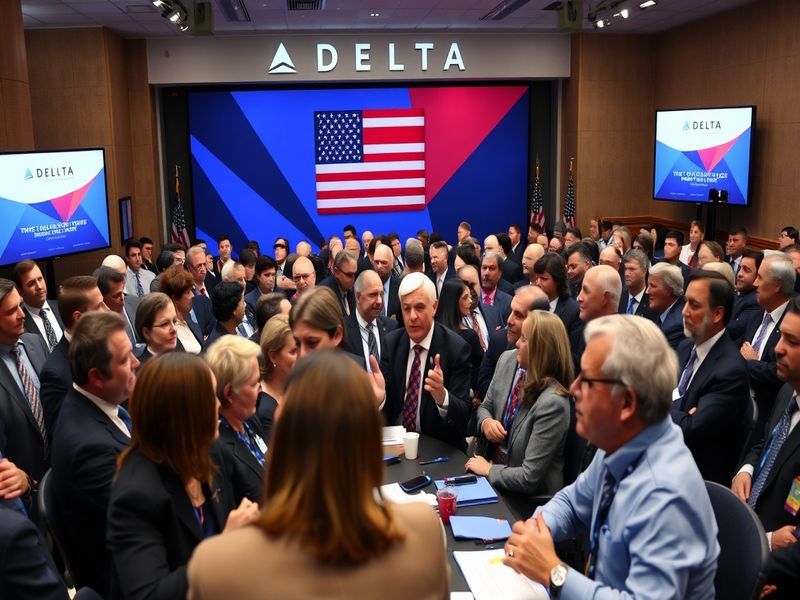
Delta Airlines Congress: How the Airline Shapes U.S. Aviation Policy
In rare moments of bipartisan alignment, the U.S. Congress has found an unlikely partner in Delta Air Lines. Far from the usual lobbying battles over subsidies or safety regulations, Delta’s influence in Washington has quietly shaped policies that affect travelers, airline employees, and even global supply chains. This isn’t just about corporate interests—it’s a case study in how legacy businesses navigate the complexities of modern governance.
Delta’s relationship with Congress spans decades, from its early days as a regional carrier to its current status as one of the world’s largest airlines. Unlike tech giants that dominate headlines with flashy innovations, Delta has built its political capital through steady engagement, often working behind the scenes to shape aviation policy. From infrastructure funding to labor protections, the airline’s footprint in Congress reflects its role as both a corporate entity and a pillar of American industry.
How Delta Shapes Aviation Policy in Washington
Delta’s lobbying efforts in Congress are not about dramatic confrontations but about long-term strategy. The airline has consistently pushed for policies that prioritize infrastructure investment, streamlined air traffic control systems, and sustainable growth for the aviation sector. One of its most notable successes came in 2021, when Congress allocated $8 billion in pandemic relief specifically for airlines, a move that kept Delta—and thousands of other industry jobs—afloat.
The airline has also been a vocal advocate for the travel industry, particularly in debates over international open-skies agreements. Delta has argued against foreign carriers receiving unfair subsidies, a stance that aligns with its business model but also resonates with Congress’s broader protectionist tendencies. This positioning has earned Delta allies on both sides of the aisle, from labor unions to free-market conservatives.
Key areas where Delta’s influence is evident include:
- Infrastructure funding: Delta has supported bills that modernize airport facilities, including upgrades to runways and terminals that improve efficiency and safety.
- Labor protections: The airline has backed measures to ensure fair wages and working conditions for airline employees, a priority that has gained traction amid industry-wide staffing shortages.
- Climate initiatives: Delta has committed to carbon neutrality by 2050, and its lobbying has pushed Congress to invest in sustainable aviation fuels and green technologies.
The Human Side: How Delta’s Work Force Intersects with Policy
Delta’s relationship with Congress isn’t just transactional—it’s deeply human. The airline employs over 90,000 people, many of whom are based in Georgia, Delta’s corporate home. This workforce has become a powerful voting bloc, and politicians from both parties have taken notice. In 2020, Delta’s employees and their families played a quiet but pivotal role in local elections, influencing races that directly impacted the airline’s regulatory environment.
Labor unions, particularly the Air Line Pilots Association (ALPA), have been instrumental in shaping Delta’s messaging to Congress. Pilots, flight attendants, and ground crews have testified before committees, sharing stories of how policy decisions—from fuel taxes to air traffic control privatization—affect their daily lives. These personal narratives have humanized the stakes, making it harder for lawmakers to ignore Delta’s concerns.
For example, when Congress debated the FAA Reauthorization Act of 2023, Delta’s employees were front and center in advocating for provisions that would improve training standards and pilot retention. Their efforts paid off: the final bill included $500 million in funding for pilot training programs, a direct win for Delta and its workforce.
Controversies and Challenges: When Delta’s Influence Faces Scrutiny
Delta’s political engagement hasn’t been without controversy. In 2022, the airline faced backlash over its decision to raise fares during a period of high inflation, with critics accusing Delta of exploiting market conditions. While the airline defended its pricing as a response to rising fuel costs, the episode highlighted the tension between corporate profitability and public perception.
The airline has also been scrutinized for its executive compensation packages, which some lawmakers argue are excessive given the company’s reliance on public infrastructure and pandemic relief funds. In 2021, Delta’s CEO Ed Bastian received a $15 million bonus, a move that drew criticism from progressive Democrats and even some Republicans who questioned the optics of such payouts amid economic uncertainty.
Other challenges include:
- Climate backlash: While Delta has positioned itself as a leader in sustainability, some environmental groups argue its investments in carbon offsets are insufficient. Lawmakers on the left have pushed for stricter regulations, putting Delta in the crosshairs of both corporate and activist interests.
- Labor disputes: Delta’s relationship with its unions has not always been smooth. In 2020, the airline clashed with flight attendants over scheduling practices, leading to a high-profile labor dispute that required federal mediation.
- Competition with low-cost carriers: Delta’s lobbying has often been aimed at leveling the playing field against budget airlines like Spirit and Frontier. However, critics argue that Delta’s efforts to limit competition could stifle innovation and drive up prices for consumers.
What’s Next for Delta and Congress?
As Delta continues to navigate an evolving political landscape, its relationship with Congress will likely grow more complex. The airline is betting big on sustainability, but it will need regulatory support to make its carbon-neutral goals a reality. Meanwhile, labor negotiations and infrastructure funding remain critical issues that could define Delta’s next decade.
One thing is clear: Delta’s influence in Washington is not about fleeting trends or viral moments. It’s about long-term relationships, strategic investments, and the quiet work of shaping policies that affect millions of travelers and workers. As Congress grapples with the future of aviation—from supersonic travel to space-based air traffic control—Delta’s voice will remain a constant, if not always a loud one.
For now, Delta’s strategy appears to be working. The airline has avoided the kind of public scandals that have plagued other industries, and its employees remain a powerful force in local and national politics. Whether this balance will hold in an era of increasing polarization remains to be seen. But one thing is certain: Delta’s story is far from over.