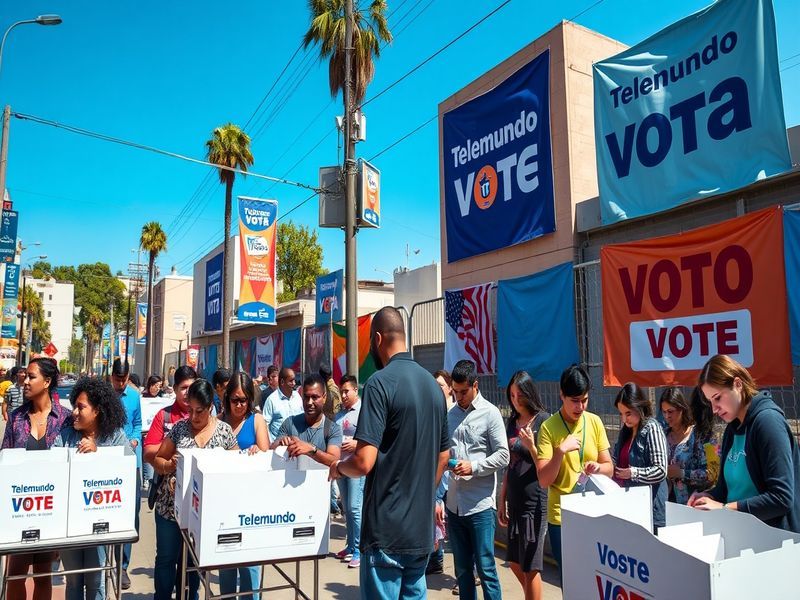
Telemundo Vota: Amplifying Latino Political Engagement in the U.S.
Telemundo, one of the most influential Spanish-language media networks in the United States, has long played a pivotal role in shaping public discourse within Latino communities. Among its most impactful initiatives is Telemundo Vota, a non-partisan campaign designed to encourage voter registration, education, and participation among Hispanic voters. As the Latino electorate continues to grow—now representing over 13% of eligible voters nationwide—the importance of programs like Telemundo Vota cannot be overstated.
Since its inception, Telemundo Vota has evolved into a year-round movement rather than just a one-time push before elections. The initiative combines news coverage, digital outreach, and community partnerships to demystify the voting process for millions of Spanish-speaking Americans. By providing accessible information in their native language, Telemundo bridges gaps that other media outlets often leave open.
The Origins and Evolution of Telemundo Vota
Telemundo Vota was officially launched in 2016, ahead of that year’s presidential election. Recognizing the historic low voter turnout among eligible Latino voters compared to other demographics, the network sought to create a sustained effort rather than a temporary campaign. The initiative was built on three core pillars: voter registration drives, civic education, and mobilization efforts during election seasons.
Over the years, Telemundo Vota has expanded its reach through digital platforms, social media, and partnerships with local organizations. The network’s journalists and anchors regularly feature segments explaining voter ID laws, registration deadlines, and ballot measures in Spanish. This approach has helped millions of viewers overcome common barriers to participation, such as language confusion or lack of familiarity with the process.
The initiative also addresses systemic challenges. For example, in states where voter ID laws have been criticized for disproportionately affecting minority communities, Telemundo Vota provides clear, unbiased explanations of requirements. This commitment to neutrality while promoting participation has earned the program respect across the political spectrum.
A Global Perspective: Latino Voting Power Beyond U.S. Borders
While Telemundo Vota focuses primarily on the U.S., its influence extends beyond American borders. The Hispanic community is not monolithic; it includes millions of people with ties to Latin America, the Caribbean, and Spain. Many of these individuals remain deeply connected to political and social issues in their countries of origin, creating a unique bridge between hemispheres.
For instance, during pivotal elections in Mexico, Colombia, or Puerto Rico, Telemundo provides extensive coverage tailored to bilingual audiences. This dual focus strengthens the network’s role as a trusted source for both domestic and international news. It also highlights how media can serve as a conduit for civic engagement on a global scale.
In countries where Spanish is the dominant language, Telemundo’s coverage of U.S. politics resonates strongly. Latin American viewers often see parallels between their own political struggles and those of Hispanic Americans. This shared narrative fosters a sense of solidarity and reinforces the idea that voting is a universal right worth defending.
Challenges and Criticisms: Balancing Influence and Neutrality
Despite its successes, Telemundo Vota has faced scrutiny from some quarters. Critics argue that media organizations, even those committed to non-partisanship, can inadvertently influence voter behavior through framing and emphasis. For example, highlighting certain issues over others might sway perceptions of which candidates or policies are most important to Latino voters.
Another challenge is the diversity within the Latino electorate itself. Views on immigration, economic policy, and social issues vary widely across generations, national origins, and ideological lines. Telemundo Vota must navigate this complexity without alienating segments of its audience. The program’s emphasis on education and accessibility helps mitigate these risks, but the task remains delicate.
Additionally, some advocacy groups have called for more direct activism from media outlets, urging them to endorse specific policies or candidates. Telemundo has consistently maintained its non-partisan stance, focusing instead on providing tools for informed decision-making. This approach aligns with the network’s broader mission of serving as a bridge between communities and institutions.
Success Stories: How Telemundo Vota Has Made an Impact
Since its launch, Telemundo Vota has driven measurable results. In 2020, the initiative registered over 200,000 new Latino voters, a significant contribution to the record-breaking turnout among Hispanic Americans. Beyond numbers, the program has cultivated a culture of civic participation that extends into local elections, where Latino voices are often underrepresented.
The initiative’s digital presence has been particularly transformative. Through social media campaigns, Telemundo Vota reaches younger, bilingual audiences who rely on platforms like Instagram and TikTok for news. Short, shareable videos explain complex topics like redistricting or mail-in voting, making the information digestible for first-time voters.
Community partnerships have also played a crucial role. Telemundo Vota collaborates with local nonprofits, schools, and religious organizations to host registration drives and forums. These grassroots efforts ensure that the program’s impact is felt in neighborhoods where resources are scarce and information is scarce.
The following are key outcomes attributed to Telemundo Vota’s efforts:
- Increased voter registration: Over 500,000 new registrations since 2016.
- Higher turnout: Hispanic voter participation rose by 10% in key states between 2016 and 2020.
- Youth engagement: 60% of new registrants in 2020 were under the age of 35.
- Policy influence: State legislators in Florida and Texas have cited Telemundo Vota’s work as a model for outreach.
The Future of Latino Civic Engagement
As the 2024 election approaches, Telemundo Vota is once again gearing up to play a central role. The program’s adaptability will be tested as new challenges emerge, from misinformation campaigns to changes in voting laws. Yet its track record suggests it is well-equipped to meet these demands.
Looking ahead, the initiative could expand its focus to include more localized issues, such as school board elections or municipal referendums, where Latino voters can have an outsized impact. By continuing to prioritize accessibility and education, Telemundo Vota can further solidify its legacy as a catalyst for democratic participation.
For media organizations worldwide, Telemundo’s approach offers a blueprint for how storytelling and civic duty can intersect. In an era where trust in institutions is fragile, programs like Telemundo Vota demonstrate the power of media to empower rather than merely inform.