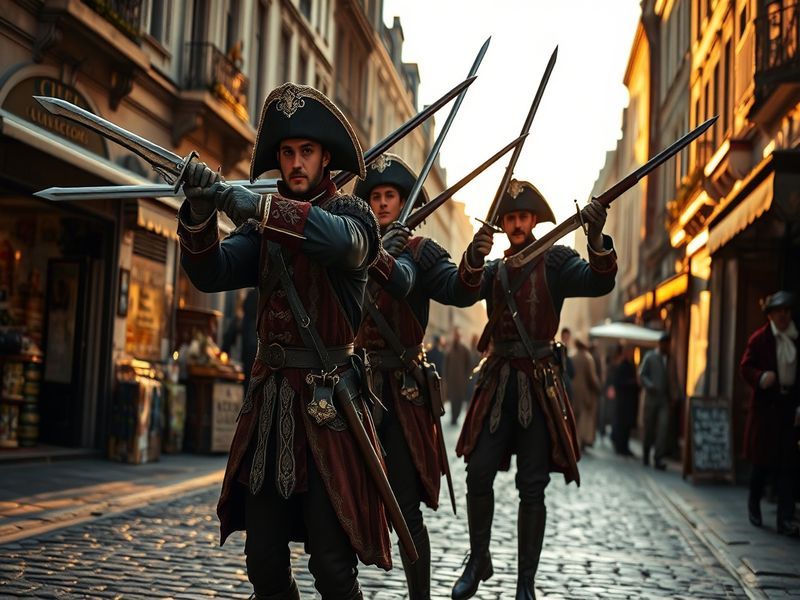
Alexandre Dumas’ The Three Musketeers (1844) is far more than a swashbuckling adventure set in 17th-century France. Since its serialization, the story of d’Artagnan and his comrades—Athos, Porthos, and Aramis—has transcended borders, languages, and generations, embedding itself into global pop culture in unexpected ways. From early stage adaptations to modern anime and video games, the tale’s themes of friendship, loyalty, and daring exploits have proven universally resonant.
The novel arrived during a golden age of French literature, when serial novels captivated mass audiences. Dumas, along with his collaborator Auguste Maquet, crafted a narrative that blended history with fast-paced fiction. The story unfolded against the backdrop of Louis XIII’s reign and Cardinal Richelieu’s political machinations, giving it an air of authenticity that appealed to readers across Europe and beyond.
The Birth of a Legend: Dumas’ Historical Fiction Roots
Dumas drew inspiration from real historical figures and events, though he took significant creative liberties. The musketeers themselves were loosely based on real members of the King’s Musketeers, an elite unit of the French army. By weaving their fictional exploits with historical events like the Siege of La Rochelle, Dumas created a narrative that felt both grounded and fantastical.
This blend of history and fiction proved pivotal. Readers weren’t just entertained—they were educated. The novel sparked interest in 17th-century France, influencing later historical works and even academic studies. In Japan, for instance, The Three Musketeers became a staple in literature classrooms, where its dramatic structure and moral dilemmas were analyzed alongside traditional Western classics.
A Story That Travels Well
The novel’s journey across cultures began early. By the late 19th century, translations appeared in German, English, and Russian. Each adaptation reinterpreted the story for local tastes—sometimes emphasizing romance, other times focusing on military valor. In Russia, the tale was embraced by the intelligentsia, who saw parallels between the musketeers’ defiance of authority and their own struggles against autocracy.
Japan’s relationship with The Three Musketeers is particularly fascinating. The story was first translated in 1883 and quickly became a cultural touchstone. Japanese adaptations ranged from samurai-themed versions to modern anime series like Gankutsuou: The Count of Monte Cristo, which reimagined the tale in a futuristic setting. The themes of camaraderie and honor aligned seamlessly with Japanese values, ensuring the story’s longevity.
From Page to Stage: Theatrical Adaptations and Their Global Impact
Theater played a crucial role in spreading the musketeers’ fame. Early stage adaptations in France and England amplified the story’s dramatic potential. The 1845 Parisian premiere of Les Trois Mousquetaires drew massive crowds, with audiences captivated by the swashbuckling action and witty dialogue. These productions often emphasized the comedic and romantic elements, making the story accessible to broader audiences.
By the early 20th century, Hollywood had taken notice. Silent film adaptations introduced the musketeers to American audiences, though these versions often simplified the plot. The 1973 Richard Lester film, starring Michael York and Oliver Reed, remains one of the most beloved adaptations, blending humor with high-stakes drama. Meanwhile, Soviet filmmakers produced a critically acclaimed 1979 version that emphasized the story’s historical depth, resonating strongly in Eastern Europe.
A Global Phenomenon in Visual Media
Animation has been another key medium for the musketeers’ global spread. Disney’s 1993 animated film The Three Musketeers, part of the Entertainment canon, introduced the characters to younger generations. Japanese anime studios have also reimagined the tale, such as in the 2005 series Dog of Flanders, which featured musketeers as secondary characters.
Video games have further cemented the musketeers’ place in modern culture. Titles like Assassin’s Creed Unity feature the musketeers as key figures in its recreation of Revolutionary Paris. Meanwhile, strategy games like Age of Empires include them as legendary units, blending history with gaming fantasy.
Cultural Interpretations: How Different Nations Reimagined the Musketeers
Every culture that adopted The Three Musketeers left its own stamp on the story. In France, the musketeers are often celebrated as national icons, embodying the spirit of rebellion and adventure. French comics, or bande dessinée, frequently revisit the characters, with series like Les Trois Mousquetaires by Jean Van Hamme offering fresh takes.
In India, the story was adapted into films like The Three Musketeers* (1992), which blended the original plot with Bollywood-style musical numbers. The musketeers’ camaraderie and heroism fit seamlessly into Indian storytelling traditions, where friendship and loyalty are central themes.
Even in Africa, the story found new life. Nigerian filmmaker Tunde Kelani adapted the tale into a 2005 film titled Agogo Eewo, set in a Yoruba village. By transplanting the musketeers’ adventures into a local context, Kelani made the story relatable to West African audiences while preserving its core themes.
Why the Musketeers Resonate Across Cultures
The enduring appeal of The Three Musketeers lies in its universal themes. Friendship, honor, and the fight against injustice are values that transcend borders. The musketeers’ motto, “All for one, and one for all,” encapsulates a shared human desire for solidarity and purpose.
Moreover, the story’s adaptability has allowed it to remain relevant. Whether through period dramas, modern retellings, or even memes, the musketeers continue to evolve. In 2020, a viral TikTok trend featured users reenacting famous musketeer duels, proving that even in the digital age, the story’s spirit endures.
The Musketeers in the 21st Century: Legacy and Future
Today, The Three Musketeers remains a cultural touchstone, its influence visible in everything from literature to fashion. The story has inspired countless novels, including Anthony Horowitz’s The Three Musketeers: The Queen’s Diamonds and Fred Saberhagen’s The Dracula Poems, which reimagines the musketeers as vampire hunters.
In gaming, the musketeers appear in titles like For Honor and Assassin’s Creed, where their swordplay and tactics are celebrated. Even fashion brands have drawn inspiration from their iconic outfits, with brands like Louis Vuitton referencing musketeer aesthetics in their campaigns.
The Next Chapter: What’s Awaiting the Musketeers
With new adaptations constantly emerging, the musketeers’ future looks bright. Upcoming film and television projects promise to introduce the characters to younger audiences once again. Meanwhile, indie game developers continue to explore the story’s potential, with narrative-driven games offering fresh perspectives on the musketeers’ adventures.
As long as stories of friendship, adventure, and defiance of authority remain compelling, the musketeers will endure. Their legacy is a testament to the power of storytelling—a reminder that great tales, like great friendships, stand the test of time.
Whether you’re a longtime fan or discovering the musketeers for the first time, their world invites you to step into a realm where heroism is measured in both sword strokes and moral courage. All that’s left is to raise a glass and say, “To the musketeers!”