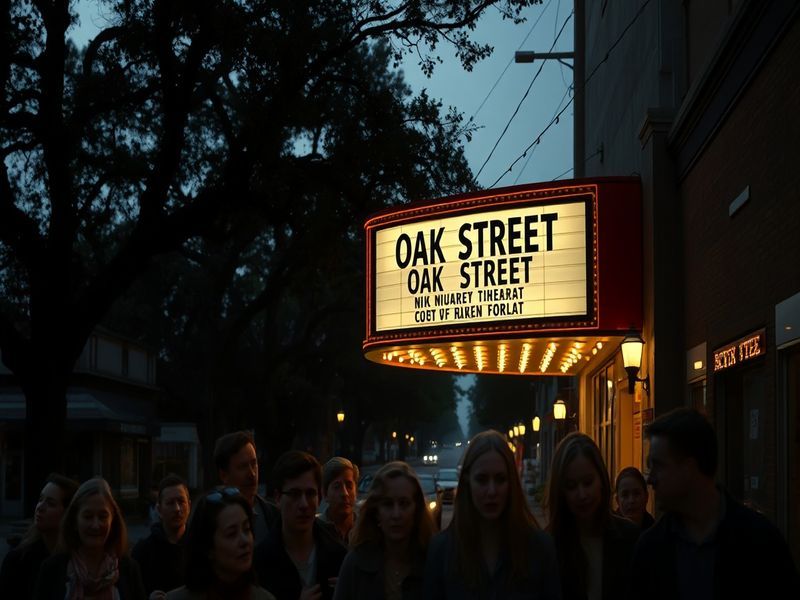
The End of Oak Street: A Trailer That Echoes Global Cinema
The first full trailer for The End of Oak Street dropped this week, and it’s already drawing comparisons to some of the most visually arresting films of the past decade. Directed by debut filmmaker Elena Vasquez, the trailer offers only fragments of the story—enough to intrigue, but never enough to satisfy. Set in a fictional coastal town that feels like a fusion of New England and Portugal’s Algarve region, the footage blends sun-bleached nostalgia with an undercurrent of unease.
Vasquez, who previously worked as a cinematographer on indie documentaries, brings a documentary-like precision to the film’s visual language. The trailer opens with a slow pan across a boardwalk lined with shuttered shops, their faded storefronts advertising “Last Chance Sales” from summers long past. A child’s laughter mixes with the sound of waves, but the tone shifts abruptly when a shadow crosses the frame. The juxtaposition is deliberate: beauty masking tension, a hallmark of films like The Wicker Man or Midsommar.
Global Influences and Cinematic Homages
What makes The End of Oak Street stand out isn’t just its aesthetic. It’s the way it weaves together influences from global cinema without ever feeling derivative. The trailer nods to:
- Italian neorealism in its use of natural light and non-professional extras
- Japanese horror’s slow-burn dread, particularly in the framing of empty spaces
- French New Wave’s handheld camera work during chaotic scenes
- American indie films like Hereditary in its unsettling sound design
This international tapestry reflects Vasquez’s own background—born in Argentina, raised in Spain, and now based in New York. The film’s setting may be fictional, but its DNA is unmistakably global. Even the trailer’s color grading leans into a muted, desaturated palette that recalls the work of Belgian director Chantal Akerman in Jeanne Dielman, while the sudden bursts of color—red balloons, a neon sign flickering in a diner—feel like direct lifts from Wong Kar-wai’s Chungking Express.
Cultural Context: Small Towns as Metaphors
Small towns in film have always served as microcosms for larger societal fears. The End of Oak Street continues this tradition, but with a twist. Its coastal setting suggests themes of transience and displacement—echoing both climate anxiety (as rising sea levels threaten the town) and economic precarity (the boardwalk’s decline mirrors post-industrial rural areas worldwide).
Critics have already begun drawing parallels to recent films that use rural or coastal settings as metaphors for societal collapse, such as The Last of the Mohicans’s wilderness or Force Majeure’s avalanche metaphor. But Vasquez’s approach feels more intimate. The trailer hints at a story that’s as much about family secrets as it is about environmental collapse—a dual narrative that resonates in an era where both personal and planetary crises feel inescapable.
In Poland, where Vasquez shot part of the film, critics have compared The End of Oak Street to the work of Krzysztof Kieślowski, particularly in how it blends the mundane with the metaphysical. Meanwhile, in Japan, audiences familiar with The Boy and the Beast or Shin Godzilla might see echoes of those films’ blend of realism and mythmaking.
What the Trailer Tells Us—and What It Hides
The trailer is a masterclass in restraint. It reveals:
- The protagonist, a single mother played by rising star Mira Patel, working at a failing tourist shop
- A mysterious figure arriving on a train, carrying a suitcase that might—or might not—contain something dangerous
- A local legend about a shipwreck that occurred during a storm in 1972, with survivors claiming to have seen “something in the water”
- Flashbacks to a fire in the town’s history, possibly connected to the current events
What it doesn’t reveal is just as important. There’s no clear villain, no obvious supernatural element, and no indication of whether the story will lean into psychological horror, social realism, or magical realism. This ambiguity is either brilliant or frustrating, depending on who you ask. Some viewers have speculated that the film could be a spiritual successor to The Witch, while others see it as a sibling to recent folk horror films like Men or The Feast.
The trailer’s most chilling moment comes when Patel’s character picks up a vintage postcard in the tourist shop. The postcard shows the boardwalk as it once was—bustling, vibrant, alive. She flips it over, and the handwriting on the back reads: “We’ll be back soon.” The line is delivered in a voiceover by an unseen character, and the screen cuts to black before we see who’s speaking. It’s a moment that lingers, the kind of detail that rewards repeat viewings and fuels endless theories.
Why This Trailer Matters Beyond the Film
The End of Oak Street arrives at a cultural inflection point. After years of pandemic isolation and digital overstimulation, audiences are returning to theaters craving stories that feel both personal and universal. The trailer’s success lies in its ability to tap into that hunger without giving too much away—a balancing act that’s harder than it looks.
In an era where most trailers feel like extended ads, packed with spoilers and CGI set pieces, Vasquez’s trailer is refreshingly opaque. It trusts the audience to lean in, to sit with the uncertainty, to ask questions rather than be handed answers. This approach has already sparked debates online about the film’s potential genre, with some arguing it’s a horror film in disguise and others insisting it’s a straight drama with eerie undertones.
There’s also the question of representation. Patel’s casting as the lead—a woman of color in a role that isn’t explicitly defined by her race—reflects a growing trend in indie cinema toward normalizing diverse protagonists without making their identities the central conflict. It’s a subtle but significant shift, and one that could have ripple effects beyond this single film.
What’s Next for The End of Oak Street
The film is set to premiere at the Toronto International Film Festival in September, with a planned theatrical release following in October. A24 has already acquired North American rights, a deal that suggests the studio sees potential in the film’s crossover appeal. Early word from festival screenings hints that the full movie lives up to the trailer’s promise, balancing its atmospheric dread with deeply human moments.
For now, the trailer remains the closest thing we have to the film itself. It’s a tantalizing tease, a promise of something greater. Whether The End of Oak Street delivers on that promise will depend on Vasquez’s ability to sustain its mood without losing narrative coherence. But one thing is certain: this trailer has already carved out its own space in the cultural conversation, proving that in a landscape crowded with noise, sometimes less really is more.