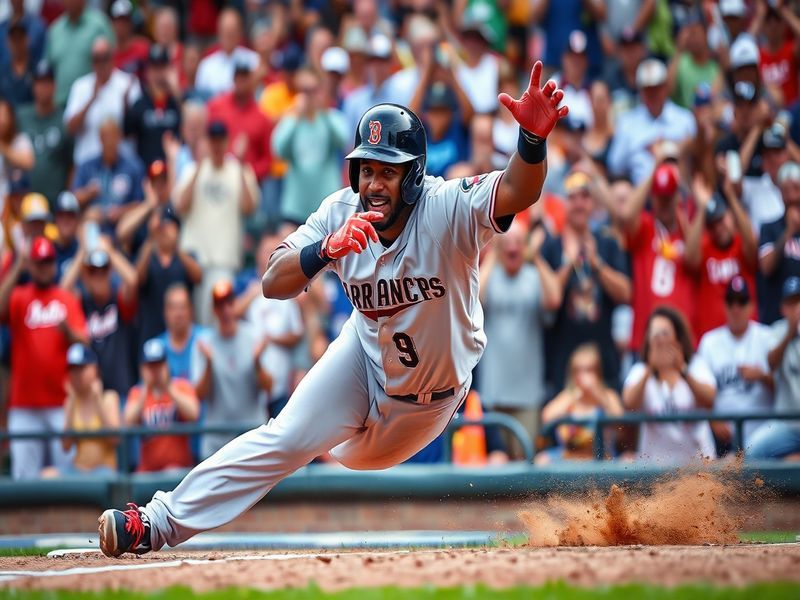
Carl Crawford arrived in Major League Baseball as a 21-year-old outfielder with the Tampa Bay Devil Rays in 2002, carrying a bat that would soon become synonymous with elite hitting and blazing speed. Over a 15-year career, Crawford compiled a résumé that placed him among the game’s most dynamic two-way players, blending prodigious power with game-changing baserunning. His ability to change the complexion of a game in a single at-bat or stolen base made him a fan favorite and a cornerstone of the early 2000s Rays franchise.
Early Career and the Rise of a Star
Born in Houston, Texas, in 1981, Crawford was drafted by the Devil Rays in the second round of the 1999 MLB Draft straight out of high school. Though he debuted with a modest .259 average in 2002, the raw talent was undeniable. By 2003, he began to emerge, posting a .281 average with 17 home runs and 25 stolen bases, flashing the rare combination of power and speed that would define his career.
Crawford’s breakthrough came in 2004, when he became the first player in Rays history to hit 20 home runs and steal 20 bases in a season. That year, he batted .294 with 20 HR, 80 RBI, and 35 stolen bases, earning his first All-Star selection at age 23. His performance signaled the arrival of a new era in Tampa Bay baseball, one built on youth, energy, and athletic excellence.
A Franchise Cornerstone
Crawford spent eight seasons with the Rays, becoming the face of the franchise during its rise from league doormat to contender. In 2008, he played a pivotal role in Tampa Bay’s first American League pennant, batting .279 with 15 HR, 70 RBI, and 50 stolen bases. His defense in left field was equally impressive, earning him three Gold Glove Awards during his tenure. Crawford’s consistency and leadership helped transform the Rays into perennial playoff contenders, setting the stage for future success.
The Peak Years: 2009–2010
Crawford’s prime came between 2009 and 2010, when he established himself as one of the most dangerous players in the game. In 2009, he led the American League with 12 triples and 60 stolen bases, becoming the first player since 1960 to record at least 10 triples and 60 steals in a season. His .309 batting average, 15 HR, and 70 RBI rounded out a complete offensive profile.
The following year, Crawford delivered one of his finest seasons. He batted .307 with 19 HR, 90 RBI, and 47 stolen bases, finishing second in the AL MVP voting and earning All-Star Game MVP honors. His clutch hitting and baserunning were instrumental in Tampa Bay’s second straight playoff berth. For a brief period, Crawford wasn’t just a star—he was the best player in baseball.
Defensive Excellence and Five-Tool Legacy
Crawford’s value extended beyond the box score. He was a five-tool player in the truest sense: he could hit for average, hit for power, run the bases, throw out runners, and field his position with elite range. His arm strength and quick release made him a nightmare for runners attempting to take extra bases. Between 2003 and 2010, Crawford averaged 27 stolen bases per season while posting a .296 batting average and a .360 on-base percentage. Defensively, he won four Gold Gloves and three Silver Sluggers, a testament to his all-around excellence.
- 2004–2010: Five All-Star selections
- 2009: Led AL in triples (12) and stolen bases (60)
- 2010: Finished second in AL MVP voting
- Career: .290 batting average, 136 HR, 760 RBI, 487 stolen bases
- Defense: Four Gold Gloves, three Silver Sluggers
Life After Tampa Bay and Later Career
In December 2010, Crawford signed a seven-year, $142 million contract with the Boston Red Sox, one of the largest deals in franchise history at the time. The move was seen as a statement by the Red Sox, who sought to pair Crawford’s speed and power with a lineup already featuring sluggers like David Ortiz and Adrian Gonzalez. However, the transition was rocky. Injuries, including a torn thumb ligament in 2012, limited his playing time and diminished his effectiveness. He never replicated his Tampa Bay form in Boston, though he remained a respected veteran presence in the clubhouse.
After parts of five seasons in Boston, Crawford was traded to the Los Angeles Dodgers in 2015 as part of the blockbuster deal that sent Hanley Ramirez and relief pitcher Joel Hanrahan to the Red Sox. In Los Angeles, Crawford served primarily as a platoon outfielder and pinch-hitter, contributing to the Dodgers’ deep postseason runs in 2015, 2016, and 2017. Though his role diminished, he provided veteran leadership and timely hitting, including a key pinch-hit RBI single in Game 2 of the 2017 World Series.
Crawford retired following the 2016 season, though he played briefly in the Mexican League in 2018 and 2019. His final MLB appearance came in Game 7 of the 2016 World Series, a fitting end for a player who had spent much of his career in high-pressure postseason moments.
Legacy and Impact on the Game
Carl Crawford’s career bridged two eras in baseball. He debuted as a speed-and-defense specialist before evolving into a complete hitter capable of carrying a lineup. His 487 career stolen bases place him among the top 50 in MLB history, and his .290 career batting average ranks him among the most consistent hitters of his generation. Crawford’s impact extended beyond statistics, though. He represented the rise of Tampa Bay as a small-market success story and embodied the athleticism and versatility that modern scouting departments covet.
For younger players, Crawford remains a blueprint for two-way production. His ability to impact games in multiple ways—whether with a 450-foot home run, a leaping catch in the gap, or a stolen base that shifted the momentum—mirrors the kind of multidimensional talent that coaches and analysts now prioritize. Though his career was not without its struggles, particularly in Boston, Crawford’s body of work ensures his place in the conversation about the most exciting players of the 2000s.
Beyond the field, Crawford’s humility and work ethic earned him respect across the league. Teammates often praised his leadership, and his quiet professionalism contrasted with the flashier personalities that dominated the era. In an age where analytics and power numbers increasingly dictated player value, Crawford stood out as a player who could do it all—and do it with style.
Where Does He Rank Among Left Fielders?
When evaluating Crawford’s place in baseball history, context matters. Among left fielders of his era, he ranks among the best in stolen bases, defensive runs saved, and total value. His career WAR (Wins Above Replacement) of 49.4 places him in the same conversation as contemporaries like Ryan Braun, Matt Kemp, and Andre Ethier—though his peak was higher and more sustained than most.
Unlike many power hitters of his time, Crawford’s game was not built on launch angles or exit velocity. It was built on bat speed, instincts, and an unshakable belief in his abilities. That authenticity resonated with fans and teammates alike, cementing his reputation as one of the most reliable and exciting players of his generation.
Today, Crawford remains involved in baseball through charitable work and occasional appearances. While he never reached Cooperstown, his legacy is secure as a player who made the game more dynamic and entertaining. For a generation of fans who grew up watching him patrol left field in Tampa Bay, his highlights—whether a diving catch or a steal of home—remain indelible memories.
Conclusion: A Career That Spoke for Itself
Carl Crawford’s career was a study in consistency, versatility, and understated dominance. He arrived in the majors as a prospect with tools to burn and left as a franchise icon, a five-tool legend, and one of the most exciting players of his time. Though his career had its share of challenges, the peaks far outweighed the valleys. In an era dominated by power hitters and analytical approaches, Crawford reminded everyone that baseball is still a game of skill, speed, and heart.
For the Rays, he was the player who helped build a winner. For the Red Sox and Dodgers, he was a veteran presence in big moments. For the game itself, he was proof that talent, when combined with effort, can redefine what it means to be a star. Carl Crawford didn’t just play the game—he made it better.
Explore More on Dave’s Locker
Discover more stories about baseball legends and rising stars in our Sports and Analysis sections.