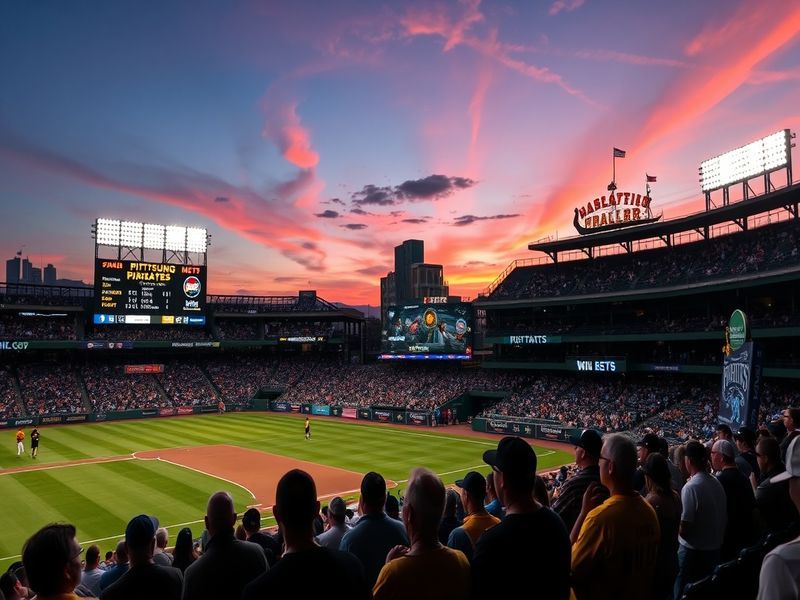
Pirates vs. Mets: A Historic Baseball Rivalry Beyond Wins and Losses
Pirates vs. Mets: When East Meets West in Baseball’s Cultural Divide
The Pirates and Mets represent two distinct philosophies in baseball, one rooted in tradition and the other in reinvention. While the Pittsburgh Pirates have spent over a century cultivating a blue-collar identity, the New York Mets emerged in 1962 as a team built on second chances and splashy debuts. Their occasional interleague matchups offer more than just wins and losses—they reveal how baseball’s cultural narratives evolve across generations.
This rivalry isn’t defined by the intensity of the Yankees-Red Sox or the Dodgers-Giants. Instead, it thrives on contrasts: the Pirates’ gritty, underdog spirit versus the Mets’ cosmopolitan flair. When these teams meet, they don’t just play baseball; they stage a collision of identities that reflects broader shifts in the sport itself.
The Pirates: Baseball’s Original Underdogs
Founded in 1881, the Pittsburgh Pirates embody baseball’s working-class roots. The team’s name alone evokes images of swashbuckling adventurers, but in reality, it stems from the era’s rough-and-tumble baseball culture. The Pirates were one of the National League’s original franchises, and their early success—including five World Series appearances in the first half of the 20th century—cemented their place in baseball history.
Yet the Pirates’ legacy is as much about resilience as it is about triumph. In 1979, they became the last team to win the World Series with a majority of their roster composed of players born in the United States. That team, led by Willie Stargell, was a family in the truest sense, with players like Dave Parker and Bill Robinson forming a brotherhood that transcended the field. Their anthem, “We Are Family” by Sister Sledge, blared through Three Rivers Stadium not as a gimmick, but as a testament to their unity.
Today, the Pirates play in a city that has embraced them as civic symbols. Pittsburgh’s blue-collar identity—steeped in steel, coal, and resilience—mirrors the team’s approach to baseball. While the franchise has struggled in recent decades, its farm system remains one of the most respected in baseball, consistently producing talent that keeps the dream of contention alive.
The Mets: New York’s Second Team with a First-Class Attitude
The New York Mets arrived in 1962 as an expansion team, inheriting the abandoned Polo Grounds and a fanbase that had just lost the Giants and Dodgers to California. Yet from the start, the Mets were different. Their first season was a disaster—120 losses—but that ignominy set the stage for one of baseball’s most improbable triumphs.
In 1969, the “Miracle Mets” shocked the world by winning the World Series, led by a pitching staff that included Tom Seaver and Jerry Koosman. Their victory wasn’t just a sports story; it was a cultural moment. In a city defined by ambition and reinvention, the Mets became a symbol of hope for the working class and the outsider. Their orange and blue colors stood in contrast to the Yankees’ pinstripes, offering a new kind of New York identity.
Over the decades, the Mets have become the city’s team for those who love drama as much as they love baseball. From the 1986 championship to the heartbreak of 2006 and 2015, the franchise has thrived on extremes. Their ballpark, Citi Field, is a modern cathedral where fans don’t just watch games—they become part of the spectacle. The Mets’ identity is fluid, shifting with each era, but always anchored in New York’s unshakable confidence.
When the Pirates and Mets Collide: A Clash of Cultures
Interleague play introduced the Pirates and Mets to each other in 1997, and since then, their matchups have been defined by contrast. The Pirates bring a scrappy, fundamental approach to the diamond, while the Mets rely on power and personality. These games are less about division titles and more about storytelling.
Consider the 2013 series at PNC Park, where the Mets’ Lucas Duda hit a walk-off home run in the 16th inning—a game that lasted over six hours. The Pirates, known for their endurance, pushed the limits of baseball’s traditional rhythms. Meanwhile, the Mets’ lineup that year, featuring David Wright and Matt Harvey, represented the new wave of superstar-led teams that prioritize analytics and athleticism.
These matchups also highlight baseball’s global evolution. The Pirates’ farm system has increasingly featured international talent, from Colombia’s Starling Marte to Australia’s Adam Laroche. The Mets, meanwhile, have leaned into a multicultural roster, with stars like Yoenis Céspedes and Edwin Díaz bringing flair from Cuba and Puerto Rico. When these teams face off, they showcase baseball’s growing diversity.
The Global Lens: How These Teams Reflect Baseball’s Changing Face
Baseball is no longer just an American pastime. It’s a global sport with roots in Latin America, Asia, and Europe. The Pirates and Mets, though based in the U.S., embody this transformation in different ways.
The Pirates were early adopters of international scouting, signing Roberto Clemente in 1954 and building a legacy of Latin American talent. Today, their top prospects often hail from Venezuela, the Dominican Republic, and beyond. The Mets, too, have embraced global talent, but with a different approach. Their emphasis on analytics and player development has made them a destination for international free agents and drafted players alike.
This global perspective extends beyond the field. In cities like Pittsburgh and New York, baseball is intertwined with immigration, labor, and urban identity. The Pirates’ struggles in the 1980s and 1990s mirrored the decline of Pittsburgh’s steel industry, while the Mets’ rise in the 1980s coincided with New York’s economic rebirth. These teams aren’t just sports franchises; they’re cultural artifacts.
As baseball continues to expand globally—with games played in London, Tokyo, and Mexico City—the Pirates and Mets represent two pathways forward. One team clings to tradition, while the other embraces change. Yet both are vital to the sport’s future.
Why These Matchups Matter Beyond the Scoreboard
The Pirates and Mets may not be traditional rivals, but their interleague series offer something rare in modern baseball: authenticity. In an era where teams are increasingly built around analytics and short-term gains, these matchups remind fans of the human element in the game.
For the Pirates, games against the Mets are opportunities to prove that small-market teams can compete with the big-city powerhouses. For the Mets, these series are a chance to flex their muscle in front of new audiences. But most importantly, these games allow baseball to tell its story in all its complexity—from the blue-collar grit of Pittsburgh to the cosmopolitan energy of New York.
In the end, the Pirates vs. Mets rivalry isn’t about who wins or loses. It’s about what baseball represents: tradition, reinvention, and the enduring power of the game to bring people together.
For fans looking to dive deeper into the history and culture of these teams, Dave’s Locker Sports offers comprehensive coverage, including player profiles, historical retrospectives, and in-depth analysis of baseball’s shifting landscape.