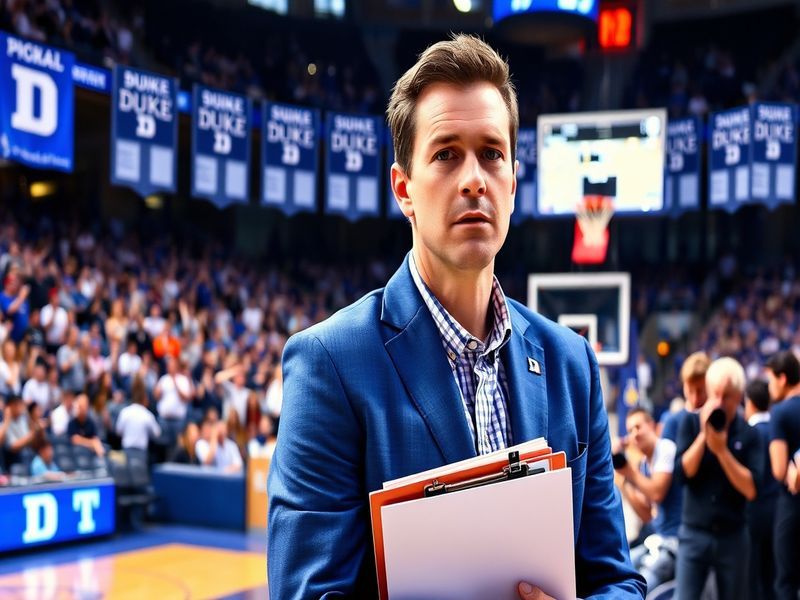
Jon Scheyer: Duke Coach Redefining Basketball’s Modern Era
Jon Scheyer’s name resonates in basketball circles for more than just his on-court achievements. The 38-year-old coach has quietly built a reputation as one of the most innovative strategists in college basketball, transforming Duke University’s program through a blend of analytical precision and player development. His journey from a standout high school prospect to a national championship-winning coach represents a career that reflects broader trends in sports culture.
Scheyer’s story intersects with several key narratives in modern basketball. The sport has increasingly emphasized three-pointers, positionless play, and statistical optimization—elements that define Scheyer’s coaching philosophy. His approach mirrors how basketball’s global expansion has created new pathways for coaches to rise through the ranks, particularly in elite programs that serve as talent pipelines.
Early Career and Playing Days
Born in 1987 in Northbrook, Illinois, Scheyer’s basketball roots ran deep. His father, Lee Scheyer, played professionally in Europe, instilling in Jon an early appreciation for the game’s tactical dimensions. At Glenbrook North High School, Scheyer established himself as a sharpshooter, averaging 24 points per game as a senior. His high school success earned him a spot at Duke under Mike Krzyzewski, where he would become one of the most decorated players in program history.
Scheyer’s college career (2006-2010) coincided with a transitional period for Duke. While the Blue Devils remained a perennial contender, they adapted to a changing college basketball landscape marked by the rise of the three-point shot and more versatile offensive systems. Scheyer thrived in this environment, evolving from a role player to a leader. He finished his career as Duke’s all-time leader in games played (144) and three-pointers made (297), statistics that foreshadowed his future coaching identity.
From Assistant to Head Coach: A Seamless Transition
Scheyer’s post-playing career began in the business world, but basketball’s pull proved too strong. He joined Duke’s coaching staff in 2013 under Coach K, working as an assistant for a decade. This period allowed him to absorb Krzyzewski’s leadership style while developing his own methods. Scheyer’s rise to head coach in 2021 came at a pivotal moment. Duke was searching for a coach who could blend tradition with innovation, and Scheyer’s deep institutional knowledge made him the ideal candidate.
His first season as head coach in 2022-23 was a proving ground. Scheyer’s team, led by freshmen like Dereck Lively II and Mark Mitchell, showcased his emphasis on defensive intensity and three-point shooting. While the season ended in disappointment with an early NCAA Tournament exit, it revealed Scheyer’s ability to develop young talent—a skill increasingly valued in a sport where one-and-done players dominate headlines.
Coaching Philosophy and Global Influences
Scheyer’s approach to coaching reflects broader shifts in basketball’s global evolution. His system prioritizes spacing, ball movement, and defensive versatility, concepts that have gained traction worldwide. Programs from Europe to Australia now emphasize these principles, reflecting basketball’s globalization. Scheyer’s ability to implement such a system at Duke—a program with a rich history but facing modern challenges—highlights his adaptability.
One of Scheyer’s most intriguing innovations has been his use of analytics to guide decision-making. The rise of data-driven coaching has transformed basketball, and Scheyer has embraced this trend wholeheartedly. His staff uses advanced metrics to evaluate player performance, game strategies, and even recruitment targets. This mirrors a global trend where basketball programs, from the NBA to top European clubs, rely on data to gain competitive edges.
Cultural Impact and the Future of Basketball
Scheyer’s story is also a cultural touchstone for basketball’s next generation. His rise from a suburban Chicago high school to the helm of one of college basketball’s most prestigious programs serves as inspiration for aspiring coaches and players worldwide. In an era where basketball’s popularity has exploded globally—particularly in countries like Australia, Germany, and Serbia—Scheyer represents the kind of leader who can bridge cultural divides within the sport.
His coaching style also reflects basketball’s evolving aesthetic. The game has become faster, more spaced-out, and reliant on perimeter shooting, trends that Scheyer has fully embraced. This shift mirrors broader cultural changes in sports, where traditional roles have blurred. For example, centers like Lively II are now expected to shoot threes and switch defensively, a far cry from the post-up specialists of past decades.
Challenges and Opportunities
Scheyer’s journey has not been without challenges. Recruiting elite talent to Duke remains a constant battle against programs with deeper pockets or flashier facilities. The rise of the transfer portal has also complicated roster-building, forcing Scheyer to adapt to a more fluid player market. Yet, these challenges have also created opportunities for innovation. Scheyer’s emphasis on player development—teaching fundamentals while also preparing athletes for professional careers—sets him apart in a landscape dominated by immediate results.
Looking ahead, Scheyer’s success could redefine what it means to be a “Duke coach.” The program has long been associated with a specific style of play and a certain type of player. Scheyer’s ability to modernize while preserving Duke’s identity will determine his legacy. His story is part of a larger narrative about the evolution of basketball coaching, where traditional pathways are increasingly complemented by analytical rigor and global perspectives.
Lessons from Scheyer’s Career
Scheyer’s career offers several lessons for aspiring coaches and players. First, adaptability is key. His evolution from a three-point specialist to a defensive-minded coach demonstrates the importance of growth. Second, institutional knowledge matters. Scheyer’s decade-long apprenticeship under Coach K gave him insights that few could match. Finally, innovation is not antithetical to tradition. Scheyer has found a way to honor Duke’s past while pushing the program forward.
As basketball continues to evolve, coaches like Scheyer will play a crucial role in shaping its future. His story is a reminder that success in sports is not just about talent or strategy—it’s about vision, adaptability, and the ability to connect with players across generations and cultures.
A Global Perspective on Scheyer’s Influence
To understand Scheyer’s impact, it’s helpful to look beyond the United States. Basketball’s globalization has created a network of coaches, players, and systems that influence one another. Scheyer’s emphasis on spacing and three-point shooting aligns with trends seen in Europe’s top leagues, where teams like Real Madrid and Barcelona prioritize ball movement and outside shooting. Similarly, his defensive schemes reflect innovations from programs like Australia’s NBL, where coaches blend NBA-style schemes with international flexibility.
Scheyer’s story also intersects with basketball’s growing presence in Asia. Countries like China, Japan, and the Philippines are investing heavily in the sport, creating new opportunities for coaches with international experience. While Scheyer has yet to coach overseas, his profile makes him a potential candidate for global projects, from FIBA competitions to NBA coaching pipelines.
Moreover, Scheyer’s rise reflects broader changes in sports culture. The days when coaches were former players with limited tactical knowledge are fading. Today’s coaches are often former analysts, data scientists, or even journalists. Scheyer’s background—a mix of playing experience and analytical rigor—positions him perfectly for this new era.
Conclusion: The Scheyer Blueprint
Jon Scheyer’s career is more than a story of individual achievement. It’s a blueprint for how modern basketball coaches can thrive in a rapidly changing landscape. His ability to blend tradition with innovation, his embrace of analytics, and his focus on player development all point to a coaching philosophy that is both timeless and forward-thinking.
As basketball continues to grow globally, coaches like Scheyer will be at the forefront of its evolution. Whether in college basketball or on the international stage, his influence is likely to extend far beyond Durham, North Carolina. For aspiring coaches and fans alike, Scheyer’s journey offers a compelling example of how to navigate the complexities of modern sports.
In an era where basketball’s popularity shows no signs of slowing down, Scheyer’s story is a reminder that the sport’s future will be shaped by leaders who can adapt, innovate, and inspire. His career is still unfolding, but one thing is clear: Jon Scheyer is a coach to watch.