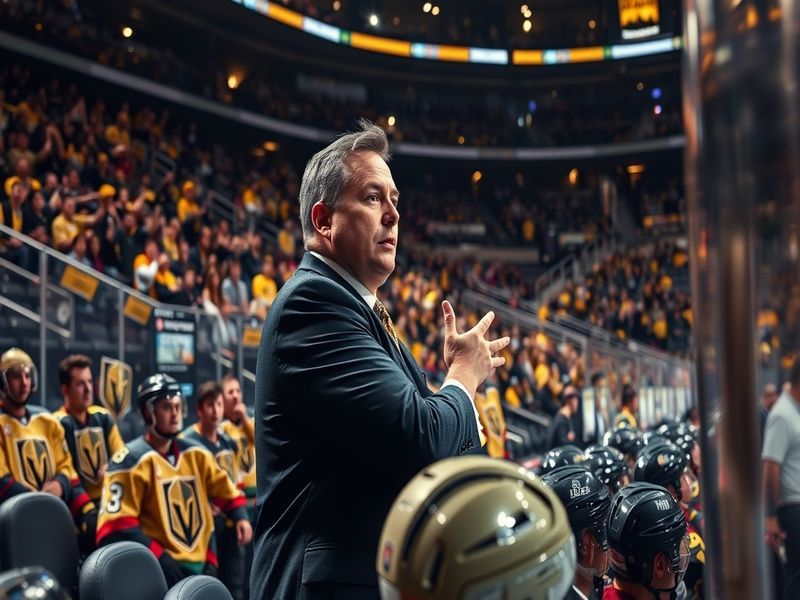
Bruce Cassidy’s first season as head coach of the Vegas Golden Knights marked a deliberate shift in the franchise’s trajectory. Known for his defensive structure and adaptability, Cassidy inherited a team that had reached the Stanley Cup Final in its inaugural season under Peter DeBoer. The challenge wasn’t just to maintain competitiveness but to refine an identity that balanced offensive creativity with disciplined play. Under Cassidy, the Golden Knights evolved from a fast-paced, high-scoring contender into a more methodical and resilient squad.
The transition reflected broader trends in the NHL, where coaching philosophies are increasingly shaped by analytics and situational adjustments. Cassidy, a former Boston Bruins coach with a reputation for managing egos and maximizing player roles, brought a European-influenced approach to a team historically built on speed and skill. This evolution wasn’t just tactical—it was cultural, signaling a maturation of the franchise’s hockey identity.
The Coaching Philosophy: Discipline Meets Adaptability
Cassidy’s coaching style has long been defined by two core principles: defensive responsibility and situational flexibility. His systems prioritize puck possession and controlled entries, a philosophy that contrasts with the high-risk, high-reward style that once defined the Golden Knights. This approach isn’t unique in today’s NHL, where even traditionally offensive teams like the Edmonton Oilers have adopted more defensive structures under coaches like Kris Knoblauch.
The Golden Knights’ roster under Cassidy has been optimized for his system. Players like Mark Stone and Jack Eichel, known for their two-way capabilities, became even more valuable under Cassidy’s structured environment. Meanwhile, younger forwards like Michael Amadio and Pavel Dorofeyev were given defined roles that emphasized defensive zone exits and transition play. The result was a team that could grind out wins in low-scoring games—a stark contrast to the high-flying Golden Knights of the DeBoer era.
This shift also mirrored broader changes in the league. As parity increases year over year, teams that can control games through structure rather than sheer talent are thriving. The Golden Knights’ success under Cassidy wasn’t just about Xs and Os; it was about building a culture where every player understood their role within a larger system.
Key Adjustments and Tactical Innovations
One of Cassidy’s most notable adjustments was in the power play. Where DeBoer’s unit ranked among the league’s best, Cassidy retooled it into a more dynamic but slightly less prolific unit. The change wasn’t about regression—it was about sustainability. The Golden Knights’ power play became less reliant on one-dimensional setups and more adaptable to defensive structures. This approach paid dividends in close games, where a single power-play goal could decide the outcome.
Defensively, Cassidy implemented a neutral-zone trap hybrid that forced opponents into low-percentage entries. This system, while not as aggressive as the forecheck-heavy approaches of the past, reduced high-danger chances against. The Golden Knights’ goals-against average improved significantly under Cassidy, a testament to the effectiveness of his systems.
Another innovation was Cassidy’s use of analytics to optimize line combinations. Unlike traditional pairings based on chemistry alone, Cassidy’s lineups were structured to maximize possession metrics. For example, the top line of Stone, Eichel, and Jonathan Marchessault was often deployed against opposing top lines, but Cassidy would adjust based on matchups in real time. This level of detail reflected a modern coaching approach that blends traditional scouting with data-driven decision-making.
Player Development Under Cassidy
Cassidy’s impact extended beyond tactics—it was evident in player development. Under his guidance, several Golden Knights took noticeable steps forward in their careers:
- Brayden McNabb: Once seen as a depth defenseman, McNabb became a trusted shutdown pairing under Cassidy. His improved positioning and defensive reads made him a critical piece of the Golden Knights’ blue line.
- Nicolas Roy: A former fourth-line grinder, Roy flourished in a middle-six role under Cassidy. His ability to play in all situations and contribute offensively made him a fan favorite.
- Keegan Kolesar: A gritty, physical forward, Kolesar became a regular in the lineup due to his improved defensive play and penalty-killing abilities.
These developments highlighted Cassidy’s knack for maximizing player potential. It wasn’t about turning stars into superstars—it was about refining role players into reliable contributors. This approach resonated in a league where depth and versatility are increasingly valued over singular superstar performances.
Cultural Impact: Shaping the Golden Knights’ Identity
The Golden Knights entered the NHL as an expansion team with a mandate to entertain. Their inaugural season was defined by high energy, aggressive play, and a willingness to take risks. While this approach yielded success, it also led to inconsistency. Cassidy’s arrival signaled a move toward professionalism and accountability—values that have become central to the franchise’s identity.
This shift wasn’t universally embraced by fans. Some purists missed the high-octane, unpredictable style that once defined the Golden Knights. However, Cassidy’s approach aligned with the broader NHL trend toward sustainability. Teams that prioritize structure and development over flash are more likely to maintain success over the long term.
The cultural impact extended beyond the locker room. Cassidy’s emphasis on accountability influenced how the Golden Knights interacted with media and fans. Players were more measured in their public statements, and the team adopted a more reserved public relations strategy. This professionalism reflected Cassidy’s own demeanor—calm, composed, and focused on process over results.
The Road Ahead: What’s Next for Cassidy and the Golden Knights?
As the Golden Knights look to build on Cassidy’s first season, several questions loom. Can they maintain their defensive structure while regaining their offensive firepower? Will Cassidy’s systems continue to evolve as the roster changes? And perhaps most importantly, can the team recapture the magic of its inaugural run while embracing a more disciplined approach?
The Golden Knights’ offseason moves, including the acquisition of forward Ivan Barbashev and defenseman Adin Hill, suggest a commitment to Cassidy’s vision. Barbashev’s physicality and two-way play fit perfectly into Cassidy’s system, while Hill’s size and mobility address a key need on the blue line. These additions indicate that the franchise is doubling down on Cassidy’s philosophy rather than reverting to its previous style.
Looking globally, Cassidy’s approach mirrors trends seen in other sports leagues. In soccer, for example, managers like Pep Guardiola and Thomas Tuchel have prioritized possession and structure over direct attacking play. Similarly, in the NBA, coaches like Nick Nurse and Erik Spoelstra have blended analytics with adaptability to maximize player potential. Cassidy’s success in Las Vegas reflects a broader shift toward professionalism in sports coaching.
The Golden Knights’ journey under Cassidy is far from over. If the team can find the right balance between discipline and creativity, they have the potential to become a perennial contender. Cassidy’s ability to adapt his systems year over year will be critical in maintaining their competitive edge.
For a franchise that has always prided itself on innovation, Cassidy’s tenure represents another evolution—one that embraces the future of hockey while honoring the team’s roots. It’s a delicate balance, but one that could define the next chapter of Golden Knights hockey.
As the NHL continues to globalize, the Golden Knights’ story under Cassidy offers a case study in how traditional hockey values can adapt to modern demands. Whether in Las Vegas or beyond, the franchise’s ability to blend entertainment with structure will be key to its sustained success.
For more on the Vegas Golden Knights’ season, visit our Sports category.
Explore more hockey analysis and news on Dave’s Locker.