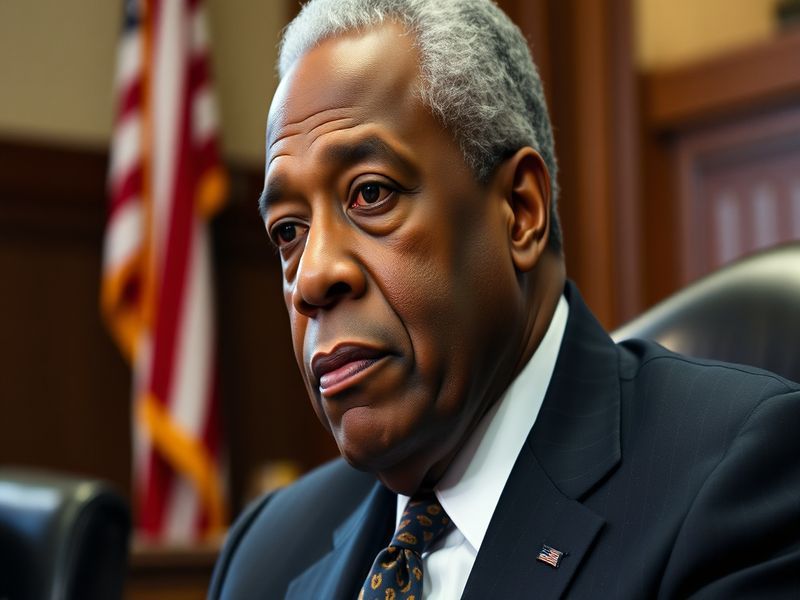
Clarence Thomas: A Justice Shaping America’s Legal Landscape
For more than three decades, Clarence Thomas has stood as one of the most influential yet polarizing figures in American jurisprudence. Appointed to the Supreme Court in 1991, Thomas became only the second Black justice in U.S. history, following Thurgood Marshall. His tenure has been marked by unwavering originalist and textualist principles, reshaping legal interpretations on issues from affirmative action to privacy rights. Globally, his impact extends beyond American borders, influencing legal debates in countries wrestling with similar constitutional questions.
Born in 1948 in Pin Point, Georgia, Thomas grew up in poverty, raised by his grandparents after his father abandoned the family. His journey to the highest court in the land reflects a narrative of perseverance, education, and ideological conviction. After graduating from the College of the Holy Cross and Yale Law School, he built a career in public service, serving as an assistant attorney general in Missouri, a legislative aide, and chair of the Equal Employment Opportunity Commission (EEOC). His confirmation to the Supreme Court, however, would become one of the most contentious battles in modern judicial history.
The Confirmation Battle and Its Lasting Shadows
The Senate confirmation hearings for Clarence Thomas were a watershed moment in American politics. In 1991, Anita Hill, a law professor, testified before the Senate Judiciary Committee that Thomas had sexually harassed her while she worked under him at the EEOC. The hearings exposed deep divisions over gender, race, and power in the workplace. Despite the allegations, Thomas was confirmed by a narrow margin of 52–48, a decision that energized conservative voters and set a precedent for future judicial nominations.
Decades later, the hearings remain a cultural touchstone. They highlighted the intersection of race and gender in American discourse, a theme that continues to resonate in movements like #MeToo. For many conservatives, Thomas’s confirmation symbolized a victory against what they perceived as politically motivated attacks. For liberals and women’s rights advocates, it underscored the systemic barriers faced by survivors of workplace harassment. The hearings also revealed the growing polarization of the Supreme Court nomination process, a trend that has only intensified in the years since.
Judicial Philosophy: Originalism and Textualism in Action
Clarence Thomas is perhaps best known for his strict adherence to originalism—the belief that the Constitution should be interpreted as it was understood at the time of its ratification—and textualism, which emphasizes the plain meaning of legal texts. Unlike some of his colleagues, Thomas does not shy away from dissenting opinions, often writing lengthy, historically grounded arguments that challenge prevailing legal orthodoxies.
His jurisprudence has left a distinct mark on cases involving race, privacy, and executive power. In Shelby County v. Holder (2013), Thomas joined the majority in striking down a key provision of the Voting Rights Act, arguing that it imposed outdated burdens on certain states. The decision drew sharp criticism from civil rights groups, who warned it would lead to increased voter suppression. Conversely, in cases like June Medical Services v. Russo (2020), Thomas dissented, arguing that the Constitution does not protect a right to abortion—a position that aligns with his broader skepticism of substantive due process.
Thomas’s originalist approach has also influenced his views on affirmative action. In Students for Fair Admissions v. Harvard (2023), he joined the majority in ending race-conscious admissions programs at colleges and universities. The decision was hailed by conservative legal scholars as a correction to decades of what they saw as unconstitutional racial preferences. Critics, however, argued it would exacerbate inequality in elite institutions. Globally, the ruling has sparked debates in countries like Canada and the United Kingdom, where affirmative action policies remain contentious.
A Justice of Contradictions and Unyielding Convictions
Clarence Thomas’s career is a study in contradictions. He is a Black man appointed by a Republican president who has consistently ruled against race-based policies designed to help minorities. He is a self-described constitutional purist who has shown deference to executive power in cases like Trump v. Vance (2020), where he joined the majority allowing state prosecutors to subpoena a sitting president. His personal life, too, has been scrutinized, particularly his close friendship with billionaire Harlan Crow, which raised ethics concerns after reports revealed Crow had paid for Thomas’s private travel and real estate deals.
Despite these controversies, Thomas remains a towering figure in conservative legal circles. His opinions are often cited by like-minded justices, and his influence can be seen in rulings that limit federal regulatory power, expand gun rights, and restrict affirmative action. Yet, his legacy is far from settled. To his supporters, he is a champion of constitutional fidelity. To his detractors, he is a symbol of the Supreme Court’s drift toward a more rigid, less flexible interpretation of the law.
The Global Ripple Effect of Thomas’s Jurisprudence
Clarence Thomas’s impact extends far beyond the United States. In countries with common law traditions, such as Canada and Australia, his originalist reasoning has been invoked in debates over judicial activism and the role of courts in democracy. In India, where the Supreme Court has grappled with balancing individual rights and state power, some legal scholars have looked to Thomas’s opinions as a model for limiting judicial overreach.
In Europe, where the European Court of Human Rights often engages in more expansive interpretations of rights, Thomas’s textualist approach has sparked discussions about the proper balance between democracy and judicial review. Critics argue that his methods could lead to a narrowing of protections for marginalized groups, a concern that has parallels in debates over the European Court’s own rulings on issues like asylum and free speech.
Thomas’s influence is also felt in international human rights law. His skepticism of substantive due process—a doctrine that underpins many privacy rights—has drawn comparisons to jurists in countries like South Africa, where the Constitutional Court has faced similar challenges in defining the scope of fundamental rights. While these comparisons are not exact, they highlight a global tension between universalist interpretations of rights and more restrained, historically grounded approaches.
Looking Ahead: The Thomas Legacy and the Future of the Court
As Clarence Thomas enters the final years of his judicial career, his legacy is still being written. With a conservative supermajority on the Supreme Court, his originalist and textualist principles are likely to shape American law for decades to come. Yet, his influence may extend even further if his ideas continue to inspire legal movements worldwide.
For better or worse, Thomas has redefined what it means to be a Supreme Court justice. He has shown that a single justice can leave an indelible mark on the law, not through compromise, but through unyielding conviction. Whether future generations view him as a guardian of the Constitution or an obstacle to progress will depend on the perspectives of those interpreting his work.
One thing is certain: the debates he has sparked—over race, power, and the role of the judiciary—will continue to define legal and political battles for years to come. For those studying constitutional law or the intersection of power and justice, Clarence Thomas remains an essential figure to understand.