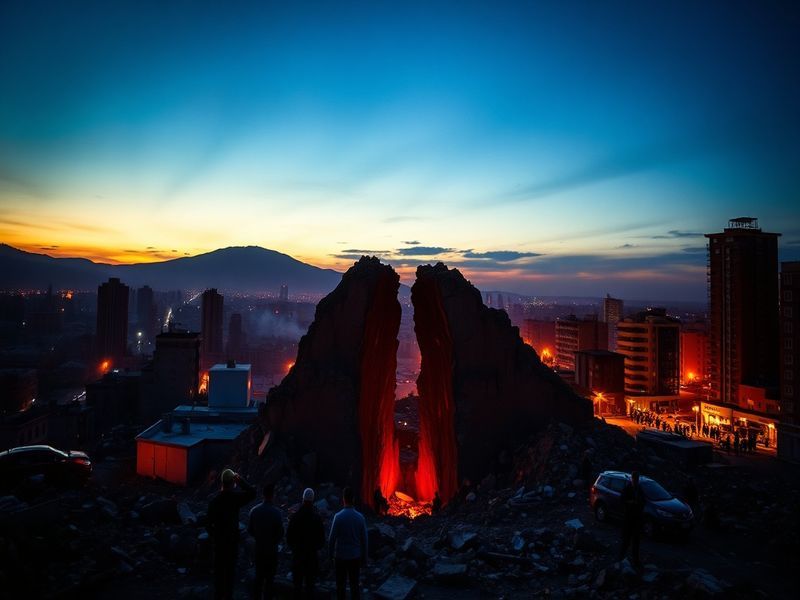
The ground shakes. Windows rattle. Buildings sway. In seconds, an earthquake can transform a familiar landscape into one of uncertainty. But how do scientists quantify the power of these natural events? The answer lies in the earthquake scale—a system designed to translate raw energy into measurable numbers that help communities prepare and respond.
Earthquake scales have evolved significantly since their inception. Today, two primary scales dominate scientific and public discourse: the Richter scale and the moment magnitude scale (Mw). While often used interchangeably in casual conversation, each serves distinct purposes in measuring seismic activity. Understanding their differences is crucial to grasping how we assess earthquake risk.
The Richter Scale: A Historical Benchmark
Developed in 1935 by seismologists Charles F. Richter and Beno Gutenberg, the Richter scale was the first widely adopted method for quantifying earthquake strength. Originally designed for California earthquakes, it measures the amplitude of seismic waves recorded by seismographs. The scale is logarithmic, meaning each whole number increase represents a tenfold increase in wave amplitude and roughly 31.6 times more energy release.
For decades, the Richter scale served as the global standard. It provided a simple, consistent way to communicate earthquake size to the public. However, its limitations became apparent as seismology advanced. The Richter scale struggles with very large earthquakes because it cannot accurately distinguish between different magnitudes beyond a certain point. This led to the development of more sophisticated measurement tools.
How the Richter Scale Works
The Richter scale assigns a single number to quantify the energy released during an earthquake. Here’s a breakdown of its key characteristics:
- Logarithmic Scale: A magnitude 5 earthquake releases 31.6 times more energy than a magnitude 4. This exponential growth helps illustrate why even small increases in magnitude can result in vastly different impacts.
- Local Magnitude (ML): The original Richter scale is technically called the local magnitude scale. It measures the largest seismic wave amplitude within 600 kilometers of the earthquake’s epicenter.
- Limitations: The Richter scale becomes less reliable for earthquakes with magnitudes above 7.0. For these events, the moment magnitude scale is preferred due to its broader accuracy.
Despite its obsolescence for large-scale events, the Richter scale remains a cultural touchstone. Media reports still reference it, and many people associate it with earthquake measurement. However, scientists have largely transitioned to more precise alternatives.
The Moment Magnitude Scale: Modern Precision
Introduced in the 1970s, the moment magnitude scale (Mw) addresses the shortcomings of the Richter scale. It measures the total energy released during an earthquake by analyzing the seismic moment—the product of the fault area, average slip, and rigidity of the rocks involved. This method provides a more accurate representation of an earthquake’s true size, especially for massive events.
The moment magnitude scale is now the global standard for reporting earthquake magnitudes. It correlates well with the Richter scale for smaller earthquakes but diverges significantly for larger ones. For example, the 2011 Tōhoku earthquake in Japan, which triggered a devastating tsunami, registered a 9.0 on the moment magnitude scale—far beyond the Richter scale’s effective range.
Why the Moment Magnitude Scale Matters
The superiority of the moment magnitude scale lies in its ability to capture the full spectrum of seismic energy. Here’s why it has become the go-to metric for seismologists:
- Comprehensive Measurement: Unlike the Richter scale, which focuses solely on wave amplitude, the moment magnitude scale considers the physical properties of the fault rupture. This makes it reliable for earthquakes of all sizes.
- Global Consistency: The moment magnitude scale is universally applicable. It works equally well for deep earthquakes beneath subduction zones and shallow quakes near fault lines.
- Energy Correlation: The scale directly correlates with the total energy released, providing a clearer picture of an earthquake’s potential impact. This is critical for emergency response planning.
While the Richter scale remains embedded in public consciousness, the moment magnitude scale is the preferred tool for scientists assessing earthquake risk. Its precision helps governments and organizations allocate resources effectively in the aftermath of a disaster.
Beyond Magnitude: Other Earthquake Measurements
Magnitude is just one piece of the earthquake puzzle. Scientists also rely on other scales to assess intensity—the effects of shaking on people, structures, and the environment. The Modified Mercalli Intensity Scale (MMI) fills this gap by describing the observable impacts of an earthquake in qualitative terms.
The MMI scale ranges from I (not felt) to XII (total destruction). Unlike magnitude scales, which are objective measurements, intensity scales are subjective and vary based on location. For example, a magnitude 7.0 earthquake in a densely populated urban area will produce higher intensity values than the same quake in a remote region.
Understanding Earthquake Intensity
The Modified Mercalli Intensity Scale helps communities understand the real-world consequences of seismic activity. Here’s how it breaks down:
- I–III (Not felt to Weak): Felt only by a few people indoors, especially on upper floors. Often compared to the vibrations of a passing truck.
- IV–VI (Light to Strong): Felt by most people indoors and some outdoors. Light damage to buildings, such as cracked plaster or fallen objects, may occur.
- VII–IX (Very Strong to Violent): Considerable damage to poorly constructed buildings. Chimneys may collapse, and heavy furniture can shift or topple.
- X–XII (Extreme): Total destruction. Ground cracks, landslides, and tsunamis may occur. Even well-built structures suffer severe damage or collapse.
Intensity scales are invaluable for post-earthquake assessments. They guide relief efforts by highlighting the most affected areas. For instance, after the 2010 Haiti earthquake, intensity maps helped humanitarian organizations identify where to deploy aid first.
How Earthquake Scales Impact Preparedness and Response
The data provided by earthquake scales is more than academic—it drives policy, engineering, and disaster response. Governments use magnitude and intensity measurements to update building codes, ensuring structures can withstand expected seismic forces. For example, California’s strict building standards are informed by historical earthquake data and the moment magnitude scale’s predictions.
Emergency planners rely on these scales to develop early warning systems. Japan’s Earthquake Early Warning (EEW) system, which provides seconds to minutes of warning before shaking begins, uses real-time magnitude estimates to alert residents. The system’s effectiveness depends on accurate, rapid calculations—something the moment magnitude scale provides.
The Role of Technology in Earthquake Measurement
Advancements in technology have revolutionized how scientists measure earthquakes. Modern seismometers, often part of dense networks like the USGS’s Advanced National Seismic System, detect even the faintest tremors. These instruments feed data into algorithms that calculate magnitude and intensity in near real-time.
Satellite technology also plays a role. Interferometric Synthetic Aperture Radar (InSAR) measures ground deformation caused by earthquakes, providing additional data to refine magnitude estimates. This technology was crucial in analyzing the 2019 Ridgecrest earthquakes in California, which produced complex ruptures across multiple faults.
For those interested in tracking seismic activity, resources like the Dave’s Locker Science category offer curated updates on recent earthquakes and measurement techniques. Staying informed about earthquake scales and their applications can help individuals and communities better prepare for future events.
Conclusion: Why Earthquake Scales Matter
Earthquake scales are more than numbers on a seismograph—they are lifelines in a world where sudden ground movement can reshape lives in an instant. From the Richter scale’s historical roots to the moment magnitude scale’s modern precision, these tools bridge the gap between raw energy and human impact. They inform building codes, guide emergency responses, and shape policies that save lives.
Understanding how earthquake scales work empowers individuals to engage with seismic risk more critically. Whether you live in an earthquake-prone region or simply want to stay informed, knowledge of these scales is a vital part of disaster preparedness. As technology advances, so too will our ability to measure and mitigate the effects of earthquakes. Until then, the scales remain our most reliable compass in navigating the planet’s restless energy.