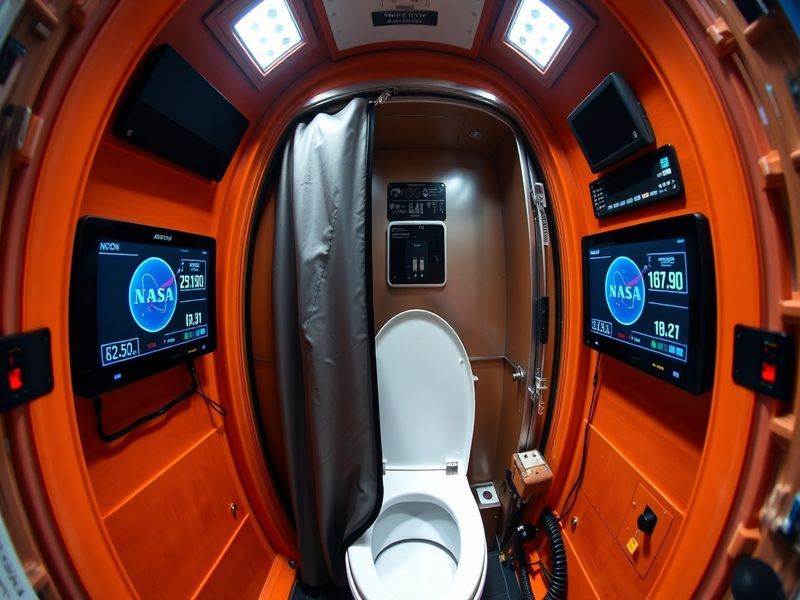
nasa artemis 2 toilet
NASA’s Artemis 2 Toilet: A Small Step for Space, a Giant Leap for Sanitation
When NASA’s Artemis 2 mission launches in 2025, it will carry four astronauts on a historic journey around the Moon. Beyond the groundbreaking science and exploration, one of the mission’s most talked-about features is often overlooked: the spacecraft’s toilet. Known as the Universal Waste Management System (UWMS), this compact yet sophisticated facility represents years of innovation in space sanitation. For a crew spending up to 10 days in microgravity, a reliable toilet isn’t just a convenience—it’s a critical system that can make or break a mission.
The challenges of designing a toilet for space are immense. On Earth, gravity does most of the work in waste disposal. In orbit, every drop of liquid and particle of solid waste must be carefully contained and processed. Early space missions, like those in the Apollo era, relied on plastic bags and suction tubes. While effective, these methods were far from user-friendly. Today’s astronauts demand better. NASA’s response? A next-generation toilet that blends engineering precision with ergonomic design.
The Evolution of Space Toilets
Space toilets have come a long way since the early days of human spaceflight. The Mercury missions in the 1960s didn’t even include toilets—astronauts relied on adult diapers. By the Gemini era, NASA introduced the first rudimentary waste collection system, which astronauts famously described as “a real challenge.” The Apollo missions upgraded to a more functional design, but still required significant manual effort. It wasn’t until the Space Shuttle program that space toilets began to resemble something closer to Earth standards.
The International Space Station (ISS) currently uses the most advanced toilet system deployed in space to date. The UWMS, which will fly on Artemis 2, is a direct descendant of the ISS system but with key improvements. Engineers at NASA and its partners, including Collins Aerospace, focused on three critical areas: comfort, efficiency, and reliability. The result is a toilet that weighs just 45 pounds and occupies about the same space as a standard Earth-side commode.
How the Artemis 2 Toilet Works
At first glance, the UWMS looks like a high-tech camping toilet. It features a seat with a curved shape to help astronauts stay in place, a urine funnel with a camera for alignment, and a fan-driven suction system to capture waste. The toilet’s design accounts for both liquid and solid waste, with separate receptacles for each. Urine is filtered and recycled into drinking water—a necessity on long missions where every drop counts. Solids are compacted and stored for disposal upon return to Earth.
The system operates in microgravity, which means waste doesn’t “fall” in the traditional sense. Instead, a powerful fan creates a flow of air that pulls waste into the appropriate containers. Astronauts must align themselves carefully, a task that becomes more difficult in the cramped quarters of the Orion spacecraft. Training on Earth helps, but microgravity introduces unpredictable variables. NASA has even developed a virtual reality training module to simulate the experience, ensuring astronauts are prepared for the real thing.
One of the most innovative features of the UWMS is its ability to operate with minimal water. Unlike Earth toilets that use several gallons per flush, the UWMS recycles water multiple times. This is crucial for missions where resupply is impossible. The system’s water recovery rate is over 90%, a testament to the closed-loop life support systems NASA has refined over decades.
Cultural and Global Perspectives on Space Sanitation
The development of space toilets isn’t just an engineering challenge—it’s a cultural one. Sanitation is deeply tied to human dignity, and space agencies must balance functionality with astronaut comfort. In the early days of spaceflight, Soviet cosmonauts used a different system that relied on a hose and bag approach. The cultural stigma around discussing bodily functions in space was so strong that astronauts often avoided the topic entirely. Today, NASA and its international partners are more open about these challenges, even hosting public tours of the UWMS to demystify the technology.
Space sanitation also reflects broader global priorities. In many parts of the world, access to clean water and sanitation remains a critical issue. The technologies developed for space toilets have potential applications on Earth, particularly in remote or disaster-stricken areas. For example, NASA has partnered with organizations to adapt waste recycling systems for use in developing countries. The UWMS’s water filtration technology could inspire solutions for communities lacking reliable water infrastructure. This crossover between space and terrestrial innovation highlights how space exploration drives progress in unexpected ways.
Culturally, the Artemis 2 toilet also represents a shift in how we view space missions. Modern astronauts are more diverse and open about their experiences, including the more personal aspects of life in space. Social media and live broadcasts from the ISS have made space more relatable to the public. When NASA released a video explaining the UWMS in 2020, it went viral—not just for its technical details, but for its humor and transparency. This approach helps humanize space exploration, making it more accessible to people around the world.
The Future of Space Toilets
The Artemis 2 toilet is a stepping stone toward even more advanced sanitation systems for future missions. NASA’s ultimate goal is to develop a toilet suitable for Mars, where crewed missions could last years. The challenges there are even greater: reduced gravity, longer durations, and the need for even more efficient waste recycling. Engineers are already experimenting with concepts like “vapor phase catalytic ammonia removal,” which could further improve water recovery rates.
Private companies are also entering the space sanitation market. Startups like HeroX and the XPRIZE Foundation have hosted competitions to crowdsource innovative toilet designs for space. One winning concept involved a modular system that could be adapted for different spacecraft, reducing the need for custom-built toilets. This collaborative approach accelerates innovation and ensures that future missions benefit from the best ideas, regardless of their origin.
For now, the Artemis 2 toilet stands as a symbol of humanity’s ambition to explore beyond Earth. It’s a reminder that even the most mundane aspects of life—like using a toilet—become extraordinary when taken out of this world. As NASA prepares for its return to the Moon, the UWMS will play a small but vital role in ensuring the mission’s success. And who knows? The technology developed for this toilet might one day improve sanitation for millions of people on Earth.
For those inspired by the intersection of space and everyday life, Science and Technology sections on Dave’s Locker offer deeper insights into the innovations shaping our future.
Conclusion
The Artemis 2 toilet may not be the most glamorous part of the mission, but it’s a critical component of humanity’s journey back to the Moon. By addressing the challenges of space sanitation with creativity and precision, NASA is paving the way for longer, safer missions to Mars and beyond. As we look to the stars, it’s worth remembering that even the smallest details can have the biggest impact. The next time you use a toilet on Earth, spare a thought for the astronauts who rely on their own high-tech version—one that’s designed to work in the harshest environment imaginable.