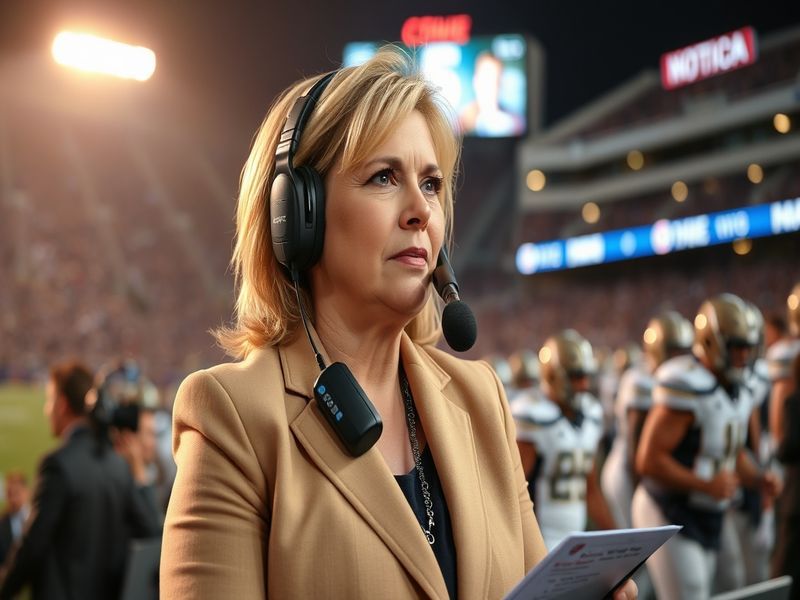
Holly Rowe’s name is synonymous with versatility and durability in sports broadcasting. For over three decades, she has carved out a niche as one of the most respected voices in college sports, earning the trust of fans, athletes, and coaches alike. Her journey—marked by perseverance, adaptability, and an unwavering commitment to storytelling—offers a masterclass in professional longevity.
Rowe’s career didn’t follow a straight path. It zigzagged through challenges, unexpected turns, and moments of personal and professional reinvention. What began as a sideline reporter has evolved into a multifaceted role where she informs, engages, and occasionally challenges the narrative of the games she covers.
From the Sidelines to the Broadcast Booth
Holly Rowe’s entry into sports broadcasting was not immediate. After graduating from the University of Utah with degrees in journalism and speech communications, she began her professional life as a teacher. That detour, however, proved foundational. It honed her ability to communicate complex ideas clearly and connect with diverse audiences—skills that would later define her broadcasting career.
Her broadcast debut came in the early 1990s when she joined ESPN as a production assistant. This behind-the-scenes role gave her an intimate understanding of how sports media operates. She absorbed the rhythms of live production, the pressure of deadlines, and the importance of accuracy—lessons that would serve her well when she stepped into the spotlight.
By 1995, Rowe had transitioned to on-air reporting. Her first major assignment was covering women’s college basketball, a role that allowed her to highlight athletes often overlooked in mainstream sports coverage. This focus on underrepresented stories became a hallmark of her work. Rowe didn’t just report the score; she brought context, humanity, and depth to every broadcast.
A Trailblazer in Women’s Sports Coverage
In an era when women’s sports received a fraction of the media attention men’s sports did, Rowe became a consistent presence courtside and on the sidelines. She covered multiple NCAA Women’s Final Fours and reported on U.S. Women’s National Soccer Team victories, including the 1999 World Cup win that captivated a nation.
Her coverage of the 1999 World Cup remains one of the most defining moments of her early career. The tournament was more than a sporting event; it was a cultural milestone. Rowe’s ability to capture the emotion of the moment—from Brandi Chastain’s iconic penalty kick to the jubilant celebrations of the team—helped bring women’s soccer into the mainstream consciousness.
This work wasn’t just about visibility. Rowe’s reporting elevated the conversation around women’s athletics, emphasizing skill, strategy, and the personal journeys of the athletes. She treated every game as a story worth telling, not just a segment to fill airtime.
Adversity and Reinvention: The Comeback That Defined a Career
Rowe’s career faced its most significant test in 2013 when she was diagnosed with a rare form of cancer. Her journey through treatment—including surgery and chemotherapy—wasn’t kept private. Instead, she shared her experience with the public, using her platform to raise awareness and offer hope to others battling illness.
Her openness about her health struggles was met with widespread support. Fans sent messages of encouragement. Colleagues at ESPN and beyond rallied around her. But Rowe’s return to broadcasting was not guaranteed. Recovery required months of rehabilitation, and the physical toll of treatment left her weakened.
Yet, in a move that surprised many, Rowe returned to the airwaves in 2014. Her comeback was gradual. She began with lighter assignments, slowly rebuilding her stamina and confidence. Within a year, she was back on the sidelines, covering college football and basketball with the same intensity and insight as before.
Her resilience became a narrative of its own—a testament to the power of perseverance and the importance of mental fortitude. Rowe didn’t just return to broadcasting; she redefined what it meant to be a sports journalist in the public eye.
The Broader Impact of Rowe’s Career
Holly Rowe’s influence extends beyond the games she’s covered. She represents a generation of journalists who transitioned from traditional reporting to multimedia storytelling. Her work reflects the evolution of sports media, where social media, streaming platforms, and digital content have expanded the role of the reporter.
Rowe has embraced these changes. She’s active on social media, engaging with fans and sharing behind-the-scenes insights. She’s also contributed to ESPN’s digital platforms, producing long-form content that delves deeper into the lives of athletes and the issues shaping college sports.
Her presence in the broadcast booth has also helped normalize women in roles traditionally dominated by men. While she’s never framed herself as a “female sports journalist,” her success has paved the way for younger women entering the field. She’s shown that expertise, preparation, and authenticity matter more than gender.
Lessons from a Career in Sports Broadcasting
Holly Rowe’s career offers several key takeaways for aspiring journalists and broadcasters:
- Start Small, Think Big: Rowe’s early career included teaching and production roles. These experiences built foundational skills that later allowed her to excel on camera.
- Embrace Adaptability: The media landscape has changed dramatically since the 1990s. Rowe’s ability to evolve with these shifts—from traditional TV to digital platforms—has been critical to her longevity.
- Turn Challenges into Opportunities: Whether facing gender bias in early assignments or battling cancer, Rowe has consistently used adversity as a catalyst for growth rather than retreat.
- Prioritize Storytelling Over Spectacle: Rowe’s strength lies in her ability to find the human element in sports. She doesn’t just describe the action; she explains its significance.
- Leverage Your Platform for Impact: From covering women’s soccer to sharing her cancer journey, Rowe has used her visibility to advocate for causes and amplify underrepresented voices.
Looking Ahead: The Future of Rowe’s Legacy
At 60 years old, Holly Rowe shows no signs of slowing down. She remains a fixture on ESPN’s college sports coverage, and her insights are regularly sought after by fans and analysts alike. Her role has expanded beyond reporting; she’s now a mentor to younger broadcasters and a voice for the next generation of sports journalists.
As college sports navigate realignment, NIL (Name, Image, Likeness) policies, and the growing influence of social media, Rowe’s perspective will be invaluable. She understands the traditions of the game but isn’t afraid to question outdated practices or advocate for progress.
Her career also serves as a reminder of the importance of authenticity in media. In an era of curated personas and algorithm-driven content, Rowe’s willingness to be vulnerable—whether discussing her health or her opinions on controversial calls—has endeared her to audiences who crave genuine connection.
As Rowe continues to shape the future of sports broadcasting, her story remains a blueprint for what it means to build a career on resilience, adaptability, and an unwavering commitment to the craft.
Conclusion
Holly Rowe’s journey from a Utah classroom to the broadcast booth of ESPN is more than a success story. It’s a testament to the power of perseverance, the value of adaptability, and the impact of authentic storytelling. In an industry often defined by fleeting moments and viral clips, Rowe has built a legacy on substance, depth, and consistency.
Her career encourages us to rethink what it means to be a journalist in the modern era. It’s not just about delivering highlights or reciting statistics. It’s about understanding the context, honoring the human stories behind the games, and showing up—no matter the circumstances—with integrity and passion.
As Rowe continues to cover the next generation of athletes and storylines, one thing is clear: her voice will remain a vital part of the conversation for years to come.
For those interested in exploring more about the evolution of sports media or the impact of women in broadcasting, visit Dave’s Locker Sports for in-depth coverage and analysis.