The brief but highly publicized visit of former President Donald Trump to Walter Reed National Military Medical Center in 2020 remains one of the most scrutinized moments of his presidency. Amid the COVID-19 pandemic, Trump’s unannounced trip to the hospital sparked immediate controversy, fueled by secrecy, misinformation, and political polarization. The event raised questions not only about transparency in government but also about the intersection of health, media, and power.
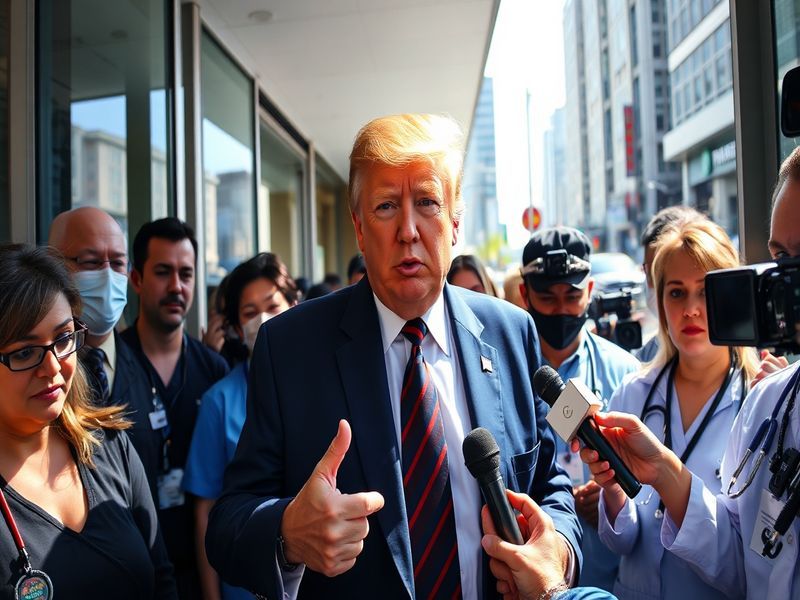
Walter Reed, a premier military medical facility in Bethesda, Maryland, is typically reserved for active-duty service members, veterans, and high-ranking government officials. Its reputation for discretion and professionalism made it an unlikely backdrop for a spectacle. Yet, when Trump arrived on October 2, 2020, accompanied by aides and Secret Service agents, the world watched in real time as images of the motorcade and masked staff circulated across global news outlets.
The Timeline of the Trump Hospital Visit
The sequence of events unfolded rapidly and with little clarity. According to official statements, Trump had tested positive for COVID-19 on October 1, 2020, following a White House event where multiple attendees later tested positive. Less than 24 hours later, at approximately 6:30 p.m., he was seen boarding a helicopter outside the White House, bound for Walter Reed.
Once at the hospital, details were scarce. The White House initially released a memo stating that Trump was “fatigued but in good spirits,” though no medical records or detailed health updates were provided. Over the next three days, a series of cryptic tweets from Trump himself—including a short video filmed on the hospital grounds—fueled speculation about his condition. He later returned to the White House on October 5, walking up the South Portico steps to the cheers of supporters, a moment that was both symbolic and controversial.
Critics questioned the timing and purpose of the visit. Was it a genuine medical precaution, or a calculated political move to project strength during a health crisis? The lack of transparency only deepened the divide, with some interpreting the secrecy as evidence of a cover-up and others seeing it as standard presidential privilege.
Media and Public Reaction: A Divided Response
The media’s role in shaping the narrative was pivotal. Major news organizations scrambled to report on the event, often with conflicting information. Some outlets emphasized Trump’s age and pre-existing conditions, framing the visit as a serious health matter. Others focused on the optics—his dramatic return to the White House, maskless and defiant, in front of a crowd of unmasked supporters.
Public sentiment mirrored this divide. Polls conducted in early October 2020 showed that 42% of Americans believed Trump’s hospitalization was serious, while 40% saw it as a political stunt. Social media amplified the polarization, with viral videos, memes, and conspiracy theories spreading rapidly. Some users claimed the entire event was staged, while others accused the media of downplaying Trump’s vulnerability.
Even within Walter Reed, reactions were mixed. While the hospital maintained patient confidentiality, anonymous staff members later told reporters that the visit disrupted normal operations. One nurse, speaking to The Washington Post, described the scene as “unprecedented” and “stressful,” noting that the hospital was not equipped to handle the level of media attention that followed.
Why Walter Reed? The Symbolism and Security Behind the Choice
Walter Reed was not chosen by chance. As the nation’s flagship military hospital, it offers advanced medical care, 24/7 security, and a controlled environment far from the public eye. For a president, it provides a rare combination of discretion and readiness. The hospital has a long history of treating high-profile patients, including former presidents Ronald Reagan and George W. Bush, all while maintaining strict confidentiality.
But the choice also carried symbolic weight. Walter Reed is named after Major Walter Reed, a U.S. Army physician who helped eradicate yellow fever in the early 20th century. The irony was not lost on critics: while Trump was receiving cutting-edge care, thousands of Americans—many without access to adequate healthcare—were dying from COVID-19. The contrast highlighted broader inequities in the U.S. healthcare system.
Security was another critical factor. The Secret Service reportedly insisted on Walter Reed due to its proximity to Washington, D.C., and its secure perimeter. The hospital’s location in a heavily wooded area also made it easier to control access and prevent unauthorized entry. Yet, despite these precautions, images of Trump’s motorcade and the hospital entrance were broadcast worldwide within hours.
The Long-Term Impact on Public Trust and Healthcare Transparency
The Trump hospital visit did more than dominate news cycles—it exposed vulnerabilities in how health crises involving public figures are managed. The lack of transparency set a precedent that fueled distrust in both government and media. When details emerged weeks later—such as Trump receiving experimental treatments like Regeneron’s monoclonal antibody cocktail—the public’s confusion only grew.
For healthcare professionals, the episode underscored the challenges of treating high-profile patients under the glare of public scrutiny. Hospitals are not public relations firms, yet they are increasingly expected to navigate political pressures. The incident prompted discussions within medical ethics circles about the boundaries between patient privacy and public interest.
It also raised questions about the role of social media in health communication. Trump’s tweets from Walter Reed bypassed traditional channels, allowing him to control the narrative directly. This shift toward real-time, unfiltered communication by public figures has since become standard, blurring the lines between medical updates and political messaging.
Years later, the Trump hospital visit remains a case study in crisis communication—or the lack thereof. It demonstrated how quickly misinformation can spread and how difficult it is to restore trust once it’s eroded. For hospitals and government agencies alike, the lesson is clear: transparency is not optional, especially in a pandemic.
Where to Learn More
For further reading on political controversies and healthcare ethics, explore our News and Health categories.
Conclusion
The Trump hospital visit was far more than a footnote in the 2020 election—it was a moment that tested the boundaries of transparency, trust, and public perception. In an era where every detail is scrutinized and every statement is dissected, the lack of clarity surrounding Trump’s health only deepened divisions. Walter Reed, a place meant for healing and discretion, became an unintended stage for political theater.
As the nation continues to grapple with healthcare disparities and the role of leadership in public health crises, the lessons from that October evening remain relevant. Transparency matters. Context matters. And in the age of instant communication, the stakes have never been higher.