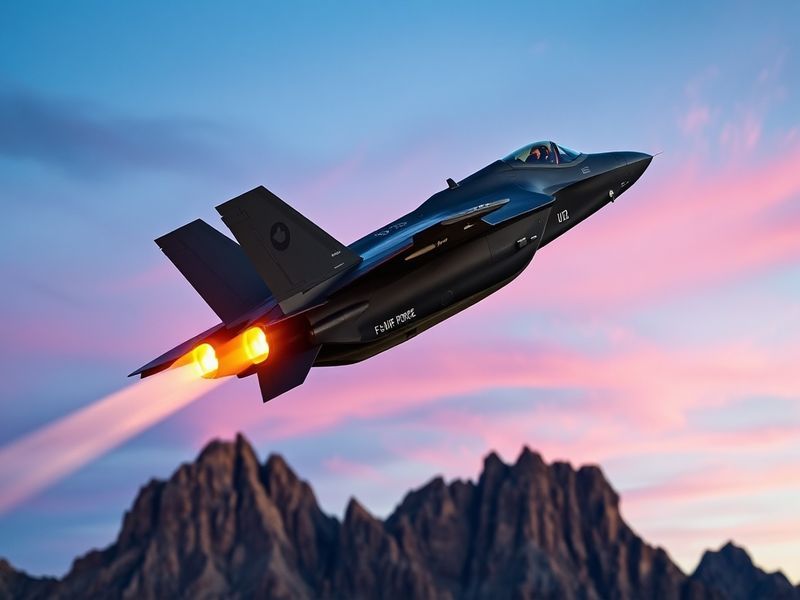
The United States has long been a global leader in military aviation, with its fighter jets serving as both a symbol of technological prowess and a cornerstone of national defense. From the early days of piston-engine fighters to the cutting-edge fifth-generation aircraft of today, US fighter jets have shaped air combat, military strategy, and even international relations. This evolution reflects not only advancements in engineering but also the shifting priorities of American defense policy.
The development of US fighter jets has been driven by the need to maintain air superiority—a goal that has only grown more complex with the rise of peer competitors and advanced anti-air systems. Today, the US Air Force, Navy, and Marine Corps operate a diverse fleet, each aircraft tailored to specific mission requirements. These platforms are not just tools of war; they are instruments of deterrence, power projection, and technological innovation.
The Evolution of US Fighter Aircraft: From Propellers to Stealth
The story of US fighter jets begins in the early 20th century, with the introduction of the Curtiss P-1 Hawk in 1925. This biplane marked the transition from wood-and-fabric aircraft to all-metal construction, setting the stage for future advancements. By World War II, the US had deployed iconic fighters like the P-51 Mustang and the P-47 Thunderbolt, which played pivotal roles in Allied victories.
The Cold War era accelerated technological progress. The advent of jet engines led to aircraft like the F-86 Sabre and F-100 Super Sabre, which dominated the skies during the Korean War. The 1960s and 1970s saw the introduction of the F-4 Phantom II, a versatile multirole fighter that served in Vietnam and beyond. However, it was the F-15 Eagle and F-16 Fighting Falcon—both introduced in the 1970s—that redefined air combat with their speed, agility, and advanced avionics.
The 1990s brought a new paradigm with the F-22 Raptor, the world’s first operational fifth-generation fighter. Stealth technology, supercruise capability, and advanced sensor fusion made it a game-changer. Today, the F-35 Lightning II represents the pinnacle of this evolution, designed as a multirole stealth fighter capable of operating in contested environments.
Key Milestones in US Fighter Jet Development
- 1925: Curtiss P-1 Hawk debuts as the US military’s first all-metal fighter.
- 1940s: P-51 Mustang and P-47 Thunderbolt dominate World War II skies.
- 1950s: F-86 Sabre and F-100 Super Sabre introduce jet-powered combat.
- 1970s: F-15 Eagle and F-16 Fighting Falcon set new standards for agility and avionics.
- 1990s: F-22 Raptor pioneers stealth and supercruise technology.
- 2010s: F-35 Lightning II becomes the most advanced multirole fighter in service.
Modern US Fighter Jets: Dominance and Deterrence
Today, the US operates three primary fifth-generation fighter jets: the F-22 Raptor, F-35 Lightning II, and the upcoming Next Generation Air Dominance (NGAD) program. The F-22, though limited in numbers due to cost, remains unmatched in air-to-air combat. Its stealth, thrust vectoring, and advanced radar systems make it nearly invisible to enemy radar while allowing it to strike with precision.
The F-35, by contrast, is designed for multirole versatility. With variants for the Air Force, Navy, and Marines, it serves as a backbone of US and allied air forces. Its stealth, sensor fusion, and networked capabilities enable it to dominate both air-to-air and air-to-ground missions. However, the F-35 has faced criticism for its cost, complexity, and developmental challenges.
Looking ahead, the NGAD program aims to replace the F-22 by the 2030s. This sixth-generation fighter will likely incorporate AI-driven systems, directed-energy weapons, and even greater stealth capabilities. The US is also investing in unmanned loyal wingman aircraft, which will operate alongside piloted fighters to extend their reach and lethality.
The Role of US Fighter Jets in Global Defense
The US fighter fleet is not just about combat—it’s about deterrence. Forward-deployed F-22s and F-35s in Europe and Asia reassure allies while signaling resolve to potential adversaries. These aircraft also serve as force multipliers, enabling joint operations with ground, naval, and cyber forces.
In the Pacific, the US relies on its fighter jets to counter China’s growing airpower. The F-35’s stealth and sensor fusion allow it to operate in highly contested environments, while the F-22’s air superiority capabilities ensure dominance in contested skies. Meanwhile, the US Navy’s F/A-18 Super Hornet and F-35C provide critical strike and air defense capabilities from aircraft carriers.
Challenges and Controversies in Fighter Jet Development
Despite their technological superiority, US fighter jets are not without controversy. The F-35 program, in particular, has faced scrutiny over its cost—now exceeding $1.7 trillion over its lifetime—and its developmental delays. Critics argue that the program’s complexity has led to maintenance challenges and operational limitations.
Another concern is the rapid advancement of anti-access/area-denial (A2/AD) systems, which threaten to limit the effectiveness of US fighter jets in contested environments. Hypersonic missiles, advanced surface-to-air missiles, and cyber warfare capabilities pose significant challenges to traditional airpower dominance. As a result, the US is investing in electronic warfare, directed-energy weapons, and AI-driven systems to counter these threats.
There are also debates about the future of manned fighters. Some analysts argue that unmanned systems will eventually replace piloted aircraft, citing the success of drones like the MQ-9 Reaper. However, the US military remains committed to manned fighters for the foreseeable future, emphasizing the need for human judgment in complex combat scenarios.
Navigating the Future of US Fighter Jets
The US fighter jet program is at a crossroads. On one hand, the F-35 and F-22 represent the pinnacle of aerospace engineering, ensuring American dominance for decades to come. On the other hand, rising costs, evolving threats, and technological disruption demand innovation and adaptation.
The US Air Force has outlined a roadmap that includes not only the NGAD program but also upgrades to existing fleets. The F-15EX, for example, is being introduced to replace aging F-15C/Ds, offering improved avionics and weapons capacity. Similarly, the F-16 fleet is undergoing modernization to extend its service life.
Internationally, the US is also expanding its partnerships. The F-35, in particular, has become a cornerstone of allied airpower, with countries like Japan, South Korea, and the UK integrating it into their fleets. This not only strengthens alliances but also ensures interoperability in joint operations.
Conclusion: The Enduring Legacy of US Fighter Jets
US fighter jets have come a long way since the days of the P-1 Hawk. They are now at the heart of America’s military strategy, combining cutting-edge technology with unparalleled combat capabilities. Yet, their future is not guaranteed. The challenges of rising costs, evolving threats, and rapid technological change demand constant innovation and adaptation.
As the US continues to invest in next-generation systems, one thing is clear: fighter jets will remain a cornerstone of American military power. They are not just weapons of war; they are symbols of technological achievement, deterrence, and global influence. For decades to come, they will shape the skies—and the world.
For those interested in the broader implications of military aviation, explore our News and Technology sections on Dave’s Locker.