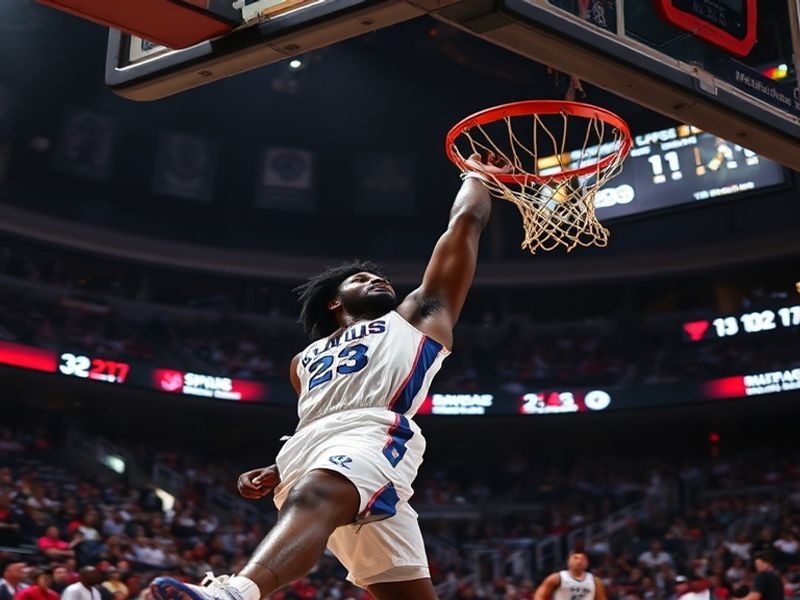
The Philadelphia 76ers and San Antonio Spurs have long stood as two of the NBA’s most philosophically distinct franchises. While the 76ers have embraced a high-octane, star-driven approach in recent years, the Spurs have remained loyal to their identity as a system-first organization. When these teams meet, the contrast becomes more than stylistic—it’s a collision of ideologies.
Over the past decade, the 76ers have prioritized elite individual talent, drafting and trading for stars like Joel Embiid and James Harden to build a superteam capable of competing for championships. Their style is built on isolation sets, post-ups, and three-point shooting, with an emphasis on creating mismatches. The Spurs, meanwhile, have historically thrived on ball movement, defensive rotations, and unselfish basketball, even when lacking the same level of star power.
When the two teams faced off in their most recent regular-season matchup, the game served as more than just a contest between two playoff-bound teams. It was a referendum on two different visions of how basketball should be played in the modern NBA.
The Rise of the 76ers’ Star-Centric Approach
The 76ers’ current roster is a product of calculated risk-taking. After years of near-misses and playoff disappointments, general manager Daryl Morey engineered blockbuster trades to acquire Harden, pairing him with Embiid to form a dynamic duo. The result has been one of the league’s most potent offensive attacks, particularly in half-court sets where Embiid’s post game and Harden’s playmaking create impossible choices for defenses.
In their last meeting with the Spurs, the 76ers’ offensive efficiency was on full display. Embiid dominated the paint, while Harden’s ability to manipulate defenses off the dribble led to open three-pointers for shooters like Tyrese Maxey. The Spurs, despite their reputation for discipline, struggled to contain Philadelphia’s isolation-heavy sets, particularly in the fourth quarter when the game tightened.
This approach has drawn both praise and criticism. Detractors argue that the 76ers’ reliance on superstars limits roster flexibility and creates long-term financial challenges. Proponents, however, point to the team’s deep playoff runs as evidence that star power remains the most reliable path to a championship.
For a deeper look at how the 76ers’ roster construction compares to other contenders, explore our NBA Teams coverage.
The Spurs’ Time-Tested Philosophy
The Spurs have long been the NBA’s gold standard for organizational stability. Under Gregg Popovich’s leadership, the team has prioritized player development, defensive intensity, and unselfish basketball—values that have yielded five championships since 1999. Even in a transitional phase following the retirements of Tim Duncan, Tony Parker, and Manu Ginóbili, the Spurs have remained a model of consistency.
In their recent matchup with the 76ers, San Antonio’s identity was on display in every possession. The Spurs moved the ball with surgical precision, exploiting defensive lapses with quick passes and open threes. While they lacked the star power to match Philadelphia’s firepower, their depth and cohesion allowed them to stay competitive throughout the game.
One of the most striking aspects of the Spurs’ approach is their commitment to young talent. Players like Jeremy Sochan and Malaki Branham are given significant minutes, reflecting a long-term vision that prioritizes growth over immediate wins. This philosophy contrasts sharply with the 76ers’ win-now mentality, raising questions about which strategy will ultimately prove more sustainable.
The Spurs’ ability to remain relevant despite roster turnover is a testament to their culture. While teams like the 76ers chase championships through star acquisitions, San Antonio continues to thrive by developing talent from within—a model that has become increasingly rare in today’s NBA.
Key Matchups That Defined the Game
When the 76ers and Spurs collide, individual battles often dictate the outcome. In their latest meeting, several key matchups stood out, each highlighting the contrasting styles of the two teams.
- Joel Embiid vs. the Spurs’ Frontcourt: Embiid entered the game averaging 30 points per night, and the Spurs had no clear answer. While Victor Wembanyama’s shot-blocking presence loomed, Embiid’s ability to score over smaller defenders kept Philadelphia’s offense humming. The Spurs’ traditional big men, such as Zach Collins, were outmatched in both size and skill.
- James Harden’s Playmaking: Harden’s ability to create off the dribble forced the Spurs’ defense into rotations that left shooters wide open. San Antonio’s vaunted defensive scheme, which thrives on communication and discipline, was stretched thin by Harden’s improvisational style.
- Dejounte Murray vs. Tyrese Maxey: Both guards are elite on-ball defenders, but their roles differ significantly. Murray’s length and athleticism allowed him to disrupt Maxey’s drives, while Maxey’s speed and shooting kept the Spurs’ defense honest. The duel between these two guards set the tone for much of the game.
- San Antonio’s Three-Point Shooting: The Spurs entered the game as one of the league’s best three-point shooting teams, and their ability to knock down open looks kept them in the game. Players like Doug McDermott and Branham capitalized on Philadelphia’s defensive breakdowns, hitting timely shots when the 76ers’ defense sagged.
These matchups underscored the broader themes of the game. The 76ers’ stars imposed their will through individual brilliance, while the Spurs relied on their collective strengths to stay competitive. The result was a tightly contested game that could have swung either way in the final minutes.
What This Matchup Reveals About the NBA’s Future
The 76ers vs. Spurs game was more than just a regular-season contest—it was a microcosm of the NBA’s evolving landscape. On one side, the 76ers represent the league’s growing reliance on superstar-driven basketball, where individual talent often outweighs system-based success. On the other, the Spurs embody a fading but still relevant philosophy: that teamwork, defense, and player development can overcome a lack of top-tier stars.
As the NBA continues to trend toward isolation-heavy, star-led offenses, the Spurs’ model faces increasing scrutiny. Can a team without a true superstar realistically compete for a title in today’s league? The answer may depend on whether the Spurs can adapt their system to the modern game without compromising their core values.
For the 76ers, the challenge is sustainability. Building a championship-caliber team around two aging stars (Embiid is 30, Harden is 34) carries significant risks. Injuries, chemistry issues, and the salary cap could all derail their championship aspirations. Meanwhile, San Antonio’s model offers a blueprint for sustained success, but it requires patience and a willingness to embrace a less glamorous style of play.
The contrast between these two teams extends beyond the court. It reflects a broader debate about the future of the NBA—one where financial constraints and competitive realities may force teams to choose between the star-driven model and the system-based approach. The 76ers and Spurs, whether by design or circumstance, have become the standard-bearers for these competing visions.
As the season progresses, their matchups will continue to captivate fans and analysts alike. Will the 76ers’ stars shine brightest in the playoffs, or will the Spurs’ collective effort and discipline prove to be the more reliable path to success? The answer may shape the league’s direction for years to come.
For more insights into how these teams stack up against the rest of the NBA, check out our NBA Analysis section.
Conclusion: Two Paths, One Uncertain Future
The Philadelphia 76ers and San Antonio Spurs represent two distinct philosophies in a league that increasingly values individual brilliance over team cohesion. While the 76ers chase championships through star power and isolation sets, the Spurs continue to prove that defense, ball movement, and player development can still lead to success.
Their recent matchup was a reminder that the NBA is not a monolith. There is room for both approaches, even if one is currently more prevalent. The 76ers’ path is fraught with risk but offers the potential for glory, while the Spurs’ path is safer but requires a longer-term commitment to their values.
As the league evolves, the debate between these two models will only intensify. One thing is certain: when the 76ers and Spurs take the court, the clash of styles makes for compelling basketball—and a fascinating glimpse into the NBA’s future.