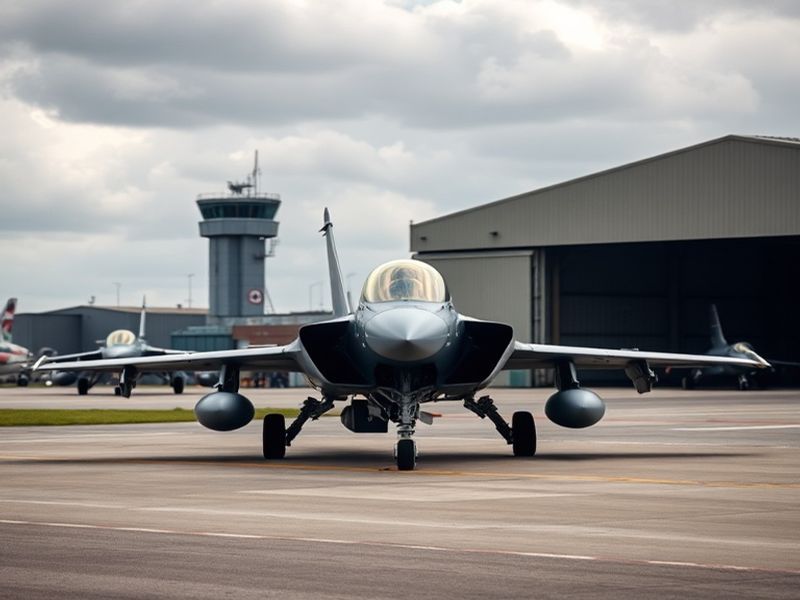
RAF Fairford stands as one of the United Kingdom’s most strategically vital military installations, serving as a forward operating base for the Royal Air Force and allied forces. Located in Gloucestershire, England, this base has played a pivotal role in global military operations for decades. Its proximity to continental Europe and advanced infrastructure make it an indispensable asset for rapid deployment and logistical support.
The Historical Significance of RAF Fairford
Commissioned in 1944, RAF Fairford was originally built to support Allied operations during World War II. Its strategic location allowed it to serve as a key staging post for bombers targeting Nazi-occupied Europe. After the war, the base transitioned into a Cold War-era asset, hosting strategic reconnaissance and nuclear-capable aircraft.
The base’s modern relevance, however, stems from its role as the only fully operational RAF base on mainland Britain equipped with a 3,040-meter runway. This makes it uniquely capable of accommodating large, heavy aircraft such as the B-52 Stratofortress and the B-1 Lancer—both critical components of the U.S. Air Force’s global strike capabilities.
A Hub for Joint Military Exercises
RAF Fairford regularly hosts major NATO and allied military exercises, including the annual Joint Warrior drills. These exercises simulate large-scale combat scenarios, testing interoperability between allied forces. The base’s facilities also support the U.S. Air Force’s Bomber Task Force missions, where American strategic bombers conduct training flights over Europe to reinforce deterrence against regional threats.
Its role in these exercises underscores the base’s function as a bridge between European and North American military strategies. The ability to project power rapidly from Fairford enhances NATO’s collective defense posture, particularly in response to emerging security challenges.
Key Capabilities of RAF Fairford
RAF Fairford’s operational value lies in its unique infrastructure and strategic positioning. Below are its most critical capabilities:
- Extended Runway: The 3,040-meter runway is one of the longest in Europe, capable of handling heavy bombers and transport aircraft.
- Logistical Support: The base includes extensive maintenance, fueling, and ordnance storage facilities.
- Host Nation Support: Fully integrated U.S. Air Force units operate alongside RAF personnel, ensuring seamless coordination.
- Forward Operating Location: Its proximity to potential conflict zones in Eastern Europe and the Middle East allows for rapid deployment.
Strategic Bomber Operations
One of RAF Fairford’s most visible roles is as a staging point for U.S. strategic bombers. These aircraft conduct long-range missions across Europe, demonstrating the U.S. commitment to NATO’s collective defense. The presence of these bombers at Fairford serves as both a deterrent and a show of force, reinforcing allied resolve in the face of geopolitical tensions.
In recent years, these operations have taken on added significance amid Russia’s military aggression in Ukraine and rising tensions in the Indo-Pacific. The ability to surge bombers into Europe at short notice enhances NATO’s rapid response capabilities, ensuring that any aggression is met with overwhelming force.
The Broader Implications of RAF Fairford’s Role
The base’s operations extend beyond mere military logistics; they have far-reaching geopolitical and strategic implications. By serving as a forward operating hub for U.S. bombers, RAF Fairford plays a crucial role in maintaining the balance of power in Europe and beyond.
Deterrence and Geopolitical Influence
The continuous presence of strategic bombers at RAF Fairford sends a clear message to potential adversaries. It signals that the U.S. and its allies are prepared to defend their interests and those of their partners. This deterrent effect is particularly important in an era where hybrid warfare and gray-zone conflicts are becoming increasingly common.
Moreover, RAF Fairford’s role in joint exercises and bomber deployments strengthens transatlantic security ties. It ensures that European and North American militaries remain interoperable, a critical factor in any large-scale contingency.
Challenges and Future Considerations
Despite its strategic importance, RAF Fairford faces challenges. The base’s aging infrastructure requires ongoing investment to maintain its operational readiness. Additionally, as global military strategies evolve, there is debate over whether the base’s role should expand to accommodate emerging threats, such as hypersonic weapons and cyber warfare.
There are also political considerations. The presence of U.S. forces in the UK has occasionally sparked local and international controversy, particularly regarding sovereignty and the environmental impact of military operations. Balancing these concerns with the need for strategic flexibility will remain a key challenge for policymakers.
Conclusion: RAF Fairford’s Enduring Relevance
RAF Fairford remains a cornerstone of European security, providing the Royal Air Force and allied forces with unparalleled operational flexibility. Its ability to support heavy bombers, host joint exercises, and project power rapidly makes it an indispensable asset in an increasingly complex security environment.
As geopolitical tensions rise and military strategies adapt to new threats, the importance of RAF Fairford is unlikely to diminish. Instead, its role may expand, ensuring that it remains a linchpin of NATO’s collective defense for decades to come.
For those interested in the broader implications of military strategy and allied operations, following developments at Dave’s Locker Analysis can provide deeper insights into how such bases shape global security dynamics.