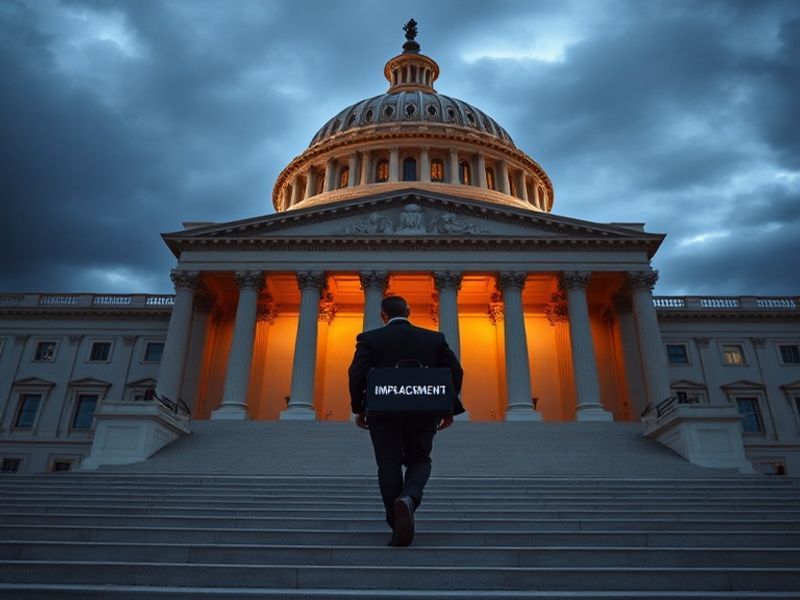
The impeachment process stands as one of the most solemn and consequential mechanisms in American democracy. Designed as a constitutional safeguard, it allows Congress to hold the highest-ranking officials accountable for serious misconduct. While often associated with presidential scandals, impeachment applies to all civil officers, including federal judges and cabinet members. Understanding this process requires examining its legal foundations, historical applications, and the political dynamics that shape its outcomes.
The Constitutional Foundation of Impeachment
The framers of the U.S. Constitution embedded impeachment in Article II, Section 4, which states: “The President, Vice President, and all civil officers of the United States shall be removed from office on impeachment for, and conviction of, treason, bribery, or other high crimes and misdemeanors.” This provision reflects a compromise between those who feared unchecked executive power and those wary of legislative overreach. Alexander Hamilton, in Federalist No. 65, described impeachable offenses as arising from the “misconduct of public men” that “relate chiefly to injuries done immediately to the society itself.”
The process unfolds in two distinct stages. First, the House of Representatives, with a simple majority vote, may impeach an official by adopting articles of impeachment. These articles outline specific allegations of misconduct. The second stage occurs in the Senate, which conducts a trial to determine whether to remove the official from office. A two-thirds majority vote is required for conviction. Chief Justice of the Supreme Court presides over presidential impeachment trials, ensuring the proceedings maintain a degree of judicial impartiality.
Historically, the Senate has acquitted all three presidents who faced impeachment trials: Andrew Johnson in 1868, Bill Clinton in 1998, and Donald Trump twice, in 2020 and 2021. Richard Nixon resigned in 1974 before the House could vote on impeachment, following the House Judiciary Committee’s adoption of three articles of impeachment related to the Watergate scandal.
Key Impeachment Cases in U.S. History
Impeachment has been used sparingly but strategically throughout American history. Each case reflects the political tensions of its era and offers insights into the evolving interpretation of “high crimes and misdemeanors.” Below are the most consequential impeachment cases:
- Andrew Johnson (1868): The first president to face impeachment, Johnson was charged with violating the Tenure of Office Act by removing Secretary of War Edwin Stanton without Senate approval. His trial centered on the post-Civil War power struggle between the executive and legislative branches. The Senate acquitted him by a single vote, preserving the fragile balance of Reconstruction-era governance.
- Richard Nixon (1974): Facing certain impeachment over the Watergate scandal, Nixon resigned before the House could vote. The Judiciary Committee had approved articles alleging obstruction of justice, abuse of power, and contempt of Congress. His resignation underscored the potency of impeachment as a deterrent against presidential misconduct.
- Bill Clinton (1998-1999): Clinton was impeached by the House on charges of perjury and obstruction of justice related to his affair with Monica Lewinsky and subsequent testimony. The Senate trial became a partisan spectacle, with Republicans arguing for accountability and Democrats emphasizing personal conduct over official duties. He was acquitted on both counts.
- Donald Trump (2019-2020 and 2021): Trump became the first president to be impeached twice. The first impeachment centered on abuse of power and obstruction of Congress regarding his dealings with Ukraine, including a July 2019 phone call with Ukrainian President Volodymyr Zelensky. The second impeachment, following the January 6, 2021, Capitol riot, charged him with incitement of insurrection. The Senate acquitted him both times.
The Political Dimensions of Impeachment
Impeachment is as much a political process as it is a legal one. While the Constitution outlines the procedural framework, the decision to impeach often hinges on partisan calculations, electoral strategies, and public opinion. The House’s role as a check on the executive can become entangled in broader political agendas, particularly when the president’s party controls one or both chambers of Congress.
For example, the impeachment of Bill Clinton occurred during a period of divided government, with Republicans controlling the House and Senate. The charges stemmed from a personal scandal, yet the proceedings were framed as a referendum on Clinton’s character and leadership. Similarly, Donald Trump’s impeachments unfolded in an era of intense polarization, with Democrats and Republicans interpreting the same facts through diametrically opposed lenses.
Public opinion plays a critical role in shaping the political feasibility of impeachment. As the Nixon case demonstrated, even mounting evidence of wrongdoing may not compel lawmakers to act if public support for removal is insufficient. Conversely, the impeachment of Trump in 2019 reflected a shift in Democratic strategy, prioritizing accountability over electoral considerations. The 2021 impeachment, following the Capitol riot, illustrated how rapidly political dynamics can evolve in response to extraordinary events.
Impeachment also raises questions about the separation of powers. Critics argue that impeachment can be weaponized for partisan purposes, undermining the legitimacy of the process. Supporters counter that the Constitution’s framers intended impeachment to be a robust tool for addressing abuses of power, regardless of partisan affiliation. The challenge lies in distinguishing legitimate accountability from politically motivated attacks.
Broader Implications: Accountability and Democratic Norms
The impeachment process serves as a barometer of democratic health. When used judiciously, it reinforces the principle that no individual is above the law. Yet its misuse can erode public trust in institutions and deepen societal divisions. The aftermath of impeachment proceedings often leaves lasting scars, reshaping political alliances and influencing future electoral outcomes.
One of the most significant implications of impeachment is its impact on the presidency itself. The specter of impeachment looms over every president, shaping decision-making and constraining behavior. Nixon’s resignation demonstrated the personal and political costs of impeachment, while Trump’s two impeachments highlighted the potential for impeachment to become a recurring feature of modern governance. These cases have normalized the idea of presidential accountability, even as they have fueled debates about its proper scope.
Impeachment also intersects with broader discussions about democratic norms and institutional resilience. The January 6 Capitol riot underscored the fragility of American democracy and the potential for impeachment to address threats to the constitutional order. In this context, impeachment becomes not just a tool for addressing individual misconduct but a mechanism for defending democracy itself.
Looking ahead, the impeachment process will continue to evolve in response to new challenges. The rise of social media and the 24-hour news cycle have transformed how allegations of misconduct are investigated and publicized. The increasing polarization of American politics may also make impeachment a more frequent recourse, raising questions about whether the process can remain a shield against tyranny rather than a weapon of political warfare.
Ultimately, impeachment embodies the tension between accountability and stability. It is a reminder that democracy requires constant vigilance, not just from its leaders but from its citizens. The process demands rigorous standards of evidence and fairness, even as it operates within the messy realities of politics. In this balance lies its enduring significance—and its fragility.
For further reading on the intersection of law and politics, explore our Politics and Analysis sections at Dave’s Locker.
Key Takeaways
- Impeachment is a constitutional mechanism for holding federal officials accountable, outlined in Article II, Section 4.
- The process involves two stages: impeachment by the House and trial by the Senate, with a two-thirds majority required for conviction.
- Historically, impeachment has been used sparingly, with only three presidents facing impeachment trials—Johnson, Clinton, and Trump—all of whom were acquitted.
- Impeachment is as much a political process as a legal one, shaped by partisan dynamics, public opinion, and institutional power struggles.
- The broader implications of impeachment include its impact on democratic norms, presidential behavior, and the resilience of American institutions.