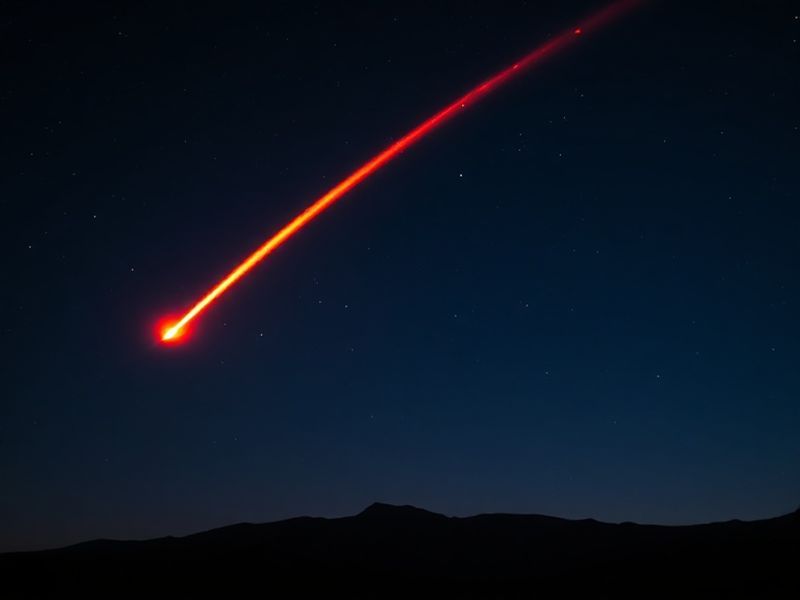
Fireball Meteor Explained: Bright Lights, Rare Sightings, and Why They Matter
“`html
Fireball Meteor: What You Need to Know About These Dazzling Space Phenomena
The night sky occasionally delivers a breathtaking spectacle in the form of a fireball meteor—a bright, long-lasting streak of light that outshines the planets and even the moon. These celestial visitors are more than just fleeting flashes; they represent fragments of comets or asteroids burning up in Earth’s atmosphere. Their brilliance and rarity make them a subject of fascination for astronomers and casual stargazers alike.
Unlike typical shooting stars, fireball meteors are significantly larger, often measuring over 4 centimeters in diameter. Their intense brightness, sometimes rivaling the full moon, makes them visible even in urban areas with light pollution. These meteors can leave behind glowing trails that linger for several seconds, creating a mesmerizing display that captivates observers.
What Exactly Is a Fireball Meteor?
A fireball meteor is formally defined by the International Astronomical Union as a meteor that shines at least as bright as the planet Venus in the night sky. This brightness threshold is roughly equivalent to a visual magnitude of -4 or higher. Fireballs are not uncommon, but those that reach this level of luminosity are estimated to occur several times each year across the globe.
- Size and Speed: Fireball meteors typically enter Earth’s atmosphere at speeds ranging from 11 to 72 kilometers per second. Their size can vary, but they are usually large enough to survive the journey through the atmosphere without completely disintegrating.
- Composition: These meteors are often composed of rocky or metallic materials, remnants from the early solar system. Their composition can provide scientists with clues about the origins of the solar system.
- Frequency: According to NASA’s Science archives, an estimated 500 fireball meteors reach the brightness of Venus each year, though most go unnoticed due to their occurrence over oceans or uninhabited regions.
The term “fireball” is sometimes used interchangeably with “bolide,” though bolides are a specific type of fireball that explodes in a bright terminal flash, often accompanied by a sonic boom. These explosive events are particularly noteworthy because they can scatter meteorites across the Earth’s surface.
The Science Behind Their Spectacular Appearance
The dazzling display of a fireball meteor begins with friction. As a meteoroid enters Earth’s atmosphere, it encounters air molecules that rapidly heat its surface. This heat causes the outer layers of the meteoroid to vaporize, creating a glowing plasma trail that we perceive as a streak of light.
The color of the fireball can vary depending on its chemical composition. For example:
- Green: Often indicates the presence of magnesium.
- Yellow: Suggests the meteoroid contains sodium.
- Red or Orange: Can signify the presence of nitrogen or oxygen in the atmosphere.
- Blue: Typically associated with copper or other metals.
Fireball meteors are also capable of producing sounds, though these are rare and usually occur only with very bright events. Witnesses have reported hearing hissing, popping, or even rumbling sounds, which are thought to be caused by the rapid heating and cooling of the atmosphere around the meteor’s path.
“The study of fireball meteors provides a unique window into the composition and dynamics of our solar system. Each event is like a free sample delivery from space, offering scientists tangible pieces of distant worlds.”
Historical Fireball Events and Their Impact
Throughout history, fireball meteors have left their mark on human culture and science. One of the most famous events occurred in 1908 over the Tunguska region of Siberia. The airburst explosion, caused by a fireball meteor approximately 50-100 meters in diameter, flattened an estimated 80 million trees over an area of 2,150 square kilometers. The energy released was equivalent to 15 megatons of TNT, making it the largest impact event in recorded history.
More recently, the Chelyabinsk meteor in 2013 provided a dramatic reminder of the potential dangers posed by these space rocks. The meteor, estimated to be about 20 meters in diameter, entered the atmosphere over Russia, creating a fireball brighter than the sun. The resulting shockwave damaged buildings and injured over 1,500 people, primarily from broken glass. This event highlighted the need for improved tracking and early warning systems for potentially hazardous near-Earth objects.
In contrast, some fireball events have been more benign but equally awe-inspiring. The Sutter’s Mill meteorite, which fell in California in 2012, provided scientists with a rare opportunity to study pristine samples of the early solar system. The fireball was so bright that it was visible across multiple states, and its subsequent recovery led to significant advancements in meteorite research.
How to Observe and Report Fireball Meteors
For those eager to witness a fireball meteor, timing and location are key. Fireballs are most commonly observed during major meteor showers, such as the Perseids in August or the Geminids in December. However, they can also occur sporadically throughout the year. To maximize your chances of seeing one, find a dark location away from city lights and allow your eyes to adjust to the darkness for at least 20 minutes.
If you’re fortunate enough to spot a fireball, reporting it can contribute valuable data to scientific research. Organizations like the American Meteor Society (AMS) and NASA’s Fireball Network collect observations from the public to track meteor activity and calculate trajectories. Reporting a fireball is straightforward:
- Note the Time and Location: Record the exact time and your geographic coordinates (latitude and longitude).
- Observe the Path: Track the direction the fireball traveled across the sky, from its starting point to its end.
- Estimate Brightness: Compare its brightness to known celestial objects, such as the moon or Venus.
- Record Any Sounds: Note any unusual noises, such as hissing or popping, that occurred during the event.
- Submit a Report: Share your observations with the AMS or NASA through their online reporting systems.
Photographing or videotaping a fireball can also enhance your report. Even a smartphone camera can capture these events if you’re prepared. Use a tripod or stable surface to avoid blurry images, and set your camera to a high ISO setting to increase sensitivity to light. If possible, use a wide-angle lens to capture as much of the sky as possible.
Fireball Meteors: A Reminder of Our Place in the Universe
Fireball meteors serve as a humbling reminder of the dynamic and ever-changing nature of our solar system. They connect us to the ancient past, offering glimpses into the materials that formed the planets billions of years ago. At the same time, they pose questions about the future and our preparedness for potential impacts.
As technology advances, so too does our ability to study these celestial visitors. Projects like NASA’s Planetary Defense Coordination Office aim to identify and track near-Earth objects, ensuring that we are better prepared for any future threats. Meanwhile, amateur astronomers and citizen scientists continue to play a crucial role in monitoring fireball activity, contributing to a global network of observers.
For those who gaze up at the night sky, fireball meteors are a reminder of the beauty and unpredictability of the universe. Whether you’re a seasoned astronomer or simply someone who appreciates a stunning natural display, these dazzling events offer a moment of connection to the cosmos. So the next time you find yourself under a clear night sky, take a moment to look up—you might just witness a fireball meteor streaking across the heavens.