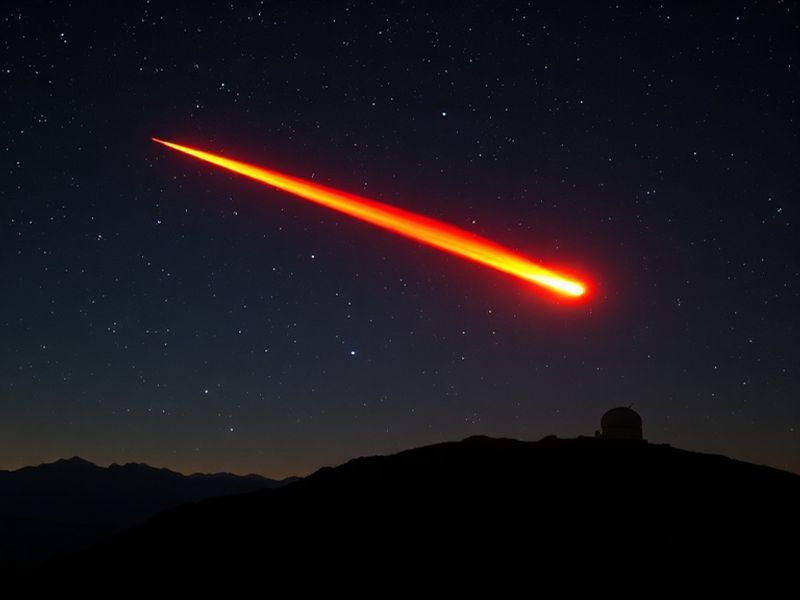
Fireball Meteor: Spectacular Cosmic Events Explained
“`html
Fireball Meteor: When the Night Sky Turns into a Spectacular Show
On a clear night, the sky often delivers unexpected surprises. One of the most breathtaking events is the appearance of a fireball meteor—a dazzling streak of light that can outshine even the brightest stars. These cosmic visitors are more than just fleeting flashes; they are fragments of distant worlds, offering scientists and stargazers alike a rare glimpse into the mysteries of space.
The term “fireball” refers to meteors that shine with an intensity at least as bright as the planet Venus. When such an object enters Earth’s atmosphere, friction heats it to thousands of degrees, creating a brilliant, glowing trail. These events are not just visually stunning; they also provide valuable data about the composition of asteroids and comets.
The Science Behind Fireball Meteors
Fireball meteors originate from space debris, often left behind by comets or asteroids. When these fragments collide with Earth’s atmosphere, they become meteors. Most burn up entirely, but larger ones may survive the journey and land as meteorites. The brightness of a fireball depends on its size, speed, and composition. Iron and nickel-rich meteors tend to produce more intense flashes, while stony ones may fragment spectacularly.
Scientists classify fireballs based on their brightness and behavior. A “bolide” is an exceptionally bright fireball that may explode in a terminal burst. These events are particularly significant because they can distribute meteorites over wide areas, giving researchers multiple samples to study. NASA’s All Sky Fireball Network tracks these events, helping astronomers map their origins and trajectories.
Key Characteristics of Fireball Meteors
- Brightness: Fireballs must be at least as luminous as Venus (-4 magnitude or brighter).
- Duration: They often last several seconds, unlike typical shooting stars.
- Color: The hue can vary from blue-white to orange-red, depending on their mineral content.
- Sound: Rarely, observers report hearing sonic booms or crackling sounds as the meteor breaks apart.
- Fragmentation: Some fireballs break into smaller pieces, creating a trail of glowing fragments.
Notable Fireball Events in Recent History
Fireball meteors have left their mark on history, both scientifically and culturally. One of the most famous recent events occurred over Chelyabinsk, Russia, in 2013. A 20-meter-wide asteroid entered the atmosphere at 19 kilometers per second, releasing energy equivalent to 500 kilotons of TNT. The resulting shockwave shattered windows across six cities and injured over 1,500 people. Though no meteorites were recovered from the main explosion, fragments found in the region provided critical insights into the asteroid’s composition.
Another remarkable event took place in 2018 over Michigan, USA. The fireball was so bright it was seen by weather satellites, and meteorite hunters quickly recovered fragments from a frozen lake. Analysis revealed that the space rock was rich in organic compounds, including amino acids—the building blocks of life. This discovery underscored the role meteors may have played in delivering essential ingredients for life to Earth.
What Fireball Meteors Tell Us About the Solar System
Fireball meteors are more than just celestial fireworks; they are cosmic messengers. By studying their composition, scientists can infer the conditions of the early solar system. For example, the presence of certain isotopes in meteorites suggests that some asteroids formed closer to the Sun than previously thought. Others contain materials that could only have formed in the outer solar system, hinting at the dynamic processes that shaped our planetary neighborhood.
These events also serve as a reminder of Earth’s place in the universe. While the risk of a catastrophic impact is low, fireballs highlight the constant bombardment our planet faces from space. Organizations like The Spaceguard Foundation work to identify and track near-Earth objects (NEOs) that could pose future threats. Advances in technology, such as the upcoming NEO Surveyor mission, promise to improve our ability to detect and deflect hazardous asteroids.
The Cultural Impact of Fireball Meteors
Throughout history, fireball meteors have inspired awe and fear. Ancient cultures often interpreted them as omens or messages from the gods. In medieval Europe, sightings were sometimes seen as divine signs, while indigenous peoples in the Americas viewed them as spirits traversing the sky. Even today, fireballs capture the public imagination, often going viral on social media when captured on camera.
Fireballs also play a role in modern storytelling. They frequently appear in science fiction films and literature as harbingers of alien invasions or cosmic doom. Yet, their real-life beauty and scientific value remind us that space is not just a backdrop for fiction—it is a dynamic, ever-changing frontier.
How to Observe and Report Fireball Meteors
For amateur astronomers and casual observers, fireballs offer an exciting opportunity to contribute to science. The American Meteor Society (AMS) encourages the public to report sightings through their online database. Key details to note include the time, location, direction, and duration of the event. Even smartphone videos can provide valuable data for scientists studying these phenomena.
If you’re lucky enough to witness a fireball, take a moment to appreciate its fleeting beauty. Whether it’s a small fragment burning up in the atmosphere or a massive bolide lighting up the night, these events connect us to the vastness of space and the ongoing story of our solar system.
Conclusion
Fireball meteors are a reminder of the dynamic and unpredictable nature of our universe. They bridge the gap between scientific discovery and human wonder, offering both researchers and stargazers a chance to witness the raw power of cosmic forces. As technology advances, our ability to study these events will only improve, deepening our understanding of the solar system and our place within it.
For now, the next time you gaze at the night sky, remember that somewhere out there, a fragment of ancient space rock may be streaking across the heavens—burning bright, if only for a moment.