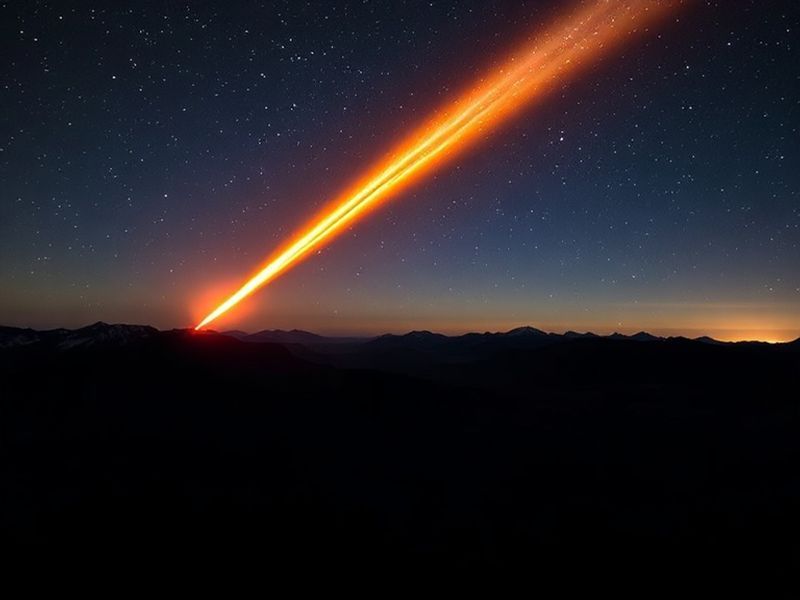
meteor fireball
“`html
Meteor Fireballs: Nature’s Rare and Spectacular Light Show
Few celestial events captivate humanity quite like a meteor fireball streaking across the night sky. These dazzling displays—brighter than the planet Venus—occur when space rocks enter Earth’s atmosphere, igniting into brilliant, often colorful plumes of light. Unlike the fleeting streaks of typical meteors, fireballs can linger for several seconds, sometimes fragmenting into smaller pieces before vanishing. Their unpredictability and grandeur have made them a subject of fascination for centuries, inspiring myths, scientific study, and even modern-day treasure hunts.
The term “fireball” is officially defined by the International Astronomical Union as a meteor brighter than magnitude -4, which is about the brightness of Venus as seen from Earth. These events are not uncommon—thousands occur globally each year—but they often go unnoticed due to their remote locations or daytime occurrences. When witnessed, however, they leave lasting impressions on those lucky enough to see them.
The Science Behind the Glow: How Fireballs Form
A meteor fireball begins its life as a meteoroid—a small rocky or metallic body hurtling through space. When one of these objects collides with Earth’s atmosphere at speeds ranging from 25,000 to 160,000 miles per hour, the friction heats the air around it to thousands of degrees. This intense heat vaporizes the meteoroid, creating the glowing trail we recognize as a shooting star. If the object is large enough, it may survive the journey and land on Earth as a meteorite.
Fireballs are classified into two main types: sporadic and shower-related. Sporadic fireballs occur randomly and are not tied to any specific meteor shower. Shower-related fireballs, on the other hand, are associated with annual meteor showers like the Perseids or Geminids, when Earth passes through debris trails left by comets or asteroids. These showers often produce higher-than-average numbers of bright meteors, increasing the chances of witnessing a fireball.
The color of a fireball provides clues about its composition. Greenish hues typically indicate the presence of magnesium, while red or orange tones suggest iron or sodium. Blue is often linked to copper. These colors are visible because different elements emit distinct wavelengths of light when heated, much like the flames of a campfire change hue depending on what’s burning.
Global Witnesses: Where Fireballs Have Made an Impact
Fireballs have been observed and documented throughout history, often leaving cultural imprints as well as physical traces. In 1492, a fireball exploded over Ensisheim in modern-day France, scattering meteorites across the countryside. Locals interpreted the event as a divine omen, and the largest fragment was enshrined in the local church. Similarly, in 1908, a massive fireball detonated over Siberia’s Tunguska region with the force of a nuclear bomb, flattening 80 million trees across 800 square miles. The event remained shrouded in mystery for decades, fueling speculation from alien invasions to black holes.
More recently, in 2013, a fireball exploded over Chelyabinsk, Russia, with a blast equivalent to 30 Hiroshima-sized atomic bombs. The shockwave shattered windows across six cities, injuring over 1,500 people. The event was captured on countless dashcams and security cameras, turning it into a global media sensation. Scientists later recovered fragments of the meteorite, which turned out to be a common chondrite, a type of stony meteorite.
Fireballs have also played roles in modern astronomy. In 2020, a fireball over central Europe was tracked by multiple observatories, allowing researchers to calculate its trajectory and predict where fragments might land. Such coordinated efforts highlight the growing importance of citizen science, where amateur astronomers and enthusiasts contribute to tracking these fleeting phenomena.
Not all fireballs are harmless. In 2018, a fireball over Michigan, USA, produced a meteorite that landed on a frozen lake. The event was so well-documented that scientists were able to retrieve the rock within days, providing pristine samples for study. This rapid recovery is rare and invaluable for researchers seeking to understand the early solar system.
Myths, Legends, and Modern Obsessions
Before science explained fireballs, ancient cultures wove them into their mythologies. In Aboriginal Australian traditions, fireballs were sometimes seen as the torches of ancestral spirits traveling across the sky. Norse legends described them as the glowing weapons of gods like Thor, while in medieval Europe, they were often interpreted as omens of war or divine wrath. These stories reflect humanity’s long-standing awe of the unknown.
Today, fireballs inspire both scientific curiosity and pop culture fascination. Social media amplifies their reach, with videos of fireballs often going viral within hours. Platforms like Dave’s Locker Science frequently feature user-submitted footage of these events, turning amateur astronomers into contributors to global databases. Organizations like the American Meteor Society maintain fireball tracking networks, where witnesses can report sightings and help triangulate trajectories.
The commercial world has also taken notice. Companies now sell “fireball hunting” kits, complete with GPS devices and high-resolution cameras, catering to enthusiasts eager to document their own celestial encounters. Space tourism companies have even floated the idea of offering “meteorite hunting” trips, where travelers could search for fragments of recent fireballs.
How to Spot a Fireball: Tips for Aspiring Sky Watchers
Witnessing a fireball is largely a matter of luck, but there are ways to increase your chances. First, check the calendar for major meteor showers, such as the Perseids in August or the Leonids in November. These events are predictable and often produce higher-than-average numbers of bright meteors. Second, find a dark sky location away from city lights, as light pollution can drown out even the brightest fireballs. Finally, allow your eyes to adjust to the darkness for at least 20 minutes to maximize your visibility.
If you’re lucky enough to see a fireball, there are steps you can take to contribute to scientific research. Note the time, direction, and duration of the event. If possible, record the fireball with your smartphone or a dedicated camera. Then, report your sighting to organizations like the American Meteor Society or the International Meteor Organization. Your data could help scientists refine their models of meteoroid behavior.
For those who prefer to stay grounded, fireballs offer plenty of indirect ways to engage. Museums often display meteorite fragments recovered from fireballs, such as the famous Willamette Meteorite at the American Museum of Natural History. Even jewelry made from meteorite fragments has surged in popularity, blending science with fashion.
The Future of Fireball Research
Advancements in technology are transforming how we study fireballs. High-resolution cameras, satellite networks, and machine learning algorithms now allow scientists to detect and analyze fireballs in unprecedented detail. Projects like the Desert Fireball Network in Australia use autonomous cameras to track meteoroids across the sky, calculating their orbits and potential landing sites. This data helps researchers understand the origins of these space rocks and their roles in the solar system’s history.
There’s also growing interest in planetary defense. While the odds of a catastrophic meteorite impact are low, organizations like NASA’s Planetary Defense Coordination Office monitor near-Earth objects (NEOs) that could pose a threat. Fireballs serve as reminders of the dynamic and sometimes hazardous environment of space, reinforcing the need for vigilance and preparedness.
As space exploration expands, so too does the potential for new discoveries. Missions like NASA’s OSIRIS-REx, which collected samples from the asteroid Bennu, could provide clues about the composition of fireball-producing meteoroids. Meanwhile, amateur astronomers continue to play a vital role, bridging the gap between professional research and public engagement.
Conclusion: A Reminder of the Cosmos
Meteor fireballs are more than just dazzling light shows—they are windows into the solar system’s past and reminders of its unpredictable present. Whether viewed as scientific curiosities, cultural symbols, or simply breathtaking spectacles, they connect us to the vastness of space and the mysteries it still holds. For those who have witnessed one, the memory lingers long after the glow fades. And for the rest of us, the next fireball is always just a matter of time.
So, the next time you find yourself under a clear night sky, take a moment to look up. You might just catch a glimpse of nature’s most spectacular fireworks.
—
METADATA
{
“title”: “Meteor Fireballs: When Space Rocks Light Up the Sky”,
“metaDescription”: “Discover how meteor fireballs form, where they’ve struck Earth, and how to spot them in the night sky.”,
“categories”: [“Science”, “News”],
“tags”: [“meteor fireball”, “shooting stars”, “space rocks”, “meteorites”, “celestial events”],
“imageDescription”: “A vibrant night sky scene featuring a bright green meteor fireball streaking across the horizon, with silhouetted trees and a distant observatory dome in the background. The fireball leaves a glowing trail with subtle fragmentation, evoking awe and wonder.”
}
—END METADATA—
“`