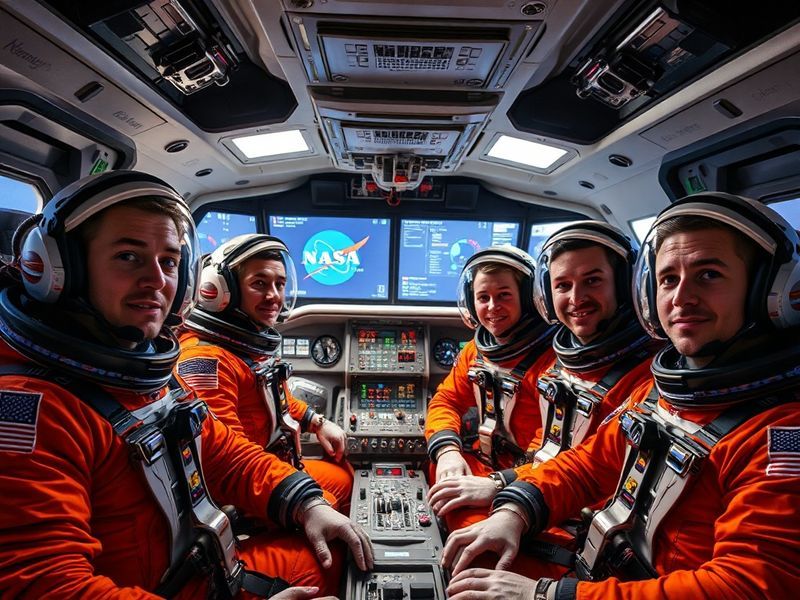
NASA Artemis II Astronauts: Meet the Crew for Historic Lunar Flyby
“`html
Meet the NASA Artemis II Astronauts Set for Lunar Mission
NASA has selected four astronauts for the Artemis II mission, marking the first crewed lunar flyby in over 50 years. Scheduled for launch in late 2024 or early 2025, this mission will test the Orion spacecraft’s systems and pave the way for future lunar landings. The crew comprises three NASA astronauts and one from the Canadian Space Agency (CSA), reflecting international collaboration in space exploration.
The Artemis program aims to return humans to the Moon and establish a sustainable presence by the end of the decade. Artemis II is a critical step, serving as a test flight before the planned Artemis III mission, which will land astronauts near the lunar south pole. This mission will also carry the hopes of a new generation of space explorers and engineers.
The Crew: A Blend of Experience and Innovation
The Artemis II crew represents a mix of veteran astronauts and first-time flyers. Reid Wiseman, a former U.S. Navy test pilot, will command the mission. Wiseman previously served as NASA’s Chief Astronaut and has logged 165 days in space during a 2014 expedition to the International Space Station (ISS). His leadership will be crucial in navigating the challenges of deep space travel.
Victor Glover, a NASA astronaut and U.S. Navy captain, will serve as the pilot. Glover made history as the first Black astronaut to complete a long-duration stay on the ISS during the SpaceX Crew-1 mission. His expertise in spacecraft systems and orbital mechanics will be vital for Artemis II’s success. Glover’s role as pilot underscores NASA’s commitment to diversity and inclusion in space exploration.
The mission specialists are Christina Koch and Jeremy Hansen. Koch, an electrical engineer and veteran ISS astronaut, holds the record for the longest single spaceflight by a woman at 328 days. Her experience in extravehicular activities (EVAs) will be invaluable for future lunar surface missions. Hansen, a Canadian astronaut and former fighter pilot, is the first non-American to be selected for a lunar mission. His inclusion highlights the growing role of international partners in NASA’s Artemis program.
A Mission of Firsts and Challenges
Artemis II will be the first crewed mission beyond low Earth orbit since Apollo 17 in 1972. Unlike its predecessor missions, Artemis II will not land on the Moon. Instead, the crew will perform a lunar flyby, testing Orion’s systems in deep space before returning to Earth. This trajectory will take them farther from Earth than any human has traveled before—approximately 6,400 miles beyond the far side of the Moon.
The mission will also test Orion’s life support, navigation, and communication systems in the harsh environment of deep space. These systems must function flawlessly to ensure the crew’s safety. Engineers have made significant upgrades to Orion since the uncrewed Artemis I mission in 2022, including improvements to the heat shield and radiation protection.
Communication delays between Earth and the spacecraft will require the crew to operate more autonomously than during ISS missions. This shift presents both a challenge and an opportunity for NASA to refine its protocols for future deep space exploration, including missions to Mars.
The Role of International Partnerships
NASA’s collaboration with international partners is a cornerstone of the Artemis program. The inclusion of Jeremy Hansen from the Canadian Space Agency (CSA) is a testament to this partnership. Canada is contributing the Canadarm3 robotic system to the Lunar Gateway, a small space station orbiting the Moon that will support future missions.
Other international contributions include the European Space Agency’s (ESA) Orion service module, which provides power and propulsion for the spacecraft. Japan’s JAXA is developing a pressurized rover for lunar surface exploration, while private companies like SpaceX and Blue Origin are building lunar landers for future missions. These collaborations reflect a global effort to return humans to the Moon and establish a sustainable presence.
NASA has also emphasized the importance of commercial partnerships in Artemis. Companies like Lockheed Martin and Northrop Grumman are key contractors for the Orion spacecraft and Space Launch System (SLS) rocket. These partnerships have driven innovation and reduced costs, making deep space exploration more accessible.
What’s Next for Artemis and Beyond
Artemis II is just the beginning of NASA’s ambitious lunar exploration plans. If successful, the mission will set the stage for Artemis III, which aims to land astronauts near the lunar south pole. This region is of particular interest due to the presence of water ice, which could be used for drinking water, oxygen, and rocket fuel.
The Lunar Gateway, a small space station orbiting the Moon, will serve as a staging point for future missions. NASA plans to use the Gateway as a hub for scientific research and a waypoint for astronauts traveling to and from the lunar surface. The Gateway will also support international and commercial partnerships, fostering a sustainable human presence on the Moon.
Beyond the Moon, the Artemis program is a stepping stone for NASA’s goal of sending humans to Mars. The technologies and systems tested during Artemis missions will be critical for deep space exploration. NASA’s long-term vision includes establishing a permanent lunar base and eventually launching crewed missions to the Red Planet.
The Human Impact of Artemis II
The Artemis II mission is more than a technical achievement—it is a symbol of human ambition and curiosity. For the four astronauts selected, this mission represents the culmination of years of training and preparation. For the global audience watching, it is an opportunity to witness history in the making.
The crew’s diverse backgrounds and experiences reflect the evolving nature of space exploration. From Koch’s record-breaking spaceflight to Hansen’s historic role as the first non-American lunar flyer, Artemis II embodies the spirit of collaboration and innovation. Their journey will inspire future generations of astronauts, engineers, and scientists to push the boundaries of what is possible.
As the Artemis II crew prepares for their mission, they carry with them the hopes and dreams of people around the world. Their success will not only advance our understanding of the Moon but also demonstrate the power of human ingenuity and cooperation. The countdown to launch has begun, and the world will be watching.
For those interested in following the latest developments in space exploration, be sure to check out Dave’s Locker Science section for updates on Artemis missions and other cutting-edge research.