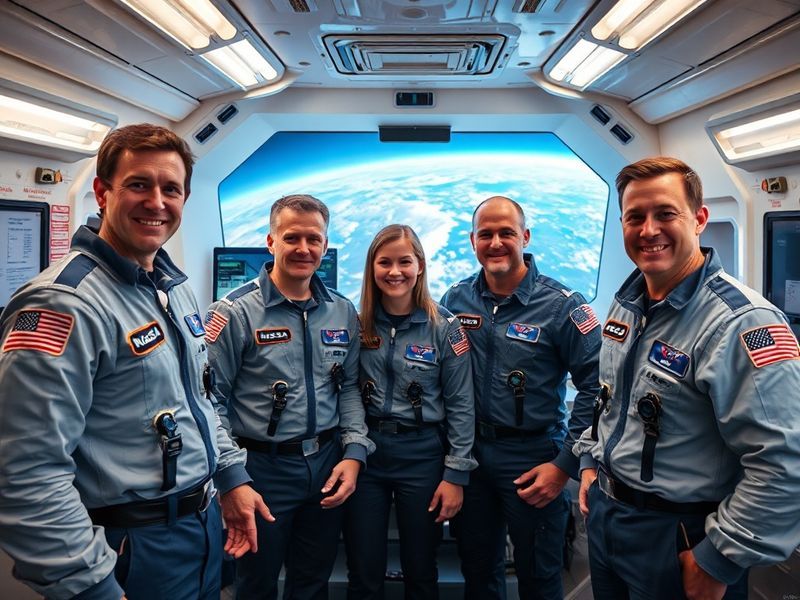
NASA’s Artemis program marks a new chapter in human space exploration, and at its heart is the Artemis II mission—a crewed lunar flyby that will test the systems needed for future Moon landings. Scheduled for no earlier than September 2025, this mission will send four astronauts around the Moon and back, preparing the groundwork for Artemis III, which aims to land the first woman and the next man on the lunar surface. The crew, announced in April 2023, represents a blend of seasoned astronauts and first-time space travelers, each bringing unique expertise to one of humanity’s most ambitious undertakings.
The selection of the Artemis II crew underscores NASA’s commitment to diversity and experience. The team includes three NASA astronauts and one Canadian Space Agency (CSA) astronaut, reflecting international collaboration in deep space exploration. Their training spans years of preparation, from high-G reentry simulations to emergency procedures aboard the Orion spacecraft. This mission is not just a technical milestone—it’s a symbol of what humanity can achieve when nations unite under a shared vision of discovery.
The Artemis II Crew: Who’s Who in the Mission
The four astronauts chosen for Artemis II were selected from a pool of highly trained professionals with backgrounds in military aviation, engineering, and science. Each brings a distinct perspective to the mission, ensuring that every phase of the flight is backed by deep expertise.
Reid Wiseman, a former U.S. Navy test pilot and former Chief of the Astronaut Office, will command the mission. Wiseman previously served as a flight engineer on the International Space Station (ISS) during Expedition 41, logging 165 days in space. His leadership and experience in long-duration spaceflight make him a natural choice to lead this groundbreaking endeavor.
Victor Glover, a NASA astronaut and U.S. Navy captain, will serve as the pilot. Glover made history as the first African American astronaut to live aboard the ISS for an extended mission during Expedition 64. His piloting skills and operational experience will be critical during the lunar flyby, where precision and adaptability are paramount.
Christina Koch, an electrical engineer and veteran of six spacewalks, will be the mission specialist. Koch holds the record for the longest single spaceflight by a woman—328 days aboard the ISS. Her expertise in spacecraft systems and extravehicular activity (EVA) will be invaluable during the mission’s technical phases.
Jeremy Hansen, a Canadian Space Agency astronaut and former fighter pilot, rounds out the crew as the second mission specialist. Hansen is the first Canadian selected for a lunar mission, a milestone for Canada’s growing role in space exploration. His background in tactical aviation and astronaut training prepares him to handle the complexities of deep space navigation.
Why the Artemis II Mission Matters
Artemis II is more than a test flight—it’s a proving ground for the technologies and procedures that will enable humanity’s return to the Moon and eventual journeys to Mars. The mission will validate the Orion spacecraft’s life support, navigation, and communication systems in the harsh environment of deep space. Unlike the Apollo missions, which were limited to short lunar stays, Artemis II will demonstrate the endurance and resilience required for long-duration missions.
The mission’s trajectory will take the crew farther from Earth than any humans have traveled before. After launching atop the Space Launch System (SLS) rocket, Orion will enter a high Earth orbit before performing a translunar injection burn, sending it on a free-return trajectory around the Moon. The crew will not land on the lunar surface but will instead fly past it at a distance of approximately 6,400 miles, testing the spacecraft’s systems in the process. This flyby will set the stage for Artemis III, where astronauts will finally step onto the Moon’s south pole.
Beyond its technical objectives, Artemis II carries profound scientific and cultural significance. The mission will expand our understanding of lunar geology, radiation exposure, and the effects of microgravity on the human body. It will also inspire a new generation of explorers, much like the Apollo missions did in the 1960s and 70s. By including a diverse crew, NASA is sending a clear message: space exploration is for everyone, and the benefits of discovery should be shared across all nations and backgrounds.
Key Objectives of the Artemis II Mission
- Validate Orion’s Systems: Test the spacecraft’s heat shield, life support, and navigation during the lunar flyby.
- Demonstrate Crew Operations: Evaluate how astronauts perform tasks in deep space, including communications and emergency protocols.
- Assess Radiation Exposure: Measure the radiation levels inside Orion to better understand risks for future long-duration missions.
- Test Lunar Communication: Ensure reliable communication between Earth, Orion, and potential future lunar landers.
- Inspire Global Collaboration: Strengthen partnerships with international agencies like the CSA and commercial partners like SpaceX and Blue Origin.
Broader Implications: The Future of Space Exploration
The Artemis program is a stepping stone toward a sustainable human presence on the Moon and, eventually, Mars. By establishing the Lunar Gateway—a small space station orbiting the Moon—NASA and its partners aim to create a permanent infrastructure for scientific research and commercial activities. This outpost will serve as a staging point for lunar landings and deep space missions, reducing the need to launch everything from Earth.
Commercial involvement is another critical aspect of Artemis. Companies like SpaceX, with its Starship lunar lander, and Blue Origin, with its Blue Moon lander, are developing systems to transport astronauts and cargo to the lunar surface. These partnerships are accelerating innovation while reducing costs, making space exploration more accessible. The Artemis II mission will test some of these systems, paving the way for future collaborations.
Beyond the technical and scientific benefits, Artemis II holds cultural and economic promise. The mission is expected to generate thousands of jobs, from engineering roles to manufacturing and tourism. Space tourism, already a growing industry, could see a surge in interest as civilians eye the Moon as a potential destination. Additionally, the data gathered from lunar missions will aid in understanding Earth’s climate and geology, offering insights into planetary science.
However, challenges remain. Funding, international competition, and the technical hurdles of long-duration spaceflight are all obstacles that NASA and its partners must navigate. The success of Artemis II will hinge on the crew’s ability to adapt to unforeseen circumstances, a reality that Wiseman, Glover, Koch, and Hansen are well-prepared to face.
Looking Ahead: What Comes After Artemis II
If Artemis II succeeds, the stage will be set for Artemis III, currently planned for no earlier than 2026. This mission will see the first woman and the next man land on the Moon’s south pole, a region believed to contain water ice—a critical resource for future exploration. The south pole’s permanently shadowed craters could hold clues to the solar system’s early history, making it a prime target for scientific study.
Longer-term goals include establishing a sustainable lunar base by the end of the decade, with Artemis missions serving as the foundation. This base could support scientific research, mining operations, and even serve as a launch point for Mars missions. The technologies developed for Artemis will also be applicable to crewed missions to Mars, which NASA aims to achieve in the 2030s or 2040s.
The Artemis II crew’s journey will be watched by millions, not just for its technical achievements but for its symbolic power. In an era of geopolitical tensions and environmental challenges, the mission offers a reminder of what humanity can accomplish when it looks beyond Earth. As Koch once said, “We’re not just going to the Moon to plant a flag and leave. We’re going to stay and learn.”
For those eager to follow the mission’s progress, space technology updates and science news outlets will provide real-time coverage. As the launch window approaches, the world will watch as four pioneers embark on a voyage that could redefine our place in the cosmos.
Conclusion
NASA’s Artemis II mission is a testament to human ingenuity, collaboration, and the relentless pursuit of knowledge. The crew—Wiseman, Glover, Koch, and Hansen—embodies the spirit of exploration, carrying with them the hopes of a planet eager to push the boundaries of what’s possible. Whether it’s testing the limits of technology, inspiring the next generation of astronauts, or laying the groundwork for a sustainable lunar presence, Artemis II is more than a mission. It’s a promise of what lies ahead.
As the countdown to launch begins, the world will witness history in the making. And though the Moon has been visited before, this time, humanity is going back to stay.