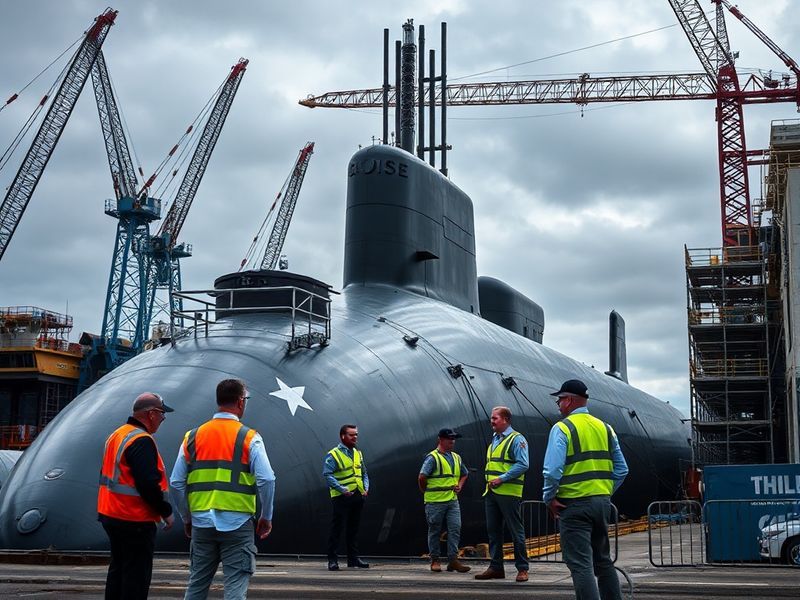
Navy Cancels USS Boise Overhaul: A Submarine’s Costly Decline
“`html
Navy Cancels USS Boise Overhaul After 12 Years of Maintenance Delays
The U.S. Navy has officially canceled the mid-life refueling and overhaul of the Los Angeles-class attack submarine USS Boise (SSN 764), marking the end of a prolonged and troubled maintenance period that lasted more than a decade. The decision follows years of escalating costs, technical challenges, and shifting strategic priorities within the submarine force.
USS Boise, commissioned in 1992 and homeported in Norfolk, Virginia, was originally scheduled to begin its mid-life refueling overhaul at Newport News Shipbuilding in 2013. Instead, the submarine spent nearly all of its operational life in a state of extended maintenance, effectively sidelining a vessel designed for forward deployment and combat readiness.
Why the USS Boise Overhaul Was Canceled
The cancellation decision reflects a combination of financial constraints, industrial capacity issues, and evolving naval priorities. According to multiple defense sources and public statements from Naval Sea Systems Command (NAVSEA), the projected cost of completing Boise’s overhaul had ballooned from an original estimate of around $300 million to over $700 million—more than double the cost of building a new Virginia-class submarine.
Key factors behind the cancellation include:
- Chronic labor shortages at Newport News Shipbuilding, which is also responsible for building new submarines and aircraft carriers, limiting available yard space and skilled workers.
- Technical complications discovered during initial assessments, including corrosion in the reactor compartment and issues with steam generators.
- Shift in submarine fleet priorities, with the Navy focusing on accelerating production of newer Virginia-class and Columbia-class boats over maintaining aging Los Angeles-class vessels.
- Budget reallocation due to rising costs in other areas, including shipbuilding delays, personnel expenses, and operational demands in the Pacific and Atlantic theaters.
The Navy has not yet announced a formal decommissioning date, but sources indicate Boise will likely be placed in a reserve status before eventual disposal—effectively ending its service life after just 32 years, far short of the typical 35–40 years expected for Los Angeles-class submarines.
Broader Implications for the U.S. Submarine Fleet
The cancellation of USS Boise’s overhaul underscores deeper challenges facing the U.S. submarine force, which is currently operating at historically low readiness levels. With 15 of the Navy’s 68 attack submarines deployed at any given time—well below the desired 66% deployment rate—the loss of Boise’s potential return to service further strains operational capacity.
This decision also highlights the growing strain on Newport News Shipbuilding, the sole provider of U.S. submarine maintenance and construction. The shipyard is currently managing over 10 major submarine programs, including the Columbia-class ballistic missile submarine, while also handling aircraft carrier refueling overhauls. Industry analysts warn that without increased investment or additional shipyard capacity, delays and cancellations like Boise’s could become more common.
Moreover, the case raises questions about the long-term viability of the Los Angeles-class fleet. With the Virginia-class submarine program now fully operational and producing two new boats per year, the Navy has fewer incentives to invest heavily in maintaining older boats. Many in the defense community argue that the focus should shift toward accelerating the retirement of Los Angeles-class vessels and prioritizing the Columbia-class SSBN program and advanced Virginia-class variants.
What’s Next for USS Boise?
While the Navy has not issued a formal decommissioning timeline, several possibilities exist for the future of USS Boise. The most likely scenario is that the submarine will be placed in the inactive reserve fleet, where it will remain in a non-operational status until a final disposal decision is made.
Potential outcomes include:
- Scrapping or recycling: The hull could be dismantled under the Ship-Submarine Recycling Program, a process that has been used for several Los Angeles-class boats in recent years.
- Museum ship: Though less likely due to the submarine’s relatively recent service history and lack of public campaign, Boise could be preserved as a museum vessel if sufficient funding and interest emerge.
- Donation for research or training: The Navy occasionally transfers older submarines to academic institutions or training centers for use as platforms for sonar testing, marine biology research, or damage control training.
- Sale to a foreign navy: While rare for U.S. nuclear-powered submarines, there is precedent for transferring conventionally powered boats. However, nuclear propulsion technology limits this option significantly.
Regardless of the final outcome, USS Boise’s story serves as a cautionary tale about the risks of extended maintenance delays in an era of constrained budgets and growing global competition. It also highlights the urgent need for the Navy and shipbuilding industry to address industrial base challenges before they further erode fleet readiness.
Lessons for Naval Maintenance and Shipbuilding
The USS Boise case is not an isolated incident. Several other Los Angeles-class submarines have faced extended maintenance periods, including USS Miami, which was damaged by arson in 2012 and never returned to service, and USS San Francisco, which collided with an underwater mountain in 2005 and required extensive repairs before being decommissioned in 2017.
These examples point to systemic issues within the submarine maintenance pipeline:
- The shipbuilding industrial base is operating at or near capacity, with limited redundancy or surge capability.
- Cost overruns and schedule slippages are becoming more common as older ships require increasingly complex repairs.
- The Navy’s ship maintenance budget has not kept pace with inflation or technological demands, leading to prioritization dilemmas.
To address these issues, defense analysts recommend several steps:
- Increasing investment in shipyard infrastructure and workforce development.
- Expanding the use of modular repairs and pre-planned maintenance to reduce downtime.
- Accelerating the transition to newer submarine classes to reduce reliance on aging platforms.
- Improving transparency and accountability in cost estimation and scheduling for major overhauls.
Without meaningful reform, the Navy risks repeating the USS Boise experience—where a once-capable warship becomes a financial and operational liability, ultimately sidelined by the very system meant to sustain it.
Conclusion: A Submarine in Peril Mirrors Fleet Challenges
The cancellation of USS Boise’s overhaul is more than just the story of one submarine—it is a reflection of broader pressures facing the U.S. Navy as it navigates an era of great power competition, budget constraints, and industrial limitations. In an age where the service is racing to expand its submarine fleet to counter China and Russia, every day a submarine sits idle in a shipyard represents a strategic vulnerability.
USS Boise’s fate should serve as a wake-up call. The Navy must modernize its maintenance processes, invest in its industrial base, and make tough decisions about the future composition of its fleet. Otherwise, more submarines may find themselves in the same limbo—technically part of the fleet, but operationally irrelevant.
As the Navy charts its course forward, one thing is clear: the age of easy fixes and routine overhauls is over. The challenges facing USS Boise are the challenges facing the fleet, and the time to address them is now.
For further reading on naval operations and defense analysis, visit our News and Analysis sections.