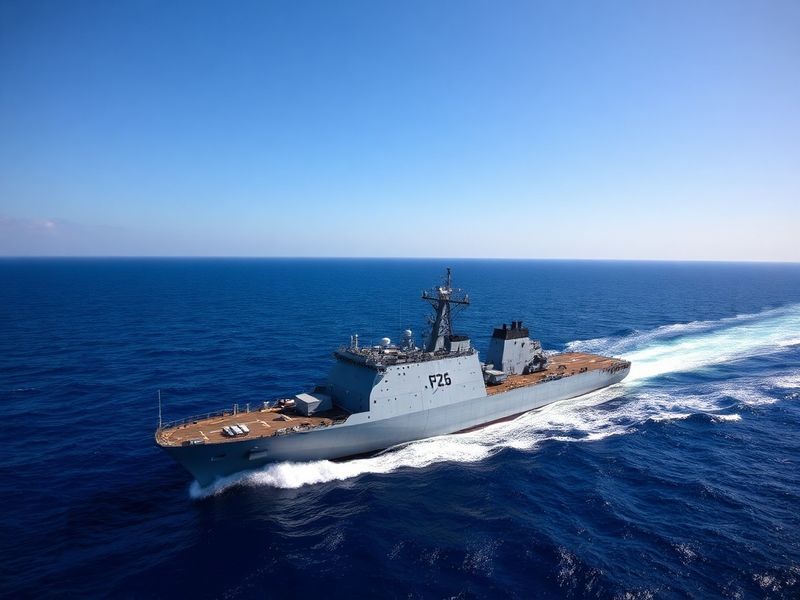
The USS John P. Murtha (LPD-26) is more than just another amphibious transport dock in the U.S. Navy’s fleet. Commissioned in 2017, this San Antonio-class vessel represents a leap in maritime engineering, strategic flexibility, and global power projection. Named after the late U.S. Congressman John Murtha—a pivotal figure in defense policy—this ship embodies both technological innovation and the evolving priorities of American naval operations.
Unlike traditional aircraft carriers or destroyers, the Murtha is designed for rapid deployment, humanitarian aid, and expeditionary warfare. Its versatility makes it a cornerstone of modern naval strategy, particularly in an era where conflicts are increasingly hybrid and global crises demand rapid response. With a displacement of 25,000 tons and a crew of 360, the ship can carry Marines, helicopters, and even the futuristic hovercraft known as the LCAC (Landing Craft Air Cushion). This adaptability ensures it remains relevant from the Pacific to the Middle East.
A Ship Built for the Future: Design and Capabilities
The USS John P. Murtha is a marvel of 21st-century naval architecture. Constructed by Huntington Ingalls Industries in Pascagoula, Mississippi, it incorporates stealth features, advanced communication systems, and modular cargo spaces that can be reconfigured for different missions. The ship’s well deck allows for the launch and recovery of amphibious vehicles, while its flight deck supports MV-22 Ospreys and CH-53 helicopters—critical assets for rapid troop insertion.
One of the most notable aspects of the Murtha’s design is its use of advanced radar and sensor systems. These include the AN/SPS-48E air search radar and the AN/SPS-73 surface search radar, which provide enhanced situational awareness in contested environments. The ship also features the Advanced Enclosed Mast/Sensor (AEM/S) system, which reduces radar cross-section and improves stealth.
The vessel’s propulsion system is another highlight. Powered by four diesel engines, the Murtha can reach speeds of over 22 knots and has a range of 12,000 nautical miles. This endurance allows it to operate independently for extended periods, a crucial advantage in regions where logistical support is limited.
Global Deployments: From Humanitarian Missions to Combat Readiness
Since its commissioning, the USS John P. Murtha has participated in numerous high-profile operations across the globe. Its missions reflect the diverse roles of modern naval forces, blending military readiness with diplomatic engagement.
- Pacific Partnership 2018: The Murtha served as a floating hospital and logistics hub during this annual humanitarian mission in Southeast Asia. Medical teams aboard the ship provided free healthcare to remote island communities in the Philippines and Vietnam, while engineers conducted infrastructure repairs. Such deployments reinforce U.S. alliances and soft power in the region.
- Operation Inherent Resolve: In 2020, the Murtha supported counter-ISIS operations in the Middle East, transporting Marines and equipment to forward operating bases. Its ability to launch helicopters and hovercraft made it a critical asset in the fight against extremist groups.
- Humanitarian Assistance in the Caribbean: Following Hurricane Maria in 2017, the Murtha delivered critical supplies to Puerto Rico, including food, water, and medical equipment. Its well deck allowed for the rapid unloading of landing craft, bypassing damaged ports.
These operations underscore the ship’s dual role as both a warfighting platform and a tool for global stability. In an era where climate change and political instability create new challenges, vessels like the Murtha are indispensable.
Cultural and Strategic Significance
The naming of the USS John P. Murtha was not without controversy. John Murtha, a Democrat and longtime advocate for veterans, was a polarizing figure in military circles due to his outspoken criticism of the Iraq War. However, his legacy in defense policy and his support for the shipbuilding industry in his home state of Pennsylvania ensured its naming was politically viable.
Culturally, the Murtha represents a shift in how the U.S. Navy is perceived. Unlike the iconic battleships of World War II or the nuclear-powered carriers of the Cold War, modern amphibious ships like the Murtha are designed for flexibility rather than sheer firepower. This reflects a broader trend in military strategy, where adaptability and rapid response are prioritized over large-scale engagements.
The ship’s presence in international waters also serves as a reminder of America’s global commitments. In the South China Sea, where territorial disputes continue to escalate, the Murtha’s ability to project power—while also conducting freedom of navigation operations—sends a clear message to allies and adversaries alike. Similarly, in the Arctic, where melting ice is opening new shipping lanes, the Murtha’s capabilities could be crucial in asserting U.S. interests.
Challenges and the Road Ahead
Despite its advanced capabilities, the USS John P. Murtha faces challenges. The cost of maintaining and upgrading such vessels is substantial, and budget constraints often force the Navy to prioritize other programs. Additionally, the rise of anti-access/area-denial (A2/AD) systems—such as hypersonic missiles and long-range drones—poses a threat to traditional naval platforms.
To counter these threats, the U.S. Navy is investing in unmanned systems, directed-energy weapons, and next-generation sensors. The Murtha itself is slated for upgrades, including the integration of the Marine Corps’ new Light Amphibious Warship (LAW) concept, which could further enhance its capabilities.
Looking ahead, the USS John P. Murtha will likely continue to play a pivotal role in America’s naval strategy. Whether supporting allies in Europe, conducting disaster relief in the Pacific, or deterring aggression in the Middle East, its presence ensures that the U.S. remains a dominant force on the world’s oceans.
For enthusiasts of military technology and global affairs, the Murtha stands as a symbol of innovation and adaptability. It is a reminder that in an unpredictable world, flexibility—and the ships that enable it—remain the key to security and stability.
To explore more about naval innovations and global defense strategies, visit our News and Technology sections. The future of maritime power is being written today, one deployment at a time.
© 2023 Dave’s Locker. All rights reserved.