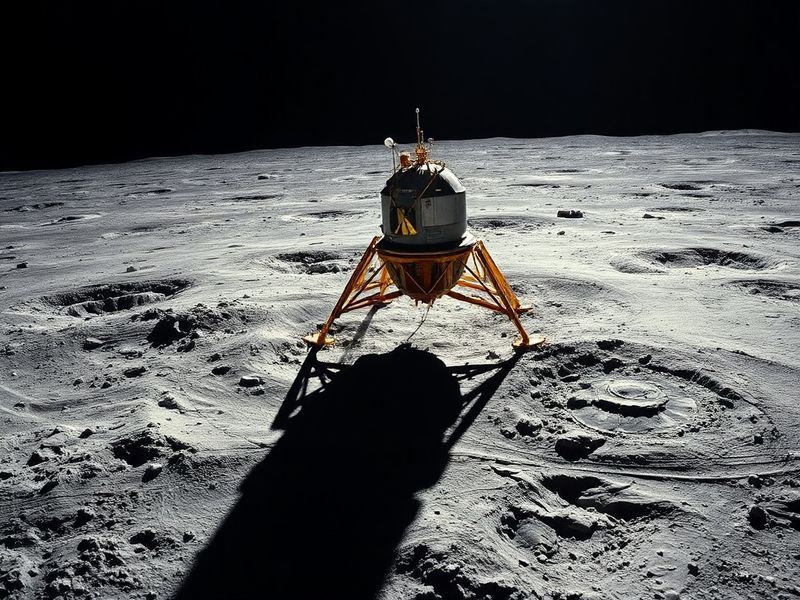
On July 20, 1969, humanity achieved what was once considered impossible. The Apollo 11 mission landed astronauts Neil Armstrong and Buzz Aldrin on the lunar surface while Michael Collins orbited above in the command module. This moment marked not just a victory for NASA but a turning point for all of humanity, proving that the boundaries of exploration extend far beyond our planet.
The mission was the culmination of nearly a decade of relentless effort, scientific innovation, and political determination. It came at a time when the United States and the Soviet Union were locked in a fierce Space Race, each vying for dominance in the cosmos. Apollo 11 wasn’t just about planting a flag—it was about demonstrating technological superiority, scientific prowess, and the indomitable human spirit.
The Road to the Moon: A Race Against Time
President John F. Kennedy set the ambitious goal in 1961: land a man on the Moon and return him safely to Earth before the end of the decade. At the time, the U.S. was still playing catch-up to the Soviets, who had already launched Sputnik and put Yuri Gagarin into orbit. The pressure was immense, and the stakes could not have been higher.
The Apollo program was a massive undertaking, involving over 400,000 engineers, scientists, and technicians. The Saturn V rocket, the most powerful rocket ever built at the time, stood at over 360 feet tall—taller than the Statue of Liberty. Each component, from the guidance systems to the life support modules, had to be meticulously designed and tested. Failures were not an option, and the program’s early years saw setbacks, including the tragic Apollo 1 fire in 1967, which killed three astronauts during a pre-launch test.
Despite the challenges, NASA pressed forward. The program included a series of precursor missions, such as Apollo 8, which became the first crewed mission to orbit the Moon in December 1968. These missions helped refine techniques for navigation, communication, and lunar landing procedures. By the time Apollo 11 launched on July 16, 1969, the world was watching, waiting, and hoping for success.
The Eagle Has Landed: The Lunar Landing
The descent to the lunar surface was one of the most harrowing phases of the mission. As Armstrong and Aldrin piloted the Lunar Module, Eagle, toward the Moon’s surface, alarms blared in the cockpit. The onboard computer was overwhelmed with data, and the astronauts faced the terrifying realization that they were running low on fuel. Mission Control in Houston famously told them, “You’ve got about 60 seconds left,” as the module’s fuel gauge neared critical levels.
With just seconds to spare, Armstrong took manual control of the lander, carefully navigating past a field of boulders to find a suitable landing spot. At 4:17 PM Eastern Time, he radioed the now-iconic words: “Houston, Tranquility Base here. The Eagle has landed.” The relief in Mission Control was palpable, followed by a wave of celebration that rippled across the globe. Millions of people had gathered around televisions and radios, holding their breath as they waited for the next update.
Six hours later, Armstrong descended the ladder and set foot on the Moon, declaring, “That’s one small step for [a] man, one giant leap for mankind.” Aldrin followed, and together they spent 21 hours and 36 minutes on the lunar surface. They collected 21.5 kilograms (47.5 pounds) of Moon rocks, planted the American flag, and deployed scientific experiments, including a seismometer and a laser ranging retroreflector, which is still in use today.
Challenges Faced During the Mission
The Apollo 11 mission was not without its near-disasters. One of the most critical moments came during the ascent from the Moon’s surface. The astronauts discovered that the switch for arming the ascent engine had broken, which could have prevented them from leaving the Moon. Fortunately, Aldrin was able to use a felt-tip pen to activate the switch, a quick-thinking solution that saved the mission.
Upon returning to the command module, the crew faced another potential disaster: the hatch of the lunar module refused to seal properly, risking a loss of pressure. Aldrin had to force the hatch shut, using all his strength to ensure a tight seal. These incidents highlighted the fragility of the mission and the constant vigilance required to ensure success.
Legacy and Impact: Beyond the Moon Landing
The success of Apollo 11 had far-reaching consequences, both for space exploration and for society as a whole. The mission sparked a renewed interest in science and technology, inspiring generations of students to pursue careers in STEM fields. It also fostered international collaboration, as other nations began to develop their own space programs.
Scientifically, the Moon rocks brought back by the Apollo missions provided invaluable insights into the Moon’s origin and the early history of the solar system. The data collected from the experiments left on the lunar surface, such as the seismometer, helped scientists better understand the Moon’s internal structure and seismic activity.
The technological advancements made during the Apollo program also had practical applications on Earth. Innovations in computing, materials science, and telecommunications were spun off into everyday technologies. For example, the integrated circuits developed for the Apollo Guidance Computer laid the groundwork for modern microprocessors, which are now found in everything from smartphones to household appliances.
A Cultural Phenomenon That Transcended Science
Apollo 11 was more than a scientific achievement; it was a cultural milestone. The mission united people around the world, transcending political and geographical boundaries. It was one of the first global events to be broadcast live on television, with an estimated 650 million people—about one-fifth of the world’s population at the time—watching the landing and the first steps on the Moon.
The images and footage from the mission became iconic, embedding themselves in the collective consciousness. Armstrong’s words, Aldrin’s salute to the flag, and the stark beauty of the lunar landscape captured the imagination of millions. The mission also sparked a sense of wonder and possibility, reinforcing the idea that humanity’s potential is limitless.
The Future of Lunar Exploration: Building on Apollo 11
In the decades since Apollo 11, NASA and other space agencies have continued to push the boundaries of lunar exploration. The Artemis program, named after Apollo’s mythological twin sister, aims to return humans to the Moon by 2025, including the first woman and the first person of color. Unlike the Apollo missions, which focused solely on reaching the Moon, Artemis is designed to establish a sustainable human presence on the lunar surface, paving the way for future missions to Mars.
The Artemis program includes several key components:
- Space Launch System (SLS): The most powerful rocket ever built, designed to carry astronauts and cargo to the Moon and beyond.
- Orion spacecraft: A state-of-the-art crew vehicle that will transport astronauts to lunar orbit and back to Earth.
- Lunar Gateway: A small space station orbiting the Moon that will serve as a staging point for lunar landings and deep-space missions.
- Commercial partnerships: NASA is collaborating with companies like SpaceX and Blue Origin to develop lunar landers and other technologies.
These efforts represent a new era of lunar exploration, one that builds on the legacy of Apollo 11 while pushing the boundaries of what is possible. The goal is not just to visit the Moon but to learn how to live and work there sustainably, preparing for the eventual human exploration of Mars.
Why Apollo 11 Still Matters Today
More than five decades after Apollo 11, its significance remains undiminished. The mission was a testament to human ingenuity, perseverance, and the power of collaboration. It reminded us that when we set our minds to a challenge, we can achieve the extraordinary. In an age where skepticism about science and technology sometimes overshadows progress, Apollo 11 stands as a shining example of what humanity can accomplish when we work together toward a common goal.
For those who witnessed it live, Apollo 11 was a defining moment in their lives. For younger generations, it serves as a reminder of the importance of exploration, innovation, and dreaming big. As we look toward the future, the lessons of Apollo 11—resilience in the face of adversity, the importance of scientific inquiry, and the unifying power of shared achievement—remain as relevant as ever.
Whether you’re a space enthusiast, a student of history, or simply someone who appreciates the power of human achievement, Apollo 11 is a story that continues to inspire. It challenges us to ask: What other boundaries can we push? What other frontiers can we explore? The answers may lie in the next giant leap for mankind.
For those interested in exploring more about space exploration and its impact on technology and culture, visit our Technology and Science category pages for further reading.