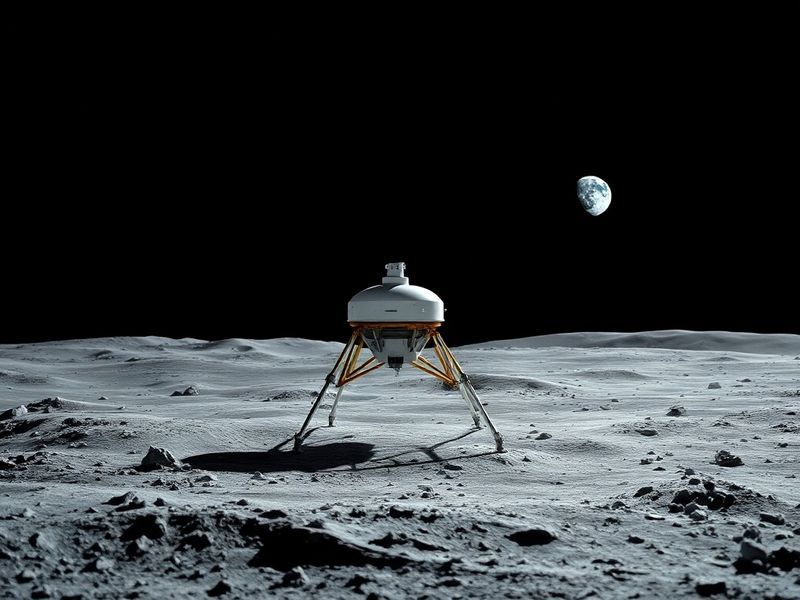
Artemis 3: NASA’s Next Giant Leap to the Moon Explained
“`html
Artemis 3: NASA’s Mission to Return Humans to the Moon
NASA’s Artemis program represents one of the most ambitious undertakings in space exploration since the Apollo missions. With Artemis 3, the agency aims to achieve what hasn’t been done in over five decades: landing humans on the lunar surface, including the first woman and person of color. Scheduled for no earlier than September 2026, this mission will mark humanity’s return to the Moon, but with a focus on sustainability and preparation for future deep-space exploration.
Mission Objectives and Scientific Goals
The primary objective of Artemis 3 is straightforward: land astronauts near the lunar south pole, an area of immense scientific interest due to its permanently shadowed craters that may contain water ice. This mission will carry four astronauts aboard the Orion spacecraft, which will dock with the Starship Human Landing System (HLS) developed by SpaceX for the lunar descent. Two astronauts will then transfer to Starship for the surface mission, while the other two remain in lunar orbit aboard Orion.
Scientific goals include collecting lunar samples, conducting experiments to study the Moon’s geology, and testing technologies that could support future human missions. NASA has identified 13 potential landing regions, each offering unique geological features and scientific value. These sites were chosen based on criteria such as the ability to support a safe landing, proximity to permanently shadowed regions, and the potential to harvest resources like water ice.
The mission will also test new spacesuits developed by Axiom Space, designed for greater mobility and flexibility compared to Apollo-era suits. These suits must withstand the harsh lunar environment while allowing astronauts to perform complex tasks during their six-and-a-half-day surface stay.
Technological Innovations and Challenges
Artemis 3 is not just a repeat of Apollo; it is a leap forward in space technology. The mission relies on several key innovations that set it apart from its predecessors:
- Space Launch System (SLS): NASA’s most powerful rocket ever built, designed to carry the Orion spacecraft and its crew beyond Earth’s orbit. The SLS is a cornerstone of the Artemis program, with the capability to deliver payloads to the Moon in a single launch.
- Starship HLS: SpaceX’s lunar lander, selected by NASA for Artemis 3, will play a critical role in transporting astronauts from lunar orbit to the surface. Starship’s design allows for a spacious interior and the ability to carry significant cargo, including scientific instruments and potential habitat modules for future missions.
- Orion Spacecraft: Equipped with advanced life support systems, Orion is designed for long-duration missions. Its heat shield, capable of withstanding re-entry speeds from lunar distances, ensures the safe return of the crew to Earth.
- Lunar Gateway: While not directly part of Artemis 3, the Lunar Gateway—a small space station orbiting the Moon—will serve as a staging point for future missions. It will provide a platform for scientific research and a waypoint for astronauts traveling to and from the lunar surface.
However, the mission is not without challenges. The development of Starship HLS has faced delays and technical hurdles, raising questions about NASA’s timeline. Additionally, the complexity of coordinating multiple spacecraft, including Orion, Starship, and potential support missions, adds layers of risk. The lunar south pole’s rugged terrain and extreme temperatures also pose significant engineering challenges for both landing and surface operations.
Broader Implications for Space Exploration
Artemis 3 is more than a standalone mission; it is a stepping stone toward broader goals in space exploration. One of its most significant contributions is the establishment of a sustainable human presence on the Moon. By testing technologies and methodologies for resource utilization, such as extracting water ice for drinking water and rocket fuel, NASA aims to reduce dependence on Earth for future missions.
The mission also serves as a testbed for international collaboration. NASA’s Artemis Accords, a set of principles for peaceful and cooperative exploration, have been signed by over 40 countries. These agreements foster collaboration in areas such as lunar science, technology development, and infrastructure sharing. Countries like Canada, Japan, and the European Union are contributing critical components, such as the Canadarm3 robotic arm and the European Service Module for Orion.
Beyond the Moon, Artemis 3 is a precursor to human missions to Mars. The technologies and experiences gained from lunar exploration will inform the design of spacecraft, life support systems, and habitats needed for the long journey to the Red Planet. NASA’s goal of sending humans to Mars in the 2030s or 2040s hinges on the success of Artemis and the lessons learned from these lunar missions.
Public and Scientific Anticipation
The anticipation surrounding Artemis 3 is palpable, not just within the scientific community but also among the general public. This mission represents a new era of space exploration, one that is more inclusive and sustainable. By including the first woman and person of color on the lunar surface, NASA is sending a powerful message about diversity and opportunity in STEM fields.
Scientifically, the mission holds the promise of groundbreaking discoveries. The lunar south pole is a treasure trove of scientific data, offering insights into the Moon’s formation, the history of the solar system, and even the potential for life beyond Earth. The samples collected during Artemis 3 could rewrite our understanding of the Moon and its resources.
For space enthusiasts, the mission offers a rare opportunity to witness history in the making. NASA and its partners are planning extensive media coverage, including live broadcasts of the launch, landing, and surface activities. This transparency ensures that the world can share in the excitement and achievements of Artemis 3.
As the mission approaches, the focus will inevitably shift to preparation and execution. Every detail, from the training of astronauts to the testing of spacecraft, must be meticulously planned. The success of Artemis 3 will not only mark a milestone in space exploration but also set the stage for the next generation of lunar and interplanetary missions.
In the grand tapestry of space exploration, Artemis 3 is a critical thread. It builds on the legacy of Apollo while pushing the boundaries of what is possible. For those watching from Earth, it is a reminder of humanity’s enduring curiosity and ambition—a testament to our ability to reach for the stars.
For more on space exploration and the technologies shaping our future, visit Dave’s Locker Technology or explore Science for deeper insights into the science behind missions like Artemis 3.