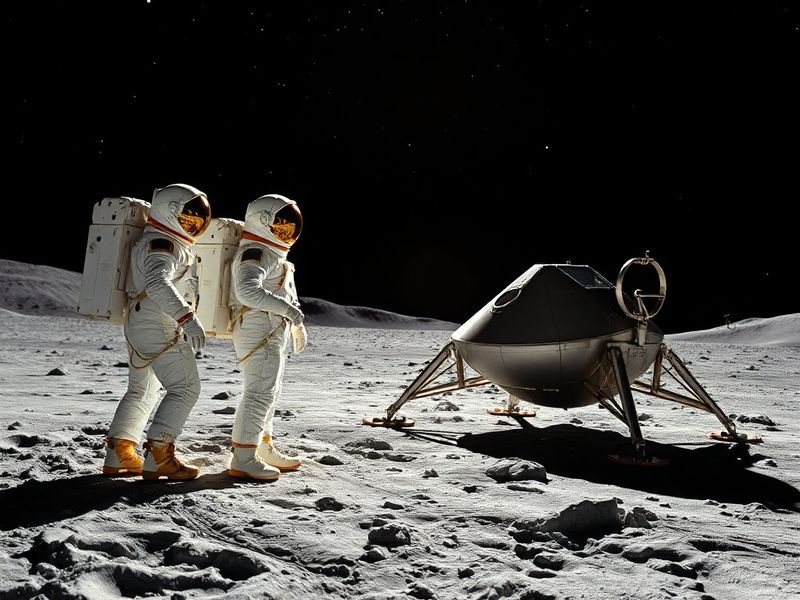
Artemis 3: NASA’s Return to the Moon and Why It Changes Everything
“`html
Artemis 3: The Next Giant Leap for Humanity Beyond Earth
NASA’s Artemis program represents humanity’s most ambitious return to the lunar surface since the Apollo era. At its core, Artemis 3 stands as the mission that will finally place humans back on the Moon—specifically near the lunar South Pole, a region never before visited by astronauts. Scheduled for launch no earlier than September 2026, this mission is not merely a symbolic repeat of history. It is a critical step toward establishing a sustainable human presence on the Moon and laying the groundwork for future voyages to Mars.
The mission’s significance extends beyond national pride or scientific curiosity. Artemis 3 embodies a new era of international collaboration, commercial partnership, and technological innovation. With SpaceX’s Starship selected as the Human Landing System (HLS), the mission will test new capabilities in lunar descent, surface operations, and ascent—each a building block for the Artemis architecture. But the stakes are higher than hardware. This mission will redefine humanity’s relationship with space, influence global space policy, and inspire a generation to look upward with renewed wonder.
The Lunar South Pole: Why This Destination Matters
Unlike the Apollo landings, which targeted equatorial regions, Artemis 3 aims for the lunar South Pole. This choice is driven by science and survival. Permanently shadowed craters in this area are believed to contain water ice—a vital resource for drinking, oxygen production, and rocket fuel. Access to such deposits could reduce the cost of future missions by enabling in-situ resource utilization (ISRU).
Moreover, the South Pole offers unique observational advantages. The Sun remains low on the horizon, casting long, dramatic shadows and offering a perpetual twilight environment. This lighting condition allows for enhanced visibility of surface features and may reveal new insights into the Moon’s geology and formation history.
Exploring this region will also help scientists understand the lunar exosphere and the origins of lunar volatiles—compounds like water, methane, and ammonia that could be key to sustaining long-term human habitats. These findings will not only inform lunar science but also serve as a proving ground for similar operations on Mars, where polar ice deposits may play a similar role.
Technology and Partnerships: The Engine Behind Artemis 3
Artemis 3 is not a solo NASA endeavor. It is a tapestry of public and private collaboration, with partnerships spanning multiple continents and industries. At the forefront is SpaceX, whose Starship HLS—a fully reusable lunar lander—was selected in 2021 after a competitive procurement process. This decision marked a turning point: NASA is now relying on commercial providers to deliver crew to the lunar surface, a model previously untested for human spaceflight.
The mission also integrates international contributions. Canada will provide the Canadarm3 robotic system for the Lunar Gateway, a small space station orbiting the Moon. The European Space Agency (ESA) is developing the ESPRIT and I-HAB modules, while Japan’s JAXA contributes advanced life support and battery systems. These partnerships reflect a global consensus: space exploration is no longer a zero-sum competition but a collaborative venture with shared benefits.
Technologically, Artemis 3 will debut several innovations:
- Advanced Spacesuits: Developed by Axiom Space and Collins Aerospace, these suits are designed for mobility, radiation protection, and life support in the harsh lunar environment.
- Lunar Gateway: A small but critical waypoint in lunar orbit, serving as a command center, science lab, and docking hub for crew and cargo.
- Starship HLS: A two-stage system capable of landing up to 100 metric tons on the Moon, with the ability to refuel in lunar orbit for multiple missions.
- Precision Landing Systems: New terrain-relative navigation and hazard avoidance tools will allow the crew to land safely near the South Pole, where rugged terrain and steep slopes pose challenges.
These systems are not just prototypes—they are operational tools designed to support not just one mission, but a sustainable lunar infrastructure. That’s the long-term vision: turning the Moon into a proving ground for deep space exploration.
Broader Implications: Beyond the Moon and Toward Mars
The impact of Artemis 3 will ripple far beyond the lunar surface. It will shape the future of human spaceflight, influence economic development in low Earth orbit, and redefine international relations in space. One of the most immediate effects will be on the commercial space sector. Companies involved in Artemis—from launch providers like SpaceX and Blue Origin to suit manufacturers and in-space infrastructure firms—are already positioning themselves as leaders in the emerging lunar economy. Investments in lunar mining, tourism, and research could soon follow, creating a new frontier for private enterprise.
From a geopolitical standpoint, Artemis is a strategic counterbalance to China’s lunar ambitions. While NASA emphasizes transparency and cooperation, China’s Chang’e program and planned International Lunar Research Station (ILRS) represent a parallel track. The presence of multiple actors on the Moon increases the risk of competition over resources and landing sites. Artemis 3, therefore, is not just a scientific mission—it’s a statement of intent: the United States and its allies are committed to a rules-based approach to space exploration.
Artemis 3 also has profound cultural implications. It will be the first crewed lunar landing with a woman and a person of color on the crew. This representation matters. It signals to millions around the world that space is accessible to all, not just a privileged few. It also challenges outdated narratives about who belongs in space exploration.
Perhaps most importantly, Artemis 3 is a stepping stone to Mars. Every system tested on the Moon—life support, power generation, habitat design, and human adaptation—will inform the architecture for a crewed mission to the Red Planet. The Moon is not a detour; it is a training ground. And Artemis 3 is the first real test of that training regimen.
What Comes Next: The Roadmap After Artemis 3
Artemis 3 is only the beginning. Following this mission, NASA plans to launch Artemis 4 through Artemis 8, each with increasing complexity and duration. These missions will deliver additional Gateway modules, expand lunar surface habitats, and eventually establish the Artemis Base Camp near the South Pole. The goal is not just to visit the Moon, but to live and work there.
Private companies are also planning their own lunar initiatives. Companies like ispace and Astrobotic are targeting the Moon with robotic landers, while ventures like SpaceX’s dearMoon project aim to send civilian crews on lunar flybys. The commercialization of cislunar space is accelerating, and Artemis 3 will serve as a catalyst for this transformation.
Yet challenges remain. Technical hurdles—such as developing reliable lunar dust mitigation systems and ensuring robust power supplies during the 14-day lunar night—must be overcome. Political continuity is another concern. Space programs span multiple presidential administrations, and funding stability is never guaranteed. Public support, too, must be maintained. The Apollo program benefited from a Cold War-era urgency; Artemis must find its own narrative—one rooted in science, sustainability, and inspiration.
As we look toward 2026, Artemis 3 stands as a beacon of human ambition. It is more than a mission. It is a declaration: humanity is not confined to one planet. It is a reminder that curiosity and courage can still drive us forward, even in an age of division and distraction. And it is a promise—to ourselves and to future generations—that the stars are not out of reach.
We are going back to the Moon. But this time, we are going to stay.
And from there, the journey to Mars begins.
Further Reading and Resources
To learn more about NASA’s lunar exploration efforts and the commercial space industry, visit:
- Technology Section on Dave’s Locker for updates on aerospace innovation and partnerships.
- Science Section for in-depth analysis on planetary science and space exploration.
About the Author
This article was written by a staff journalist at Dave’s Locker, covering the intersection of science, technology, and culture. With a focus on space exploration and innovation, the team provides timely, insightful analysis on the forces shaping our future beyond Earth.