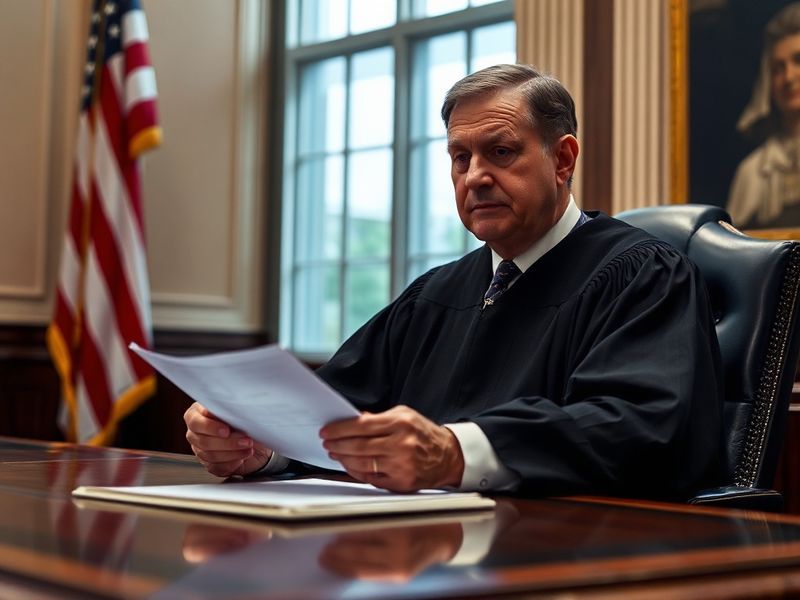
Samuel Alito: How the Supreme Court’s Conservative Justice Shapes U.S. Law
“`html
Samuel Alito: The Supreme Court’s Steadfast Conservative Voice
For over two decades, Justice Samuel Alito has stood as one of the most influential—and polarizing—figures on the United States Supreme Court. His rulings have reshaped American law on issues ranging from abortion to religious liberty, often siding with a strict interpretation of the Constitution. As the Court continues to shape the nation’s legal landscape, Alito’s role remains central to debates over judicial philosophy, political influence, and the future of constitutional rights.
Early Life and Legal Career: A Foundation in Constitutionalism
Born in Trenton, New Jersey, in 1950, Samuel Anthony Alito Jr. grew up in a working-class Italian-American family. His father, a high school teacher, and mother, a school principal, instilled in him a respect for education and public service. Alito attended Princeton University, where he earned both his undergraduate degree and a master’s in public policy, before graduating from Yale Law School in 1975.
His legal career began in earnest as a clerk for Judge Leonard I. Garth on the U.S. Court of Appeals for the Third Circuit. This early exposure to judicial decision-making set the stage for his future approach to the law. Alito later served as a U.S. Attorney in New Jersey and held positions in the Department of Justice under the Reagan administration, where he developed a reputation as a principled conservative lawyer with a deep commitment to originalist and textualist interpretations of the Constitution.
Before his Supreme Court appointment, Alito spent 16 years on the U.S. Court of Appeals for the Third Circuit, where he authored hundreds of opinions. His judicial record during this time revealed a judge who favored limited government intervention, robust protection of individual rights under the Second Amendment, and a skepticism of expansive federal regulatory power. These themes would later define his approach on the nation’s highest court.
Supreme Court Tenure: A Legacy of Judicial Conservatism
Nominated by President George W. Bush in 2005 to replace Justice Sandra Day O’Connor, Alito was confirmed by a 58–42 Senate vote, with several Democratic senators expressing reservations about his conservative record. From the outset, he aligned himself with Justices Antonin Scalia and Clarence Thomas, forming a trio of originalist justices who sought to limit judicial activism and return to constitutional text.
Alito’s jurisprudence has consistently reflected a belief in judicial restraint—though his definition of restraint often prioritizes preserving traditional values over accommodating social change. One of his most consequential opinions came in Dobbs v. Jackson Women’s Health Organization (2022), where he authored the majority decision overturning Roe v. Wade, effectively ending the constitutional right to abortion. The decision was hailed by conservatives as a return to democratic self-governance and condemned by progressives as a rollback of long-standing rights.
Beyond abortion, Alito has played a pivotal role in cases involving religious liberty. In Burwell v. Hobby Lobby (2014), he joined the majority in ruling that closely held corporations could refuse to provide contraceptive coverage under the Affordable Care Act if it conflicted with their religious beliefs. More recently, in Kennedy v. Bremerton School District (2022), he authored the majority opinion supporting a high school football coach’s right to pray on the field after games, reinforcing protections for public expression of faith.
His opinions often draw on historical context, referencing the Founders’ intent and early American legal traditions. Critics argue that this approach can lead to overly narrow interpretations that disregard modern social realities. Supporters, however, praise his commitment to textual fidelity and his rejection of what he sees as judicial overreach.
Key Legal Positions of Samuel Alito
- Abortion: Overturned Roe v. Wade in Dobbs, returning abortion regulation to the states.
- Religious Liberty: Expanded protections for religious expression in public spaces and institutions.
- Second Amendment: Supported broad interpretations of gun rights in cases like New York State Rifle & Pistol Association v. Bruen (2022).
- Executive Power: Upheld limits on federal agency authority, favoring judicial review over deference to agencies.
- Free Speech: Defended expansive protections for speech, including controversial or offensive expression.
Controversies and Public Perception: A Polarizing Figure
Alito’s judicial record has made him a lightning rod in national debates. His dissent in Obergefell v. Hodges (2015), which legalized same-sex marriage nationwide, revealed his skepticism of judicial expansion of rights not explicitly enumerated in the Constitution. He wrote that the decision “sacrificed democratic debate for judicial fiat,” a stance that drew both praise and condemnation.
Beyond his rulings, Alito has faced scrutiny for extrajudicial activities. In 2020, it was revealed that he and his wife had attended a dinner hosted by Leonard Leo, a prominent conservative activist who had helped shape the Court’s conservative majority. The event raised questions about judicial ethics and potential conflicts of interest, though Alito maintained that the gathering was purely social.
His majority opinion in Dobbs also sparked widespread protests and international criticism, with some accusing the Court of imposing a theocratic agenda. Alito responded to these claims by emphasizing the Court’s role in interpreting the law, not legislating morality. “We cannot allow our decisions to be influenced by popular opinion,” he wrote in a 2022 concurrence, “nor can we surrender to the temptation to rewrite the Constitution to suit the preferences of the moment.”
The Broader Implications: What Alito’s Legacy Means for the Court
Alito’s influence extends far beyond individual cases. His judicial philosophy has helped shift the Court’s center of gravity toward a more conservative, originalist framework—one that prioritizes the text of the Constitution, the original understanding of its clauses, and skepticism of unenumerated rights. This approach has emboldened state legislatures to pass restrictive abortion laws, challenged federal regulatory authority, and redefined the boundaries of religious expression in public life.
Yet, his legacy is not without consequence. Critics argue that his jurisprudence has contributed to a perception of the Court as an increasingly politicized institution, eroding public trust. Polls consistently show that Americans’ confidence in the Supreme Court has declined in recent years, with many attributing this erosion to decisions perceived as partisan rather than principled.
Alito, however, remains undeterred. In a rare public speech in 2023, he defended the Court against accusations of politicization, stating, “Judges are not politicians in robes. We do not decide cases based on policy preferences or partisan loyalty. We decide based on the law.” Whether this defense resonates with the American public remains an open question as the Court continues to hear contentious cases on issues like affirmative action, voting rights, and LGBTQ+ protections.
As the Court’s conservative supermajority solidifies, Alito’s role as a stabilizing force within that bloc ensures his continued significance. His opinions will likely shape constitutional law for decades, influencing how future generations interpret the balance of power between the federal government, states, and individual rights. For supporters, he is a guardian of the Constitution’s original meaning. For critics, he is a symbol of a judiciary increasingly out of step with modern values.
What is certain is that Samuel Alito’s place in American legal history is already secure. Whether that place is celebrated or condemned will depend on the evolving priorities of a nation still grappling with the meaning of liberty, equality, and justice under law.
For those interested in further analysis of judicial trends and Supreme Court dynamics, visit our News and Analysis sections for deeper coverage of legal and political developments.