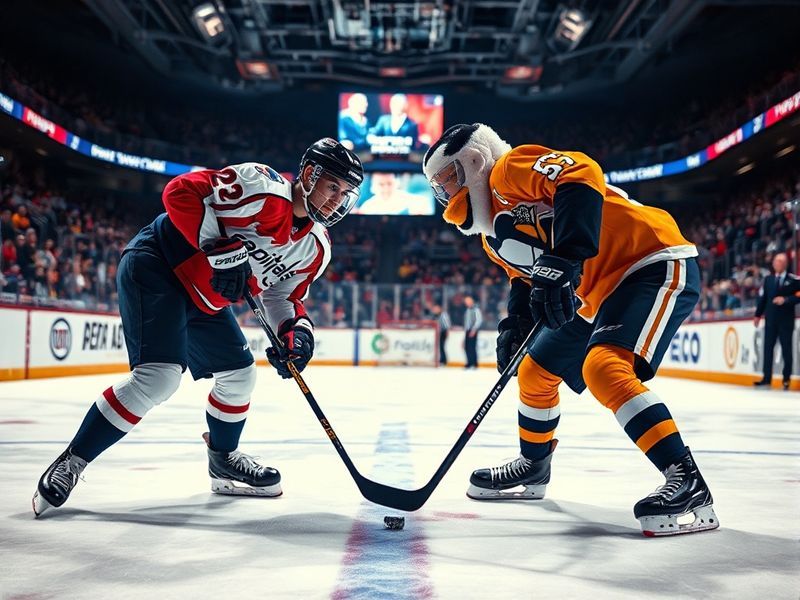
The Pittsburgh Penguins and Washington Capitals have forged one of the most compelling rivalries in modern NHL history. Over the past two decades, these two teams have clashed in high-stakes playoff series, traded iconic players, and delivered unforgettable moments that resonate with hockey fans. What began as a regional competition quickly evolved into a battle of philosophies, star power, and championship pedigrees.
The rivalry transcends mere competition. It represents the evolution of hockey strategy, the influence of generational talent, and the shifting dynamics of the league itself. From Sidney Crosby and Alex Ovechkin’s personal duel to the tactical battles between coaches, every chapter of this rivalry has added depth to the NHL’s narrative.
The Origins of a Modern Classic
The Penguins and Capitals first met in the playoffs in 1992, a meeting that set the tone for future battles. Washington stunned Pittsburgh in a first-round upset, a result that stung for a Penguins team on its way to a second Stanley Cup. That series planted the seeds for a rivalry that would mature alongside two of the league’s most talented draft classes.
By the 2000s, the rivalry had intensified. The Penguins, powered by Mario Lemieux and later Sidney Crosby, and the Capitals, led by Alexander Ovechkin, became annual contenders. Their playoff clashes in 2009, 2016, and 2017 were dramatic, physical, and often decided by overtime goals or controversial calls. These series weren’t just about winning—they were about establishing dominance in the Eastern Conference.
What makes this rivalry unique is its symmetry. Both franchises entered the 2000s with high expectations but inconsistent results. The Penguins overcame adversity with Crosby’s arrival and a core that included Evgeni Malkin and Kris Letang. The Capitals, meanwhile, endured years of playoff frustration before breaking through with Ovechkin and Nicklas Backstrom leading a resurgent squad.
Key Moments That Shaped the Rivalry
Several games and moments stand out in the Penguins-Capitals timeline. These encounters weren’t just contests on ice—they were turning points in both franchises’ histories.
- 2009 Eastern Conference Semifinals: The Capitals, fresh off a Presidents’ Trophy, were heavy favorites. But Pittsburgh, led by Crosby and Malkin, eliminated Washington in seven games. The series featured a 6–2 Capitals win in Game 1, only for the Penguins to respond with three straight victories.
- 2016 Second Round: The Capitals finally exorcised playoff demons by beating Pittsburgh in six games. Ovechkin scored a crucial goal in Game 6 to clinch the series, a moment that felt like vindication for a franchise long dismissed in big moments.
- 2017 Second Round: Pittsburgh answered emphatically. After dropping Game 1 at home, the Penguins stormed back with five straight wins, including a 6–2 dismantling in Game 6. Crosby’s performance, particularly in the face of heavy pressure, reaffirmed his status as a clutch playoff performer.
- 2018 Regular Season Showdown: In a neutral-site game in Pittsburgh, the Capitals and Penguins delivered one of the most physical games in recent memory. Ovechkin and Pittsburgh’s Tom Kuhnhackl were ejected after a line brawl, underscoring the intense emotions between the teams.
These moments weren’t just about wins and losses. They were about identity. For Pittsburgh, beating Washington reinforced its championship culture. For Washington, defeating Pittsburgh became a rite of passage. The rivalry became a measuring stick: if you could beat the other team, you belonged among the league’s elite.
The Star Power and Legacy
This rivalry has been defined by generational talent. Sidney Crosby and Alex Ovechkin entered the league in the same draft class (2004) and have been the faces of their respective franchises ever since. Their individual battles—Crosby the cerebral playmaker, Ovechkin the explosive goal-scorer—became a focal point for fans and media alike.
Beyond the two superstars, the rivalry has featured other All-Stars. Evgeni Malkin, Marc-André Fleury, Phil Kessel, and Letang formed the core of Pittsburgh’s 2016 and 2017 Cup runs. On Washington’s side, Backstrom, T.J. Oshie, and Braden Holtby played pivotal roles in the Capitals’ breakthrough seasons.
The rivalry also highlights different approaches to building a champion. Pittsburgh’s success came through a mix of drafting, development, and veteran savvy. The Penguins thrived under coaches like Dan Bylsma and Mike Sullivan, who emphasized speed, skill, and adaptability. Washington, meanwhile, relied on a more structured, defensive system under Barry Trotz, which culminated in their 2018 Stanley Cup victory.
This contrast in styles added another layer to the rivalry. It wasn’t just about star power—it was about philosophy. Could skill and creativity overcome structure and discipline? The playoffs often provided the answer.
The Rivalry’s Broader Impact
The Penguins vs. Capitals rivalry has influenced the NHL in several ways. First, it helped popularize the sport in non-traditional markets. Pittsburgh and Washington were not classic hockey markets, but the intensity of their rivalry drew national attention and expanded the league’s fanbase.
Second, the rivalry showcased the importance of drafting and player development. Both franchises invested heavily in their youth systems, proving that sustained success could be built from within. Pittsburgh’s core of Crosby, Malkin, and Letang became a model for other teams. Washington’s ability to surround Ovechkin with complementary talent demonstrated the value of roster construction.
Third, the rivalry influenced how the NHL structures its regular season and playoffs. The league recognized the appeal of marquee matchups and began scheduling more frequent showdowns between top teams. The Penguins and Capitals often met multiple times in a season, turning regular-season games into de facto playoff previews.
Finally, the rivalry highlighted the role of analytics in hockey. Pittsburgh was an early adopter of advanced metrics, using data to optimize line combinations and defensive pairings. Washington later embraced analytics under Trotz, showing how modern hockey could blend tradition with innovation.
A Rivalry That Lives On
Even as Crosby and Ovechkin age, the Penguins vs. Capitals rivalry remains relevant. New stars have emerged on both sides—players like Jake Guentzel, Evgeni Kuznetsov, and Alex Tuch have carried the torch forward. The intensity may have shifted from generational duels to tactical chess matches, but the stakes remain high.
The NHL continues to evolve, but some rivalries endure because of their history and cultural significance. The Penguins and Capitals embody that principle. Their battles have given fans unforgettable moments, from overtime thrillers to series-clinching goals. They’ve shaped the careers of some of hockey’s greatest players and defined eras in the league.
For fans, the rivalry is more than just a storyline—it’s a tradition. It’s a reminder of why hockey matters: the passion, the competition, and the moments that transcend the game. Whether it’s a regular-season tilt or a playoff showdown, Penguins vs. Capitals is always must-watch hockey.
As long as both franchises remain competitive, the rivalry will continue to thrive. And for hockey fans, that’s something to celebrate.
For more on the NHL’s evolving landscape, visit our Sports section. To explore deeper analysis of team strategies and player performances, check out Analysis.