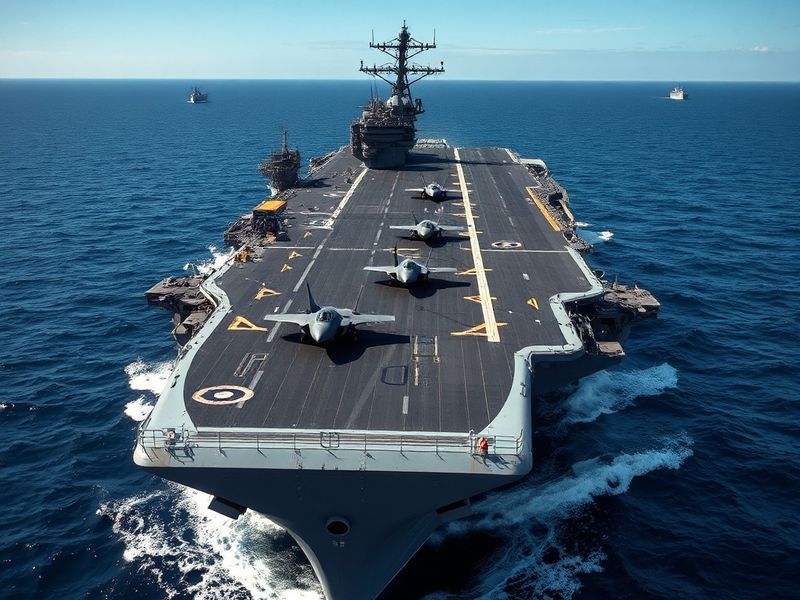
The USS Gerald R. Ford (CVN-78) represents a leap forward in naval aviation and power projection. Commissioned in 2017 after a decade of development, this next-generation aircraft carrier embodies cutting-edge technology and strategic vision. More than just a ship, it’s a floating city designed to dominate the seas for decades.
At nearly 1,106 feet long and displacing over 100,000 tons, the Ford-class carrier is the largest warship ever built by the United States. Its advanced systems promise greater efficiency, reduced crew requirements, and unmatched combat capability. Yet, its journey from concept to deployment has been marked by challenges, innovations, and implications for global naval power.
Design and Technology: A Revolution at Sea
The Ford’s design prioritizes automation and efficiency. Its Electromagnetic Aircraft Launch System (EMALS) replaces traditional steam catapults, enabling smoother, more precise launches for a wider range of aircraft. This system also reduces maintenance demands compared to older carriers.
Another standout feature is the Advanced Arresting Gear (AAG), which uses energy-absorbing water turbines to recover aircraft more gently and efficiently. These upgrades aim to increase sortie rates—the number of flights per day—by nearly 33% compared to the Nimitz-class carriers.
The Ford also incorporates a new Dual Band Radar (DBR) system, combining X-band and S-band frequencies for enhanced tracking and targeting. Its island superstructure is smaller and more streamlined, improving visibility and reducing radar cross-section.
Key technological advancements include:
- EMALS and AAG: Faster, more flexible aircraft operations with less wear and tear.
- Improved electrical systems: Designed for future energy needs, including directed-energy weapons.
- Advanced weapons elevators: Faster ordnance movement to support sustained combat operations.
- Increased automation: Reduces crew size while improving operational reliability.
Operational Capabilities and Strategic Role
The Ford’s primary mission remains power projection. With the ability to carry up to 75 aircraft—including F-35C Lightning IIs, E-2D Advanced Hawkeyes, and unmanned systems—it serves as a mobile airbase capable of influencing events across vast oceanic regions.
Its endurance is another critical advantage. The ship can operate for 25 years without refueling, thanks to its Bechtel A1B nuclear reactors. This endurance allows for extended deployments in contested environments, such as the South China Sea or the Arctic.
Moreover, the Ford-class is designed with future upgrades in mind. Its modular architecture enables rapid integration of new technologies, from hypersonic missiles to AI-driven command systems. This adaptability ensures the carrier remains relevant in an era of rapidly evolving threats.
Its role extends beyond combat. The Ford can serve as a diplomatic tool, a floating hospital, or a platform for humanitarian missions. During the COVID-19 pandemic, the USS Nimitz (a Nimitz-class carrier) was deployed to support medical response efforts—a role the Ford could fulfill with even greater efficiency.
Challenges and Delays: The Cost of Innovation
The Ford’s development has not been without controversy. Originally estimated at $10.5 billion, the ship’s final cost ballooned to over $13 billion due to design changes, construction delays, and testing setbacks. These overruns have sparked debates about defense spending and procurement efficiency.
Technical challenges emerged early. The EMALS system, for instance, faced reliability issues during testing, raising concerns about its operational readiness. Similarly, the advanced weapons elevators—originally intended to be fully automated—required extensive manual intervention, undermining one of the design’s key selling points.
The Government Accountability Office (GAO) has highlighted these issues, noting that the Ford’s full operational capability was delayed until at least 2024. Critics argue that the Navy prioritized innovation over reliability, risking the ship’s effectiveness in high-stakes scenarios.
Yet, defenders of the program point to long-term benefits. They argue that the Ford’s advanced systems will reduce lifecycle costs by cutting crew demands and maintenance needs. Over the ship’s 50-year lifespan, these savings could offset the initial investment.
Broader Implications: Shaping the Future of Naval Warfare
The USS Gerald R. Ford is more than a single vessel—it’s a symbol of America’s commitment to maintaining naval dominance. As China rapidly expands its carrier fleet and Russia modernizes its navy, the Ford-class ensures the U.S. retains a decisive edge.
Its introduction also reflects a shift in naval strategy. The Ford is optimized for distributed lethality—a concept prioritizing smaller, more agile strike groups over massive, concentrated fleets. This approach complicates adversaries’ targeting calculations while enhancing operational flexibility.
The carrier’s electromagnetic systems point toward a future where fleets are powered by directed-energy weapons and AI-driven decision-making. The Ford’s electrical grid is designed to support these technologies, positioning it as a testbed for the next generation of naval warfare.
Internationally, the Ford’s deployment sends a clear message. It reassures allies like Japan and South Korea while deterring aggression in critical regions. Its presence in the Mediterranean or the Indo-Pacific signals U.S. resolve to defend global stability.
For defense contractors, the Ford-class program is a financial boon. Companies like Huntington Ingalls Industries and General Atomics have secured lucrative contracts, while smaller firms contribute specialized components. This industrial base is vital for sustaining U.S. naval superiority.
Conclusion: A Stepping Stone to the Future
The USS Gerald R. Ford stands as a testament to American engineering and strategic foresight. While its development has faced setbacks, its potential to revolutionize naval operations is undeniable. As the lead ship of its class, it will pave the way for future carriers, ensuring the U.S. Navy remains unmatched for decades.
Its success or failure will influence defense budgets, technological innovation, and global power dynamics. For now, the Ford sails as both a marvel of modern engineering and a reminder of the complexities of military modernization.
As the world’s geopolitical landscape shifts, the Ford-class carriers will play a pivotal role in shaping the balance of power. Their story is still being written—and the next chapter may redefine naval warfare itself.
For more insights into military technology and defense innovations, visit Dave’s Locker News or explore Dave’s Locker Technology.