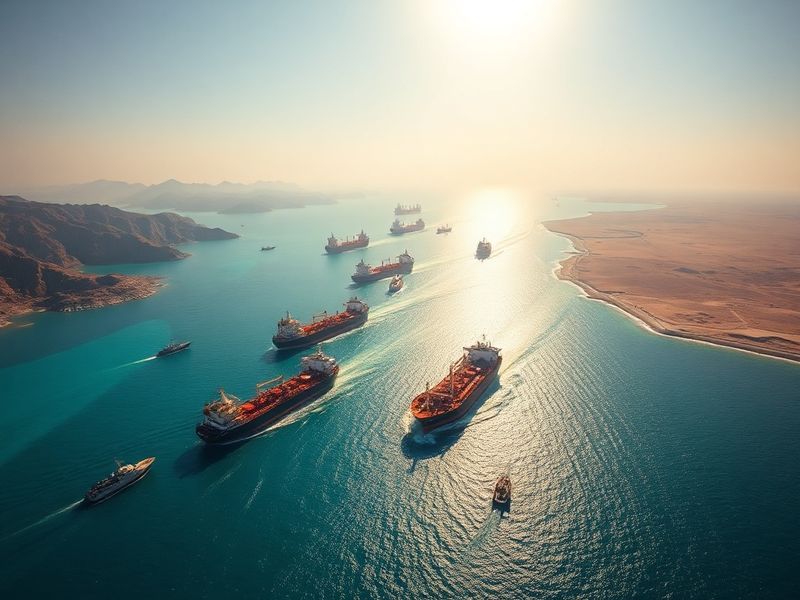
The Strait of Hormuz: A Global Chokepoint Shaping Geopolitics and Trade
The Strait of Hormuz is one of the world’s most strategically critical maritime passages, connecting the Persian Gulf to the Gulf of Oman and, ultimately, the Arabian Sea. Roughly 21 miles wide at its narrowest point, this narrow waterway serves as a vital transit route for nearly one-third of the world’s seaborne oil shipments. Its significance extends beyond energy markets, influencing military strategies, diplomatic tensions, and regional stability. For countries in the Middle East and beyond, control over this chokepoint has long been a source of both opportunity and conflict.
The strait’s geography alone makes it a natural flashpoint. With just two lanes of traffic—one in each direction—any disruption in this passage can send shockwaves through global supply chains. Historically, the Hormuz region has been a crossroads of empires, from ancient Persian and Arab civilizations to European colonial powers and modern nation-states. Today, its role in the global economy ensures that it remains a focal point in international relations, particularly as energy demand continues to rise in Asia and beyond.
The Historical and Economic Weight of Hormuz
The Strait of Hormuz has been a linchpin of trade for millennia. Ancient trade routes between Mesopotamia, India, and the Mediterranean passed through these waters, carrying spices, textiles, and precious metals. The strait’s name itself derives from the Persian term “Hormuz,” referring to the Zoroastrian god Ahura Mazda, reflecting the region’s deep historical ties to Persia.
In modern times, the strait’s economic importance grew exponentially with the discovery of oil in the Persian Gulf in the early 20th century. By the 1970s, the Hormuz route became the primary conduit for Middle Eastern oil exports, especially after the closure of the Suez Canal during regional conflicts. Today, more than 20 million barrels of oil pass through the strait daily, making it the world’s most critical oil transit chokepoint. Disruptions here, whether due to military conflict, piracy, or political tensions, can trigger price volatility in global energy markets and force costly rerouting of ships.
Beyond oil, the strait is a conduit for liquefied natural gas (LNG) exports from Qatar, the world’s largest LNG producer. The Hormuz route is equally vital for nations like Japan, South Korea, and China, which rely heavily on Middle Eastern energy imports. Any prolonged closure or obstruction of the strait would force these countries to seek alternative suppliers, often at higher costs and longer distances. For example, rerouting around the Cape of Good Hope in Africa adds weeks to shipping times and significantly increases operational expenses.
Geopolitical Tensions and Military Posturing
The Strait of Hormuz sits at the heart of a geopolitical tug-of-war. Iran, which shares the northern coast of the strait, has long asserted its influence over these waters, a stance reinforced by decades of regional conflict and sanctions. The 1980s Iran-Iraq War saw frequent attacks on oil tankers transiting the strait, while the 2019 attacks on Saudi oil facilities and the 2021 tanker seizures highlighted the ongoing volatility in the region.
Iran has repeatedly threatened to close the strait in response to sanctions or perceived aggression, most notably during the “Tanker Wars” of the 1980s and more recently amid tensions with the United States. The Islamic Revolutionary Guard Corps (IRGC) has demonstrated its ability to disrupt shipping through missile strikes, drone attacks, and the deployment of naval forces. In 2019, Iran’s seizure of the British-flagged tanker Stena Impero underscored its willingness to use the strait as a tool of coercion.
International responses have varied. The United States maintains a military presence in the region, including the Fifth Fleet based in Bahrain, to ensure the free flow of commerce. However, this presence has often exacerbated tensions. Regional allies, such as Saudi Arabia and the United Arab Emirates, have invested in alternative pipelines and expanded their own naval capabilities to reduce reliance on the Hormuz route. Meanwhile, China and Russia have sought to deepen their influence in the region through economic partnerships and military cooperation with Iran.
The strategic calculus in the Hormuz region is further complicated by proxy conflicts. The rivalry between Saudi Arabia and Iran plays out in Yemen, Syria, and Lebanon, with each side leveraging its regional alliances to challenge the other’s dominance. The strait, therefore, is not just a geographic feature but a battleground for competing visions of Middle Eastern order.
Environmental and Humanitarian Concerns
While the Strait of Hormuz is often discussed in terms of geopolitics and economics, its environmental and humanitarian impacts are equally pressing. The region’s marine ecosystem is fragile, yet heavily stressed by decades of industrial activity, including oil spills, ballast water discharge, and coastal development. The 1991 Gulf War’s deliberate oil spills and the ongoing risk of accidents pose existential threats to marine life, including endangered species like the hawksbill turtle and dugong.
Humanitarian concerns also loom large. The strait’s waters are a critical route for food and medical supplies to countries like Yemen, which has faced severe shortages due to blockades and conflict. In 2015, the Saudi-led coalition’s blockade of Yemeni ports, including those near the strait, contributed to one of the world’s worst humanitarian crises, with millions facing famine and disease. The strait’s instability thus has direct consequences for civilian populations, far beyond the realm of energy and trade.
Efforts to mitigate these risks have been limited. Regional cooperation on environmental protection remains weak, and the lack of a unified maritime security framework leaves the strait vulnerable to both deliberate harm and accidental damage. International organizations, including the United Nations, have called for greater oversight, but geopolitical divisions often stall progress.
Navigating the Future: Diplomacy and Innovation
The future of the Strait of Hormuz will be shaped by three key factors: diplomacy, technological innovation, and shifting global energy dynamics. Diplomatic efforts to de-escalate tensions have so far yielded mixed results. The 2015 nuclear deal (JCPOA) provided a temporary respite, but its collapse in 2018 and the subsequent reimposition of sanctions have pushed Iran and Western powers back into confrontation. Meanwhile, regional initiatives like the 2023 Saudi-Iranian détente offer a glimmer of hope, though their durability remains uncertain.
Technological advancements may also reduce the strait’s dominance in global trade. The rise of renewable energy and the expansion of LNG export terminals outside the Middle East could diminish the region’s energy leverage. Countries like the United States and Australia are ramping up their LNG production, while Europe’s push for energy diversification post-Ukraine war further erodes the strait’s monopoly. Still, for the foreseeable future, oil and gas from the Persian Gulf will remain indispensable to global markets.
Innovation in shipping and logistics could also alleviate some pressure on the strait. The development of Arctic shipping routes, though currently limited by ice and infrastructure, offers a potential alternative for some cargoes. Similarly, the expansion of pipelines, such as the UAE’s Habshan-Fujairah route, bypasses the strait entirely for certain exports. However, these solutions are costly and politically sensitive, often requiring cross-border agreements that are difficult to secure.
For now, the Strait of Hormuz remains a paradox—a lifeline for the global economy and a powder keg of geopolitical tension. Its stability depends on the delicate balance of power among regional actors, the policies of external powers, and the ability of nations to cooperate on shared challenges. As energy transitions unfold and new trade routes emerge, the strait’s role may evolve, but its importance is unlikely to fade entirely.
The challenges ahead are monumental. Diplomacy must take precedence over military posturing, environmental protections must be prioritized, and economic diversification should be encouraged. Without these steps, the strait will continue to be a flashpoint, with consequences that ripple across the globe. For policymakers, industry leaders, and citizens alike, understanding the Strait of Hormuz is not just about grasping a geographic reality—it’s about confronting the complexities of a world deeply interconnected yet persistently divided.