Istanbul Airport: A New Global Gateway Rewriting Travel Narratives
Perched on the western edge of the Black Sea coast, Istanbul Airport isn’t just another transit point—it’s a statement. Since its inauguration in 2018, the facility has swiftly risen to become one of the world’s busiest aviation hubs, reshaping how travelers connect between Europe, Asia, and beyond. With its sleek design, cutting-edge infrastructure, and strategic location, the airport stands as a symbol of Turkey’s ambition to reclaim its historic role as a bridge between continents.
The airport’s origins trace back to a decision to replace the aging Ataturk Airport, which had reached full capacity. Designed by a consortium including Architectural Review’s 2019 award-winning team, the new terminal spans over 1.4 million square meters—an area larger than 200 football fields. Its six runways and annual capacity of 200 million passengers position it as a key player in global aviation, challenging long-standing hubs like Dubai and Frankfurt.
A Modern Marvel of Engineering and Design
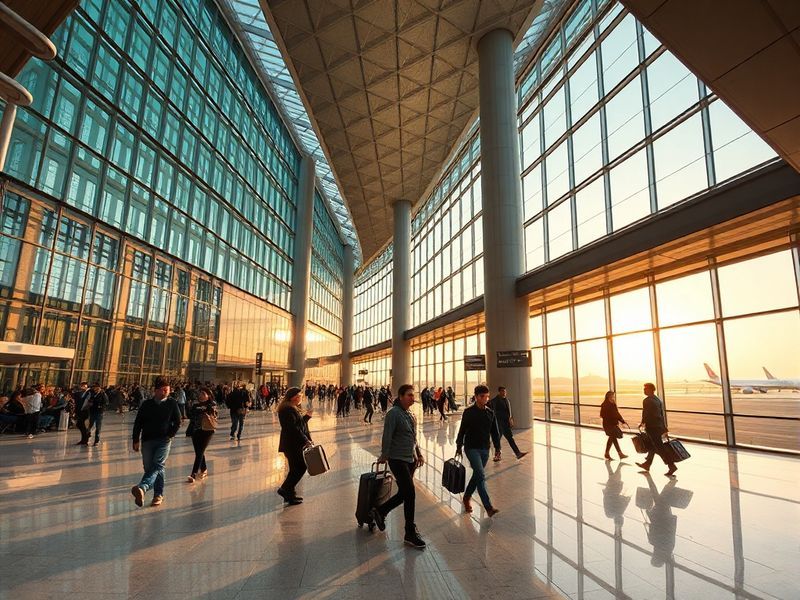
Walking through the main terminal, travelers are greeted by an expansive, light-filled atrium crowned by a soaring vaulted ceiling. The structure blends Ottoman architectural motifs with contemporary minimalism, creating a space that feels both grand and accessible. Natural light floods the interior through vast glass panels, reducing energy dependency and reinforcing the airport’s commitment to sustainability—an increasingly critical factor in global infrastructure.
Beyond aesthetics, functionality drives every aspect of the design. The airport operates with a fully automated baggage handling system capable of processing 40,000 bags per hour. Its smart infrastructure integrates AI-driven passenger flow analytics to reduce wait times, while free high-speed Wi-Fi and over 3,000 charging stations ensure connectivity remains uninterrupted. These features reflect a forward-thinking approach that prioritizes both efficiency and user experience.
The airport’s layout is intuitive, organized into four main concourses: A, B, D, and G. Each serves distinct regions—Europe, the Americas, Africa, and Asia—streamlining connections between long-haul flights. This zonal design minimizes transit times, a critical advantage for business travelers and tourists alike. The airport’s remote pier, accessible via a 250-meter-long automated passenger bridge, further enhances operational flexibility and passenger comfort.
More Than a Transit Hub: Economic and Cultural Impact
Istanbul Airport is a catalyst for economic growth, both locally and globally. According to the Turkish Ministry of Transport, the airport contributed over $3.5 billion to the national economy in its first two years of operation. Its cargo operations, which handle more than 500,000 tons annually, strengthen Turkey’s position as a logistics leader, particularly for perishable goods moving between Asia and Europe.
The airport’s influence extends into tourism, where it serves as a gateway to Istanbul’s cultural treasures. Visitors often arrive with just a few hours to spare, using the airport’s proximity to the city center—just 35 kilometers away via the new Istanbul Airport Metro—to glimpse landmarks like the Hagia Sophia or Topkapi Palace. For many, the airport itself becomes part of the journey, with its observation deck offering panoramic views of planes landing against the backdrop of the Bosphorus.
Culturally, the airport reflects Turkey’s evolving identity. While rooted in tradition, its global connectivity fosters cross-cultural exchanges. The terminal hosts exhibitions featuring Turkish art, live music performances, and culinary events showcasing regional cuisine. These initiatives not only enhance the passenger experience but also project Turkish culture onto the world stage.
Challenges and Controversies in a Growing Giant
Despite its achievements, Istanbul Airport has faced scrutiny. Environmental groups have raised concerns about its proximity to the Black Sea, citing potential ecological risks from construction and increased air traffic. The airport’s expansion plans, including a third runway and additional terminals, have sparked debates over sustainability and urban planning.
Labor issues have also emerged. The airport employs over 20,000 staff, many of whom are subcontractors. Reports of low wages and poor working conditions have led to strikes, highlighting the human cost behind its operational success. These challenges underscore the complexities of balancing rapid growth with social responsibility.
Geopolitical tensions have occasionally disrupted operations. In 2020, a temporary shutdown due to a dispute over airspace with Greece tested the airport’s resilience. Such incidents reveal the vulnerabilities of relying on a single hub for such a vast network of routes. Diversification efforts, including partnerships with other regional airports, are now underway to mitigate these risks.
A Model for Future Airports Worldwide
Istanbul Airport’s success offers lessons for other global hubs. Its integration of smart technology, passenger-centric design, and multi-modal connectivity sets a new standard. Airports like Changi in Singapore and Hamad in Doha are taking notes, particularly in areas like automation and sustainability.
For travelers, the airport represents more than a stopover—it’s an experience. Whether it’s sampling Turkish delight at a duty-free shop, exploring the local culture through art installations, or simply marveling at the scale of its operations, Istanbul Airport transforms transit into an event of its own. As global travel continues to evolve, this Turkish gateway stands ready to welcome the next chapter of aviation history.
With ambitious expansion plans on the horizon, including a proposed second airport on the Asian side, Istanbul is poised to solidify its role as the crossroads of the world. For now, it remains a testament to what happens when ambition meets innovation—on the ground and in the skies.