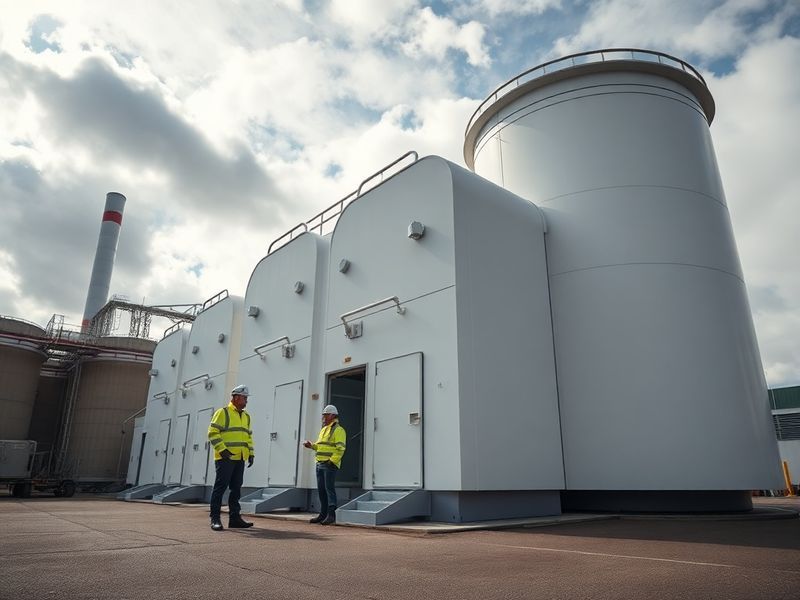
The Rolls-Royce Small Modular Reactor (SMR) represents one of the most ambitious projects in modern nuclear energy. Designed to address the growing demand for low-carbon power, this technology could redefine how nations approach energy security and sustainability. Unlike traditional nuclear plants, which require massive infrastructure and decades-long development timelines, Rolls-Royce’s SMR promises a more flexible, scalable solution.
At its core, the SMR is a compact nuclear reactor that generates around 470 megawatts of electricity—enough to power a city of 1 million people. What sets it apart is its modular design, allowing components to be factory-built and transported to sites for rapid assembly. This approach significantly reduces costs and construction time, making nuclear energy more accessible to governments and private investors alike.
How the Rolls-Royce SMR Works
The SMR’s design leverages decades of nuclear engineering expertise while incorporating modern innovations. Each module is roughly the size of a football field, housing a pressurized water reactor that operates at high efficiency. The reactor’s core uses conventional uranium fuel, but its compact size allows for passive safety systems—meaning it can shut down safely without relying on external power or human intervention.
A key feature of the SMR is its ability to scale. Multiple modules can be combined to meet varying energy demands, whether for a single industrial facility or a regional grid. This scalability makes it an attractive option for countries looking to diversify their energy mix without committing to a full-scale nuclear plant.
Rolls-Royce has emphasized the reactor’s economic viability, estimating that each SMR could be built for approximately £2.2 billion—a fraction of the cost of traditional nuclear projects. The company also highlights the potential for job creation, with thousands of roles expected in manufacturing, engineering, and plant operation.
Challenges and Controversies
Despite its promise, the Rolls-Royce SMR faces significant hurdles. Nuclear energy remains a polarizing topic, with critics raising concerns about safety, waste disposal, and the long-term financial viability of new projects. The UK government, for instance, has yet to commit fully to the SMR, leaving its future uncertain.
Another challenge is public perception. Decades of anti-nuclear sentiment, fueled by incidents like Chernobyl and Fukushima, have made communities wary of new reactors. Rolls-Royce is investing in public engagement campaigns to address these concerns, emphasizing the SMR’s advanced safety features and strict regulatory oversight.
Financing is also a critical issue. While the modular approach reduces upfront costs, securing investment for nuclear projects remains difficult due to the perceived risks. Rolls-Royce is exploring partnerships with governments and private investors to share the financial burden, but progress has been slow.
Global Implications and Competition
The Rolls-Royce SMR is not alone in the race to develop small modular reactors. The United States, Canada, and China are all advancing their own SMR designs, each with unique technical and economic advantages. For the UK, leading in this space could position it as a global hub for nuclear innovation, boosting exports and technological leadership.
In Europe, where energy security is a growing concern, the SMR could play a crucial role in reducing dependence on fossil fuels. The European Union has included nuclear energy in its sustainable finance taxonomy, signaling a potential shift in policy toward low-carbon alternatives. Rolls-Royce is positioning the SMR as a key player in this transition.
However, competition is fierce. NuScale Power, a US-based company, has already received regulatory approval for its SMR design, while China’s state-owned nuclear firms are rapidly scaling up their own modular reactors. Rolls-Royce must demonstrate not just technical superiority but also cost competitiveness to stay ahead.
What’s Next for the Rolls-Royce SMR?
The coming years will be decisive for the Rolls-Royce SMR. The company plans to submit its design for regulatory approval by 2024, a critical step toward commercial deployment. If successful, the first operational SMR could be online by the early 2030s, providing a much-needed boost to the UK’s energy infrastructure.
Rolls-Royce is also exploring export opportunities, particularly in markets like Poland, Czechia, and the Middle East, where demand for clean energy is rising. The modular nature of the SMR makes it an attractive option for countries with limited nuclear experience but a need for reliable power.
For now, the SMR remains a high-stakes gamble—one that could either revolutionize nuclear energy or become another cautionary tale of technological ambition. But if Rolls-Royce succeeds, it could pave the way for a new era of safe, affordable, and scalable nuclear power.
Key Takeaways
- Modular design: Factory-built components reduce construction time and costs.
- Scalability: Modules can be added or removed based on energy demand.
- Safety features: Passive systems ensure shutdown without external intervention.
- Global competition: The US, China, and Canada are also advancing SMR technology.
For more insights on nuclear energy advancements, explore our Technology section. To understand the broader implications of energy policy, visit our Analysis page.
The Rolls-Royce SMR is more than just a technological marvel—it’s a potential game-changer for the energy sector. Whether it fulfills that promise remains to be seen, but one thing is clear: the future of nuclear power is smaller, smarter, and more modular than ever before.