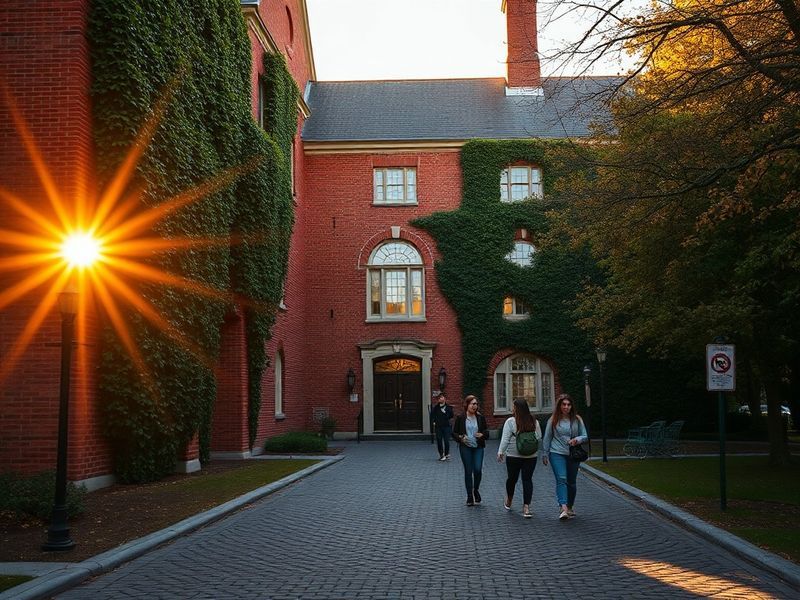
Nestled in the rolling hills of Amherst, Massachusetts, Hampshire College has long stood as a beacon of unconventional education. Founded in 1965 as part of the Five Colleges Consortium, it emerged during a time of social upheaval, designed to challenge traditional academic norms. While most institutions followed rigid structures, Hampshire took a different path—prioritizing self-directed learning, interdisciplinary exploration, and real-world impact over standardized tests and lecture halls.
Today, Hampshire remains one of the most distinctive liberal arts colleges in the United States, if not the world. Its approach to education has drawn comparisons to progressive models in Europe and beyond, where universities like Aalto University in Finland and Roskilde University in Denmark similarly emphasize student autonomy and collaborative problem-solving. Hampshire’s influence extends far beyond its campus, shaping conversations about what higher education could—and should—be in the 21st century.
The Founding Vision: Education Without Limits
Hampshire College was born from a radical idea: that education should adapt to students, not the other way around. The college was established by four institutions—Amherst, Mount Holyoke, Smith, and the University of Massachusetts Amherst—each contributing to a shared commitment to experimentation. Its founding president, Franklin Patterson, envisioned a place where students could design their own academic paths, blending disciplines in ways that traditional programs rarely allowed.
This vision was deeply tied to the social movements of the 1960s. The civil rights movement, anti-war protests, and the push for gender equality all influenced Hampshire’s ethos. Students weren’t just encouraged to think critically; they were empowered to challenge authority, question norms, and pursue knowledge that mattered to them. The college’s open curriculum, introduced in 1970, eliminated grades, majors, and even required courses. Instead, students crafted individualized programs of study, evaluated through narrative assessments rather than letter grades.
The result was an institution that felt more like a laboratory than a school. Faculty roles shifted from lecturers to mentors, guiding students through independent research, internships, and community projects. Hampshire’s model wasn’t just about academics—it was about cultivating a mindset. Alumni often describe their time there as transformative, not just intellectually but personally. Many credit Hampshire with teaching them how to learn, adapt, and innovate in an ever-changing world.
A Global Model in a Changing Higher Education Landscape
Hampshire’s influence can be seen in educational trends worldwide. In the Netherlands, Wageningen University emphasizes interdisciplinary research in sustainability, much like Hampshire’s focus on environmental studies. Meanwhile, in Scandinavia, institutions like Sweden’s Malmö University prioritize student-centered learning and real-world application—principles Hampshire has championed for decades.
Yet Hampshire’s model isn’t without its challenges. The college has faced financial struggles in recent years, including a near-closure in 2019 when it announced plans to suspend admissions due to budget deficits. A last-minute fundraising campaign and restructuring efforts saved Hampshire, but the episode highlighted the vulnerabilities of alternative education models. Unlike traditional colleges with large endowments or state funding, Hampshire relies heavily on tuition and donations, making it more susceptible to economic shifts.
Despite these challenges, Hampshire’s alumni network has remained a powerful force. Graduates include Academy Award-winning filmmaker Ken Burns, actor Lupita Nyong’o, and Pulitzer Prize-winning journalist and author Barry Lopez. Their success underscores the value of Hampshire’s approach—not just as a niche experiment, but as a viable path to meaningful careers and societal impact.
Key Innovations That Set Hampshire Apart
- Divisional System: Students progress through three divisions—no grades, just narrative evaluations. The first division focuses on foundational skills, the second on interdisciplinary exploration, and the third on a year-long independent project.
- Pass/Fail Grading: Hampshire abolished traditional grades in the 1970s, replacing them with written assessments that emphasize growth and reflection.
- Five College Consortium: Access to courses and resources at Amherst, Smith, Mount Holyoke, and UMass Amherst expands Hampshire’s academic offerings without diluting its core identity.
- Social Justice Focus: Many programs integrate activism and community engagement, from environmental justice to LGBTQ+ rights.
The Future of Hampshire: Can Radical Education Survive?
Hampshire’s survival in the 21st century hinges on its ability to adapt without compromising its core values. The college has begun embracing technology, offering online courses and hybrid learning models to attract a broader range of students. Yet it remains steadfast in its rejection of standardized testing and rigid curricula. In an era where higher education is increasingly commodified, Hampshire’s commitment to accessibility and innovation feels more urgent than ever.
Globally, the demand for alternative education is growing. Countries like Germany and Canada are experimenting with tuition-free models, while others, like Finland, prioritize student well-being over competition. Hampshire’s story serves as a case study in what happens when an institution commits to radical ideals—both the triumphs and the struggles.
For prospective students, Hampshire offers a rare opportunity: to learn in an environment where curiosity is the only prerequisite. For educators and policymakers, it poses a critical question: What if higher education wasn’t about fitting into a mold, but about breaking one?
Conclusion: Hampshire’s Enduring Legacy
Hampshire College may be small, but its impact is outsized. It has proven that education doesn’t need to be standardized to be rigorous. It doesn’t need grades to be meaningful. And it doesn’t need to conform to succeed. In a world where universities are increasingly pressured to produce “job-ready” graduates, Hampshire reminds us that the most valuable skills—critical thinking, adaptability, creativity—often come from unscripted exploration.
As higher education continues to evolve, Hampshire stands as both a model and a cautionary tale. It challenges the status quo, inspires change, and occasionally stumbles—but it never stops asking: What if we tried something different?