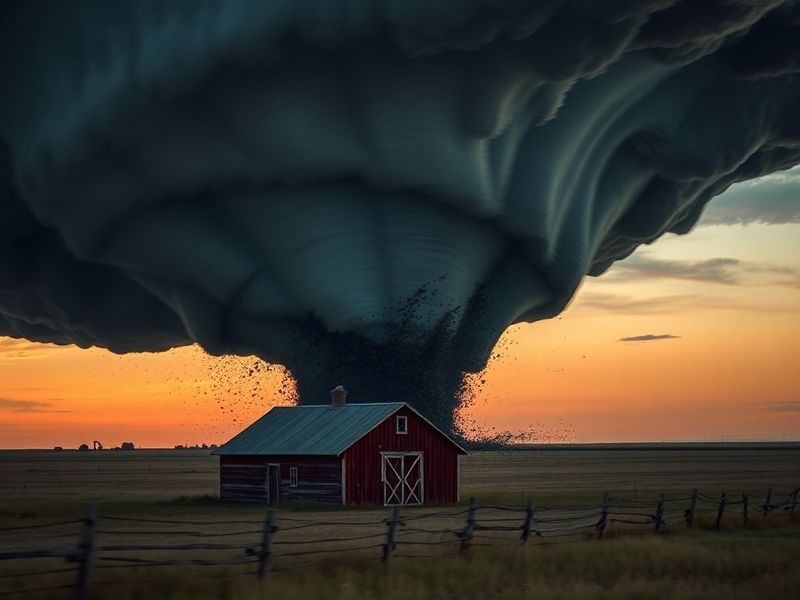
Kansas sits at the heart of Tornado Alley, a region stretching from Texas to South Dakota where warm, moist air from the Gulf of Mexico collides with cool, dry air from the Rockies and Canada. This volatile mix creates the perfect conditions for tornado formation. The state averages around 96 tornadoes per year, according to data from the National Oceanic and Atmospheric Administration (NOAA), making it one of the most tornado-prone states in the nation.
The tornado season in Kansas typically spans from late March through early July, with a peak in May and June. During these months, residents often brace for severe weather that can develop rapidly. The National Weather Service in Wichita reports that 80% of tornadoes in the state occur between 3 p.m. and 9 p.m., coinciding with peak daytime heating that fuels storm development.
Why Kansas Is So Prone to Tornadoes
The geography and climate of Kansas create an ideal environment for tornadoes. The flat terrain allows unimpeded movement of air masses, while the state’s central location exposes it to colliding air fronts. Meteorologists point to three key ingredients that frequently come together in Kansas:
- Instability: Warm, moist air at lower levels rises rapidly when heated by the sun, creating strong updrafts.
- Wind shear: Changes in wind speed and direction with altitude cause air to rotate horizontally, which can be tilted vertically by updrafts to form a mesocyclone—the rotating core of a supercell thunderstorm.
- Lifting mechanisms: Fronts, drylines, or outflow boundaries provide the necessary lift to initiate thunderstorm development.
Notable historical events underscore the frequency and intensity of Kansas tornadoes. The 1955 Udall tornado remains one of the deadliest in state history, killing 80 people and injuring over 200. More recently, the 2016 Dodge City tornado produced winds estimated at 165 mph, earning an EF3 rating on the Enhanced Fujita Scale. These events illustrate not only the destructive power of Kansas tornadoes but also the importance of early warning systems and community preparedness.
The Science Behind Kansas Tornado Formation
Tornadoes in Kansas rarely form in isolation. They are most often associated with supercell thunderstorms—long-lived, rotating storms that can produce large hail, damaging winds, and violent tornadoes. A typical supercell in Kansas may travel 50 miles or more, leaving a path of destruction in its wake.
Research from the University of Kansas has shown that tornadoes in the state tend to initiate along drylines, which are boundaries separating moist air from drier air masses. These drylines often sharpen during the afternoon as the sun heats the ground, intensifying the contrast between air masses. When a dryline intersects with a warm front or outflow boundary, the convergence can trigger explosive thunderstorm development.
Advances in radar technology have significantly improved tornado detection. The implementation of dual-polarization radar across Kansas has allowed meteorologists to identify debris lofted by tornadoes, even when the funnel is not visible. This capability has increased lead times for warnings and reduced false alarms, saving lives and property.
Contributing Factors to Tornado Intensity
Several environmental factors influence the strength and duration of Kansas tornadoes:
- CAPE (Convective Available Potential Energy): Higher CAPE values indicate greater instability, fueling stronger updrafts and more intense tornadoes.
- Storm-Relative Helicity: This measures the potential for cyclonic updraft rotation, with values above 250 m²/s² correlating with a higher risk of strong tornadoes.
- LCL (Lifted Condensation Level): Lower LCL heights mean tornadoes are more likely to form near the ground, increasing their destructive potential.
Climate variability also plays a role. Studies published in the Journal of Climate suggest that as global temperatures rise, the frequency of severe weather events—including tornadoes—may increase in Tornado Alley. However, the relationship is complex, as changes in atmospheric patterns could shift the core of tornado activity either eastward or reduce overall frequency in some regions.
Preparedness and Safety in Tornado-Prone Areas
Living in Kansas means accepting a certain level of risk, but preparedness can mitigate the dangers. The National Weather Service recommends a layered approach to tornado safety that includes awareness, planning, and practice.
First, residents should invest in multiple reliable sources of weather alerts. NOAA Weather Radio provides continuous updates, while smartphone apps like the Dave’s Locker Weather App offer location-based warnings and radar imagery. It’s essential to have at least two ways to receive alerts, as power outages or internet disruptions can occur during storms.
Second, every home should have a designated safe room or storm shelter. The Federal Emergency Management Agency (FEMA) estimates that a properly constructed safe room can withstand winds up to 250 mph. For those without a dedicated shelter, interior rooms on the lowest level of a home—such as a basement or bathroom—can provide adequate protection. Avoid windows and cover yourself with heavy blankets or mattresses to shield against flying debris.
Finally, practicing tornado drills ensures that family members know exactly what to do when a warning is issued. Schools and businesses in Kansas are required to conduct tornado drills annually, but families should also rehearse their response. Identify the nearest shelter, establish a meeting point, and prepare an emergency kit with water, non-perishable food, medications, and important documents.
Community Response and Historical Recovery
When a tornado strikes, the response from local communities often defines the outcome. In 2007, the town of Greensburg was nearly leveled by an EF5 tornado that destroyed 95% of its structures. In the aftermath, Greensburg committed to rebuilding as a model of sustainability, earning international recognition for its green initiatives. The town’s recovery demonstrates how preparedness plans, infrastructure improvements, and community resilience can transform disaster into opportunity.
Statewide efforts like the Kansas Division of Emergency Management’s “Ready Kansas” campaign provide resources and training to help communities prepare. These programs focus on public education, first responder training, and infrastructure improvements, such as reinforcing critical facilities like hospitals and emergency operations centers.
Insurance also plays a vital role in recovery. The Kansas Insurance Department reports that tornado-related claims average over $100 million annually. Residents are encouraged to review their policies regularly and consider additional coverage for wind and hail damage, as standard homeowners’ insurance may not fully cover tornado-related losses.
Lessons from Recent Events
The 2022 Andover tornado serves as a recent case study in effective response. Despite causing significant damage, including the destruction of a local high school, there were no fatalities. The city’s proactive warning system, well-practiced emergency protocols, and public awareness campaigns contributed to the positive outcome. This event reinforced the value of preparedness and highlighted the importance of investing in resilient infrastructure.
Looking ahead, Kansas continues to lead in tornado research and mitigation. The Dave’s Locker Science Hub covers ongoing studies by institutions like the University of Oklahoma’s Cooperative Institute for Severe and High-Impact Weather Research and Operations (CIWRO), which are exploring new ways to predict tornadoes with greater accuracy.
Conclusion: Living with the Storm
Tornadoes are an inescapable part of life in Kansas, but they do not have to be feared without reason. Understanding the science behind their formation, respecting their power, and preparing accordingly can reduce risks and save lives. While the state’s landscape may be flat, the challenges posed by tornadoes are anything but simple. They demand vigilance, education, and community effort.
For Kansans, tornadoes are not just weather events—they are part of the state’s identity. From the early pioneers who built sod houses to withstand the storms to today’s meteorologists using cutting-edge radar, the people of Kansas have always found ways to adapt. The goal is not to eliminate risk entirely but to live safely within it, turning awareness into action and preparation into resilience.
As climate patterns evolve and technology advances, the future of tornado forecasting and preparedness in Kansas will continue to improve. For now, the state stands as a testament to the power of nature—and the power of human ingenuity in the face of it.