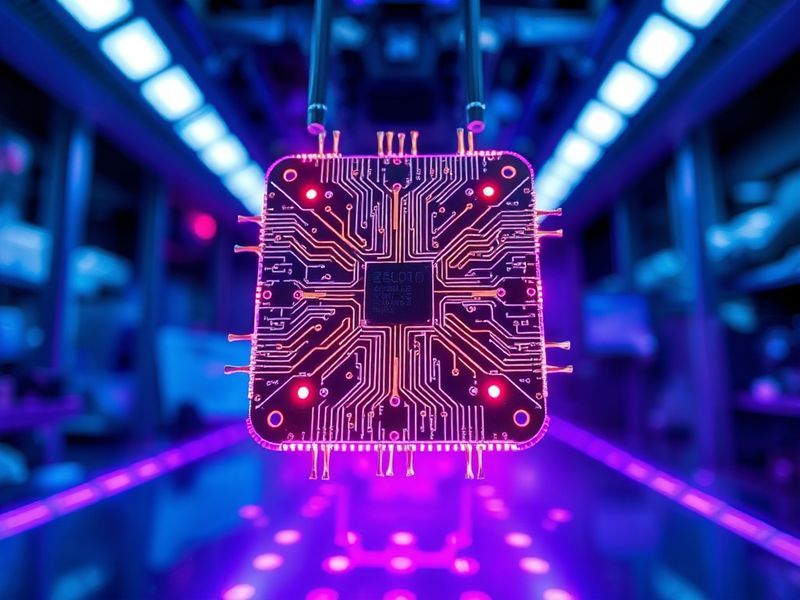
World Quantum Day Celebrates Science at the Edge of Reality
Every April 14, the global scientific community pauses to recognize World Quantum Day, a holiday that exists at the intersection of abstract theory and cutting-edge technology. The date itself is not arbitrary—it references Planck’s constant (h ≈ 4.135667696 × 10⁻¹⁵ eV·s), a foundational value in quantum mechanics. What began as a grassroots initiative in 2021 has since grown into a multi-continent event featuring public lectures, lab tours, art installations, and even quantum-themed comedy nights.
Unlike traditional holidays tied to national identity or historical events, World Quantum Day is deliberately universal. Organizers in over 65 countries coordinate through the official network, ensuring that a child in Nairobi, a researcher in Tokyo, and an artist in Buenos Aires can all participate in the same global conversation about the smallest scales of reality.
The Origins: From Hashtag to Global Movement
The idea was first proposed in 2020 by physicist Maurice Oliva-Monroy, then a postdoctoral researcher at the University of Oxford. Frustrated by the disconnect between quantum science and public understanding, he launched a social media campaign using #WorldQuantumDay. Within weeks, support poured in from institutions like CERN, IBM Quantum, and the Chinese Academy of Sciences. By 2022, UNESCO officially endorsed the initiative, calling it “a vital step toward demystifying the quantum world.”
The growth reflects a broader shift in science communication. Where once quantum physics was confined to elite journals and Nobel Prize ceremonies, today it appears in TikTok explainers, museum exhibits, and even entertainment franchises. World Quantum Day has become a cultural bridge—one that connects poets to programmers and philosophers to engineers.
How the World Celebrates: Events Beyond the Lab
Celebrations span from high-tech to handmade. In Finland, the University of Helsinki hosts an open day where visitors can “touch” a real quantum computer via a cloud interface. In India, the Indian Institute of Science Bangalore organizes a “Quantum Carnival” with laser shows, origami atoms, and a competition to design the best quantum superhero. Meanwhile, in Morocco, a collective of artists and physicists has created an interactive installation titled “The Quantum Atlas”, where visitors walk through a corridor of light projections that visualize superposition and entanglement.
Some events lean into humor. In Canada, the Perimeter Institute for Theoretical Physics hosts “Quantum Comedy Night,” featuring stand-up routines that riff on Schrödinger’s cat, multiverse theory, and the perils of quantum tunneling. In Japan, a popular chain of izakayas offered a “quantum cocktail” with ingredients that change color based on temperature—a playful nod to quantum decoherence.
Not all celebrations are urban. In rural Brazil, the National Observatory in Rio de Janeiro partnered with local schools to launch a “Quantum in the Forest” program, using satellite links to connect students with researchers while exploring how quantum biology might influence photosynthesis. The message is clear: quantum science is not just for cities with supercomputers—it belongs to everyone, everywhere.
The Cultural Ripple: Why Quantum Science Captivates the Imagination
Quantum mechanics has long been a muse for artists, writers, and filmmakers. Its paradoxes—particles existing in multiple states, information traveling faster than light, reality shaped by observation—mirror themes found in existential literature and surrealist art. The 1950s saw the rise of “quantum mysticism,” a trend that blurred the line between physics and spirituality. Today, quantum concepts appear in everything from video games like Quantum Break to the hit Netflix series Dark, which weaves quantum time travel into its plot.
This cultural fascination is more than aesthetic. It reflects a deep human need to grapple with uncertainty. In an era of rapid technological change and global instability, quantum science offers both wonder and warning. It promises breakthroughs in medicine, climate modeling, and secure communications—but also raises ethical questions about surveillance, AI, and the nature of consciousness itself.
World Quantum Day leverages this curiosity. By framing quantum physics as a shared human story—one that includes both Nobel laureates and curious teenagers—it transforms abstract equations into accessible narratives. The goal isn’t to turn everyone into a quantum physicist, but to foster a culture where scientific literacy is seen as essential to civic life.
A Day of Action and Access
Central to the observance is the commitment to open access. Many institutions waive fees for public events on April 14. For example:
- The Quantum Computing Report curates a global map of free lectures and workshops.
- The European Quantum Flagship funds “Quantum Roadshows” in underserved regions, bringing portable labs and VR simulations to schools.
- In South Africa, the Quantum Research Group at the University of KwaZulu-Natal hosts a “Bring Your Parent to Lab Day,” where families can see quantum dots glow under microscopes.
These efforts respond to a documented gap: while 78% of young people express interest in science careers, only 34% feel confident interpreting quantum concepts. World Quantum Day directly addresses this by prioritizing experiential learning—letting people see, hear, and even feel quantum phenomena firsthand.
Looking Ahead: The Quantum Future Is Now
As quantum technologies move from labs to markets, the stakes are rising. Companies like Google, IBM, and Rigetti are racing to build fault-tolerant quantum computers. Governments are investing billions: the U.S. National Quantum Initiative Act allocates $1.2 billion, while China’s $15 billion quantum program aims to dominate the field by 2030.
Yet public understanding lags behind. A 2023 survey by the Wellcome Trust found that 62% of adults in the UK couldn’t define a quantum computer—despite its potential to revolutionize drug discovery and materials science. World Quantum Day is part of the antidote. By making science visible, tangible, and yes—even fun—it helps demystify the future.
The holiday’s logo—a stylized atom with wings—symbolizes this aspiration: a fusion of precision and possibility. It suggests that quantum science is not just about what we can measure, but about what we can imagine. In a time of division, World Quantum Day reminds us that the universe—at its smallest scale—belongs to all of us.
How You Can Participate
Whether you’re a student, educator, artist, or simply curious, there are many ways to get involved:
- Attend an event: Check the official event map for local activities.
- Host your own: Organizers provide free toolkits with posters, videos, and DIY experiment guides.
- Share your voice: Use #MyQuantumStory on social media to share how quantum science inspires you.
- Support education: Donate to organizations like QuTech Academy or Quantum for Life.
No background in physics is required—just curiosity. After all, the quantum world isn’t just for scientists. It’s for anyone willing to question what’s real.