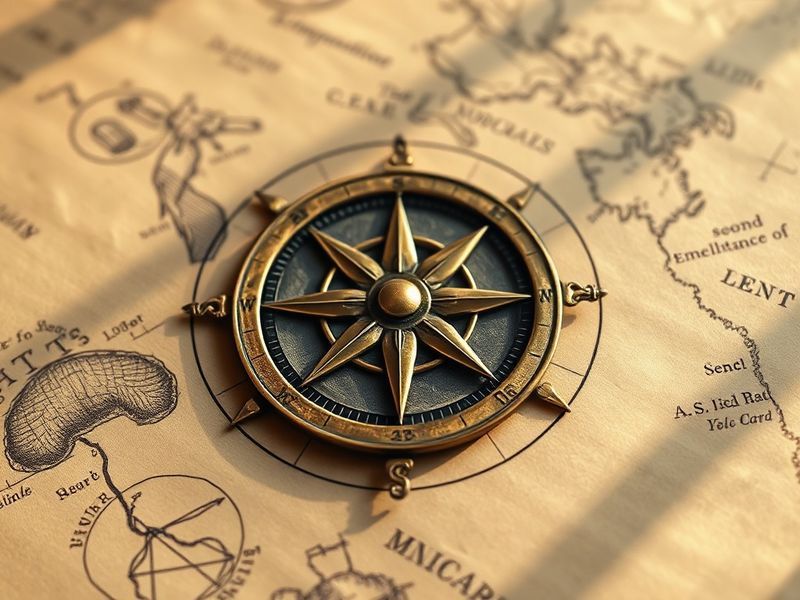
The windrose is one of humanity’s most enduring and versatile symbols. Dating back to ancient mariners who relied on it for safe passage, this eight-pointed star has evolved into a cultural icon found in everything from nautical charts to tattoos. Its simplicity and symmetry make it a universal language, bridging centuries and civilizations.
Today, the windrose appears in unexpected places—on corporate logos, in video games, and even as a spiritual emblem. Its journey from a practical navigational aid to a multifaceted symbol reflects broader themes of adaptation and reinterpretation. To understand its significance, we must explore its origins, cultural resonance, and modern applications.
The Ancient Origins of the Windrose
The earliest known windroses were used by Greek and Roman sailors around the 3rd century BCE. These early versions divided the horizon into eight principal winds, each represented by a spoke pointing to a cardinal or intercardinal direction. The Greeks named these winds after deities or local winds, such as Boreas (north wind) and Zephyrus (west wind).
By the Middle Ages, the windrose had become a staple of maritime cartography. Medieval portolan charts, used by sailors for navigation, featured elaborate windroses at the center of compass roses. These charts were meticulously drawn with radiating lines connecting ports to the wind directions, allowing navigators to plot courses with precision. The windrose’s practicality made it indispensable for explorers during the Age of Discovery, when mariners like Christopher Columbus and Ferdinand Magellan relied on it to traverse uncharted waters.
The windrose’s design also carried symbolic weight. In medieval Europe, it was often linked to the eight winds of the Bible or the eight directions of the cosmos in various mythologies. Its circular shape, devoid of a clear starting point, suggested infinity and the cyclical nature of time—an idea that resonated across cultures.
Cultural Symbolism Across Continents
The windrose’s adaptability has allowed it to take on diverse meanings in different cultures. In China, the windrose is associated with the Feng Shui bagua, an eight-trigram system used to harmonize energy in living spaces. Each direction in the bagua corresponds to a life aspect, such as wealth or health, and the windrose serves as a visual guide for balancing these energies.
In Native American traditions, the windrose is deeply tied to storytelling and spirituality. Many tribes, including the Lakota and Navajo, use directional symbols in rituals and ceremonies. The windrose represents the interconnectedness of all things—the four cardinal directions (north, south, east, west) and the four intercardinal directions (northeast, southeast, southwest, northwest) are seen as gateways to different realms of existence.
In Europe, the windrose became a heraldic symbol during the Renaissance. Noble families and cities incorporated it into coats of arms to signify strength, guidance, and exploration. The city of Venice, for example, featured a windrose in its flag, symbolizing its dominance as a maritime power. Even today, the windrose appears in the logos of shipping companies and airlines, evoking themes of adventure and reliability.
Modern Interpretations and Unexpected Uses
The 20th and 21st centuries have seen the windrose transcend its nautical roots. In the 1960s, the symbol gained popularity in the counterculture movement, where it was adopted as an emblem of freedom and alternative lifestyles. The windrose’s circular design and lack of hierarchy made it a perfect fit for the era’s ethos of nonconformity.
In contemporary times, the windrose has found its way into digital spaces. Video game developers often use it as a navigation tool within virtual worlds, such as in the gaming series “The Legend of Zelda,” where it guides players through dungeons. Graphic designers and tattoo artists also favor the windrose for its clean lines and timeless appeal. Its versatility allows it to be stylized in countless ways, from minimalist line drawings to intricate mandala-like patterns.
Beyond aesthetics, the windrose has taken on new functional roles. In meteorology, windroses are used to display wind speed and direction data, helping scientists and urban planners understand weather patterns. Architects incorporate windrose principles into building designs to optimize natural ventilation and energy efficiency. Even in sports, the windrose appears as a training aid for athletes who need to understand wind conditions, such as sailors and golfers.
The Windrose in Art and Media
Artists have long been drawn to the windrose’s geometric beauty and symbolic depth. The surrealist painter Salvador Dalí featured a windrose-like design in his work “The Persistence of Memory,” where melting clocks are arranged in a circular pattern reminiscent of a compass. In literature, the windrose often symbolizes journeys, both literal and metaphorical. John Steinbeck’s “The Log from the Sea of Cortez” includes detailed descriptions of windroses used by sailors, highlighting their role in exploration.
In popular media, the windrose has become a shorthand for adventure and discovery. The symbol appears in films like “Pirates of the Caribbean” and TV shows such as “Game of Thrones,” where it’s used to evoke themes of navigation and destiny. Even in music, bands like Radiohead have referenced the windrose in lyrics and album art, using it to symbolize the search for direction in an uncertain world.
One of the most surprising modern uses of the windrose is in branding. Companies like Starbucks and Apple have incorporated variations of the windrose into their logos, leveraging its associations with guidance and exploration. These brands use the symbol to communicate a sense of purpose and movement, aligning with their missions of innovation and global reach.
A Symbol for the Future
As society becomes increasingly interconnected, the windrose’s message of unity and direction remains relevant. In an era of globalization, the symbol serves as a reminder of our shared heritage and the importance of finding common ground. Its adaptability ensures that it will continue to evolve, finding new meanings in art, technology, and culture.
For future generations, the windrose could take on even more roles. As renewable energy sources like wind turbines become more prevalent, the windrose may become a symbol of sustainability and environmental stewardship. Urban planners might use it to design cities that prioritize walkability and green spaces, with the windrose guiding the way toward healthier living.
The windrose’s journey from an ancient navigational tool to a modern icon is a testament to its power as a symbol. It transcends time and geography, adapting to the needs and values of each era. Whether as a practical aid or a cultural emblem, the windrose reminds us that direction is not just about where we’re going—it’s about how we navigate the journey together.