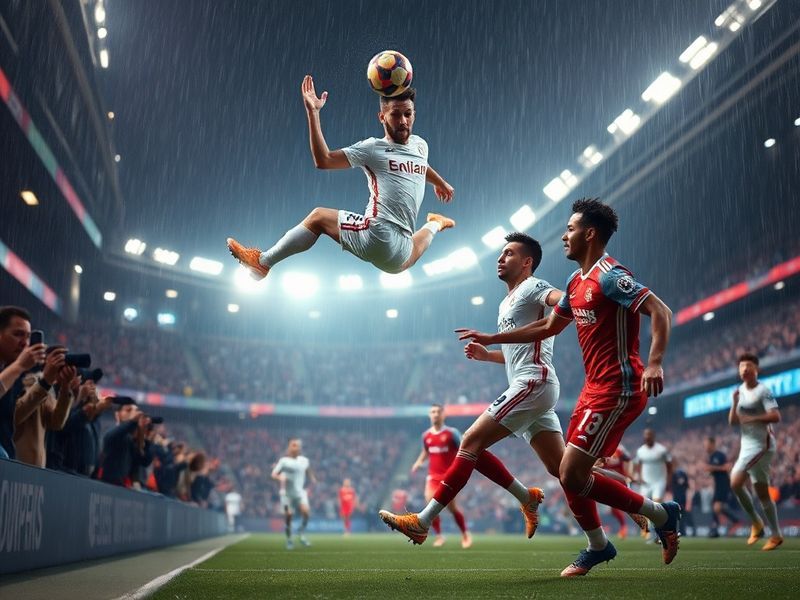
The stage is set. The lights blaze across empty stands in Munich or Madrid. Millions watch from living rooms across continents. This is not just another football match—it is a collision of history, ambition, and style. Bayern Munich and Real Madrid meet again, not as strangers but as combatants in one of sport’s oldest rivalries. Their encounters are more than fixtures; they are chapters in a global football narrative that transcends borders and cultures.
These two clubs do not merely play football. They represent power, prestige, and philosophy. Bayern embodies German precision and relentless efficiency. Real Madrid, the eternal dreamers, enchant with flair and nostalgia. When they face off in the Champions League, the world pauses. It is not just Europe that watches—it is Argentina, Nigeria, Japan, and the United States. Football, in moments like these, becomes a universal language.
The Rivalry: More Than Just a Competition
The Bayern Munich vs Real Madrid rivalry stretches back over six decades. Their first European Cup meeting came in 1976, a hard-fought draw that set the tone for decades of intensity. Since then, they have met 26 times in European competition, with Madrid holding a slender lead in wins. But numbers only tell part of the story. This is a rivalry built on moments: Zidane’s volley in Glasgow, Ronaldo’s hat-trick in Madrid, Robben’s late strike in London.
What makes this rivalry unique is its global resonance. In Latin America, Real Madrid is more than a club—it is a symbol of grace and success. In Africa, Bayern’s sustainability and consistency appeal across generations. In Asia, both clubs enjoy cult-like followings, fueled by social media and broadcasting deals. The clash isn’t just on the pitch; it’s in the hearts of fans who see their identities reflected in their teams.
It’s also a clash of systems. Bayern operates with the discipline of a Swiss watch, blending youth development with tactical adaptability. Real Madrid thrives on individual brilliance, often transforming players into legends overnight. This philosophical divide is what makes their matches so compelling—each team forces the other to evolve.
Key Moments That Defined the Rivalry
No rivalry is built on one game, but some define its legacy. Consider the 2017 Champions League semifinal. Madrid overturned a 2–1 deficit from the first leg with a 4–2 win in Munich. Cristiano Ronaldo scored twice, including a penalty in the dying minutes. The Allianz Arena fell silent. For Madrid fans, it was a masterclass in resilience. For Bayern, it was a lesson in psychological fragility.
Then came 2020, in the surreal environment of Lisbon. Bayern dismantled Madrid 4–2 in the Round of 16, a performance so dominant it felt inevitable. Flick’s team played with a metronomic rhythm, pressing high and passing with surgical precision. Madrid, missing Ramos and injured in spirit, never recovered. It was a statement: Bayern were not just contenders—they were the new kings of Europe.
But Madrid always fight back. In 2022, they turned the tables in a dramatic quarterfinal. Benzema’s two goals and Courtois’ heroics in the shootout sent Bayern crashing out. The Santiago Bernabéu erupted not just for a win, but for a statement: no matter how strong Bayern are, Madrid will always find a way.
Memorable Matches in Brief
- 1999–2000 UEFA Champions League: Real Madrid won 3–2 on aggregate, with Hierro and Morientes shining. A tactical masterclass from Vicente del Bosque.
- 2011–2012 Champions League Final: Chelsea vs Bayern was different, but Madrid and Bayern met in the semis. Ronaldo’s brace sent Madrid to the final—only for Chelsea to stun them in Munich.
- 2013–2014 UEFA Champions League: Real Madrid’s 5–0 aggregate win in the Round of 16 stunned the football world. Bale, Benzema, and Cristiano dismantled a shell-shocked Bayern.
- 2021–2022 UEFA Champions League: Madrid’s 3–1 win on aggregate in the quarterfinals, highlighted by a 4–3 thriller in Madrid. A reminder that drama is Madrid’s second language.
Cultural Impact: How the World Watches
This rivalry is a global spectacle because it is more than sport. It is culture. In Nigeria, Madrid’s signing of Michael Essien in 2009 inspired a generation of young players. In Japan, Bayern’s pre-season tours have built a fanbase that rivals the J.League’s best. In the United States, both clubs are expanding their academies, seeing America as the next frontier.
Broadcasting has amplified this reach. A Bayern vs Real Madrid match can draw over 400 million cumulative viewers across platforms. In India, where cricket dominates, football viewership spikes during these clashes. In Brazil, where local football thrives, fans still debate whether Ronaldo was more of a Madrid player than a Brazilian one—a testament to the club’s global footprint.
Social media turns every match into a digital battleground. Fans from Lagos to Lima post memes, reactions, and analyses in real time. The hashtags #HalaMadrid and #MiaSanMia become trending topics worldwide. The rivalry transcends language, uniting and dividing in equal measure.
What’s at Stake: Beyond Trophies
When these teams meet, the stakes are always high. A win isn’t just three points—it’s a statement. For Bayern, it’s proof they belong among Europe’s elite. For Madrid, it’s a chance to silence doubters and remind the world that history is on their side.
But there’s more. These matches are auditions. They showcase young talents to the world. Musiala, Gavi, Bellingham—all have risen under the global spotlight in these fixtures. Scouts, managers, and agents watch closely. A standout performance can change a career.
It’s also about legacy. Madrid’s 14 Champions League titles are unmatched. Bayern’s six put them in an elite group. But in this rivalry, history is written in real time. Every goal, every mistake, every tactical shift is etched into the narrative. When these two meet, they’re not just playing for today—they’re shaping tomorrow.
The Future: What’s Next for This Rivalry?
The next chapter is already being written. With young stars rising on both sides—Endrick at Madrid, Dusan Vlahovic and Konrad Laimer at Bayern—the rivalry is entering a new era. The old guard, like Benzema and Lewandowski, have moved on. The torch is being passed.
Tactically, both teams are evolving. Bayern under Tuchel and now Nagelsmann have embraced a more fluid style, while Madrid under Ancelotti have balanced pragmatism with flair. The contrast ensures unpredictability. Will Bayern’s pressing overwhelm Madrid’s counterattacks? Or will Madrid’s individual magic carve open Bayern’s defense?
One thing is certain: the world will watch. Whether it’s the knockout rounds of the Champions League or a pre-season friendly in the U.S., Bayern vs Real Madrid is always more than a game. It’s a cultural event. A moment of unity and division. A showcase of football at its finest.
As long as the ball rolls, this rivalry will endure. Because in football, as in life, some rivalries aren’t meant to end—they’re meant to be celebrated, debated, and remembered.
For fans of sports around the world, there is no greater stage. And for football itself, there is no greater spectacle.