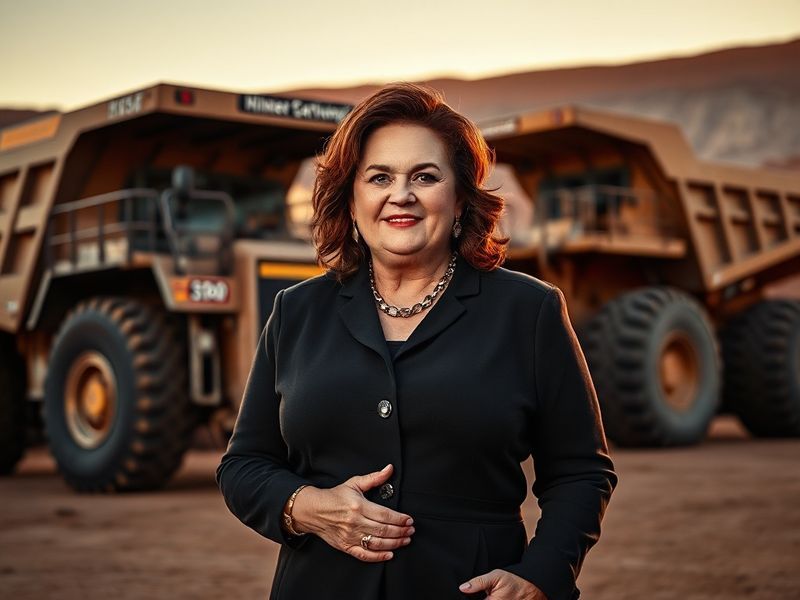
Gina Rinehart: Australia’s Mining Mogul Shaping Global Resources
Gina Rinehart stands as one of Australia’s most influential and polarizing figures, a woman whose business acumen and unapologetic approach to wealth have reshaped the mining industry. As the executive chairman of Hancock Prospecting, she inherited a company founded by her father, Lang Hancock, and transformed it into a mining powerhouse with operations spanning Australia and beyond. Her story is not just one of corporate success but of defiance, ambition, and the complexities of resource nationalism in a globalized economy.
Rinehart’s influence extends beyond Australia’s borders. She has become a symbol of the country’s resource wealth, a champion of mineral exports, and a controversial voice in debates over foreign investment and economic sovereignty. Her leadership has drawn both admiration and criticism, reflecting the broader tensions between industrial growth and environmental concerns, corporate power and public interest.
The Rise of a Mining Dynasty
Born in 1954, Gina Rinehart grew up in the shadow of her father’s mining legacy. Lang Hancock, a prospector and entrepreneur, discovered one of the world’s largest iron ore deposits in the Pilbara region of Western Australia. When he passed away in 1992, Rinehart took control of Hancock Prospecting, a company that had struggled financially under previous management. Her first major move was to secure a joint venture with global miner Rio Tinto, which provided the capital needed to develop the Roy Hill iron ore project—a $10 billion initiative that would later become one of Australia’s most significant mining operations.
The Roy Hill project, which began production in 2015, symbolized Rinehart’s strategic vision. While some critics argued that the deal favored Rio Tinto, the venture allowed Hancock Prospecting to leverage international expertise and infrastructure. Today, Roy Hill is a key player in the global iron ore market, shipping millions of tons annually to customers in Asia, particularly China.
A Controversial Figure in Global Mining
Rinehart’s business practices and public statements have often sparked debate. She has been a vocal advocate for mining expansion, arguing that Australia’s resource wealth should be exploited to fuel economic growth. Her stance has clashed with environmental groups, Indigenous rights activists, and politicians who prioritize sustainability and Indigenous land rights. In 2012, she famously dismissed climate change concerns, stating that “95% of the world’s greenhouse gas emissions come from nature” and that activists were “wasting taxpayers’ money.”
Her outspokenness has also extended to labor relations. Rinehart has been a fierce critic of unions, once describing them as a “threat to Australia’s prosperity.” In 2012, her company locked out workers at the Roy Hill project during contract negotiations, a move that drew condemnation from labor groups and politicians. The dispute highlighted the power dynamics in Australia’s mining sector, where corporate interests often clash with workers’ rights.
Despite the controversies, Rinehart’s business decisions have undeniably shaped Australia’s mining landscape. Under her leadership, Hancock Prospecting has expanded into coal, lithium, and other critical minerals, positioning itself at the forefront of the energy transition. The company’s investments in lithium, a key component in electric vehicle batteries, reflect her ability to anticipate global market trends.
Global Influence and the Future of Resource Nationalism
Rinehart’s impact is not confined to Australia. As China’s demand for iron ore and other minerals surged in the 21st century, her company became a crucial supplier, reinforcing Australia’s role as a key player in global resource markets. However, her influence has also raised questions about resource nationalism—the idea that a country’s natural resources should be controlled by its own citizens and companies rather than foreign investors.
In 2021, Hancock Prospecting faced scrutiny when it was revealed that Rinehart had lobbied the Australian government to block foreign investment in the Roy Hill project. Critics argued that her stance contradicted her earlier advocacy for foreign partnerships, while supporters saw it as a defense of Australian economic sovereignty. The episode underscored the complexities of resource nationalism in an era of globalization, where supply chains are increasingly interconnected.
Rinehart’s global perspective is also evident in her investments outside Australia. She has acquired significant stakes in media outlets, including a 14% share in Ten Network Holdings, and has explored opportunities in Africa and South America. These ventures reflect her belief in the importance of diversifying Australia’s economic partnerships while maintaining control over its most valuable resources.
The Cultural Legacy of a Mining Magnate
Beyond her business achievements, Gina Rinehart has become a cultural figure in Australia. She has been portrayed as both a hero and a villain, embodying the contradictions of a country built on resource wealth but grappling with its environmental and social costs. Her wealth, estimated at over $30 billion, has made her one of the richest women in the world, yet her public persona remains divisive.
Rinehart’s influence extends to philanthropy as well. She has donated millions to causes such as medical research and education, though her charitable efforts are often overshadowed by her business dealings. In 2012, she pledged $100 million to the Australian neuroscience research center, the Brain Institute, demonstrating a commitment to science and innovation.
Her story also reflects broader trends in global capitalism. As the world transitions to renewable energy, Rinehart’s company is well-positioned to supply the minerals needed for electric vehicles and batteries. Yet her legacy is complicated by her past statements on climate change and her resistance to environmental regulations. The tension between economic growth and sustainability is likely to define her final chapter as a business leader.
Conclusion: A Legacy Still Unwritten
Gina Rinehart’s career is a testament to the power of vision, persistence, and controversy. She has shaped Australia’s mining industry, influenced global resource markets, and sparked debates about the role of corporations in society. Whether admired for her business acumen or criticized for her policies, her impact is undeniable. As the world continues to rely on minerals and energy resources, Rinehart’s legacy will be measured not just in dollars but in the ethical and environmental choices that define the future of mining.
For those interested in the broader context of Australia’s mining industry and its global implications, exploring related topics such as Business and Politics can provide deeper insights into the forces shaping resource economies today.