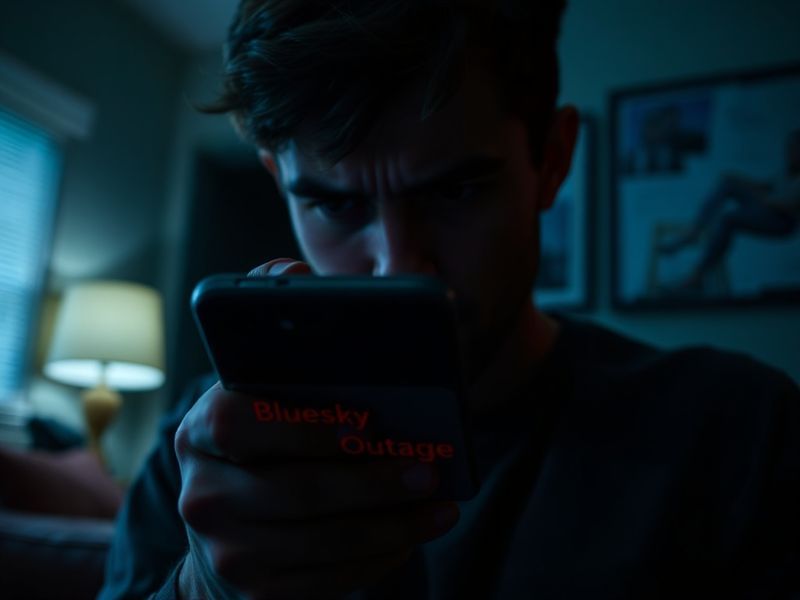
Bluesky Outage Exposes Social Media’s Fragile Infrastructure
“`html
Bluesky Outage Exposes Social Media’s Fragile Infrastructure
On a typical Tuesday afternoon, Bluesky—a decentralized social platform often praised for its resilience—experienced a widespread outage that left users unable to post, reply, or refresh their feeds. The incident, which lasted over three hours, sparked frustration among early adopters who had migrated from Twitter in search of a more stable alternative. While outages are not uncommon in the social media landscape, the timing and nature of this disruption revealed deeper vulnerabilities in even the most modern platforms.
What Went Wrong: A Timeline of the Outage
The disruption began around 2:47 PM EST, when users across multiple regions reported login failures and feed loading errors. Within minutes, the platform’s status page confirmed an ongoing issue, though initial updates provided little clarity. By 3:15 PM, Bluesky’s engineering team acknowledged a “major service disruption” affecting core functionality. Unlike traditional outages that stem from server overload or cyberattacks, this failure appeared to involve a cascading effect within its decentralized architecture.
According to a post-mortem shared by Bluesky’s co-founder Paul Frazee, the issue originated from a misconfigured update to the platform’s relay servers—nodes that facilitate communication between decentralized networks. The misconfiguration triggered a feedback loop, overwhelming the system and preventing user requests from processing. While the team implemented a hotfix, full restoration required rebuilding affected components, a process that took until 6:03 PM to complete.
Why This Matters Beyond Bluesky
The outage raises critical questions about the reliability of decentralized social platforms, which were designed to avoid the single points of failure that plague centralized networks like X (formerly Twitter) or Facebook. While Bluesky’s federated model—using the AT Protocol—aims to distribute control across independent servers, Tuesday’s incident demonstrated that decentralization does not automatically equate to resilience. The failure also highlighted how quickly user trust can erode, even for platforms marketed as alternatives to Big Tech.
For businesses and creators who rely on social media for engagement, the outage served as a reminder of the fragility of digital infrastructure. Many influencers and small businesses took to other platforms to announce the disruption, inadvertently driving traffic to competitors. This cross-platform migration during outages is a growing trend, as users seek temporary solutions when their primary networks fail.
Broader Implications for the Social Media Ecosystem
- Centralization vs. Decentralization: While decentralized platforms promise greater control and fewer single points of failure, their complexity can introduce new vulnerabilities. The Bluesky outage suggests that decentralization alone may not guarantee stability.
- User Expectations: Audiences increasingly expect seamless performance, regardless of a platform’s underlying architecture. Outages, even brief ones, can damage credibility and accelerate user churn.
- Competitive Risks: Platforms like Mastodon and Threads benefit from user frustration during outages. Temporary switches can become permanent if users find more reliable alternatives.
- Infrastructure Investment: As social media platforms scale, they must prioritize redundancy and fail-safe mechanisms. The Bluesky incident underscores the need for rigorous testing, especially for platforms handling millions of daily interactions.
Lessons for Users and Developers
For developers, the outage offers a case study in the challenges of building decentralized systems. Frazee and his team have since committed to improving their monitoring tools and implementing stricter rollout protocols for updates. The incident also serves as a reminder that even well-intentioned platforms are not immune to human error—misconfigurations can happen anywhere.
For users, the disruption was a test of patience and adaptability. Many turned to Discord servers or Mastodon instances as temporary replacements, while others simply waited for Bluesky to restore service. The episode reinforced the importance of diversifying one’s online presence, a lesson many learned the hard way during previous platform outages.
Looking ahead, the social media landscape remains in flux. Decentralized platforms continue to gain traction, but their long-term success depends on overcoming the technical and operational hurdles that centralized networks have already addressed. Until then, users will need to navigate these platforms with a mix of optimism and caution.
Conclusion: A Wake-Up Call for the Future of Social Media
The Bluesky outage was more than a temporary inconvenience—it was a stress test for the next generation of social networks. As platforms like Bluesky, Mastodon, and others compete for users disillusioned with traditional social media, reliability will become a key differentiator. The incident should prompt both developers and users to reconsider what they expect from online communities and how they adapt when those communities fail.
For now, Bluesky has resumed normal operations, and its team has pledged to learn from the experience. Whether this outage will accelerate or hinder the platform’s growth remains to be seen. One thing is certain: in an era where digital interactions are central to daily life, the stakes for platform stability have never been higher.
For more on the evolving social media landscape, explore our Trending and Technology sections.