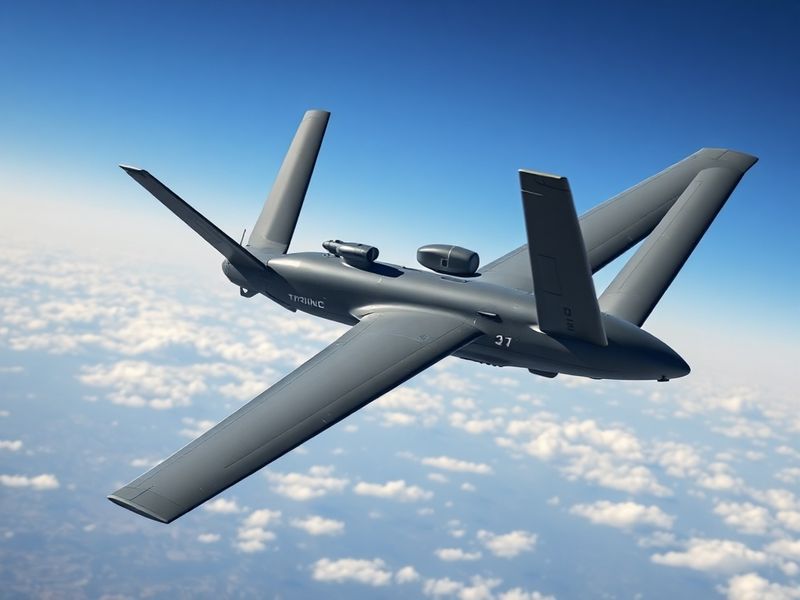
Northrop Grumman MQ-4C Triton: U.S. Navy’s Maritime Surveillance Leader
“`html
Northrop Grumman MQ-4C Triton: The Future of Maritime Surveillance
The MQ-4C Triton, developed by Northrop Grumman, represents a significant leap in maritime surveillance technology. Designed for long-endurance, high-altitude intelligence, surveillance, and reconnaissance (ISR) missions, this unmanned aerial vehicle (UAV) is engineered to operate over vast oceanic expanses. Its primary role is to support the U.S. Navy’s maritime domain awareness, complementing the capabilities of the P-8 Poseidon maritime patrol aircraft.
The Triton’s development aligns with the Navy’s broader strategy to integrate unmanned systems into its fleet, enhancing operational flexibility and reducing risks to personnel. With a wingspan of 130.9 feet and a length of 47.6 feet, the Triton is built to endure missions lasting up to 24 hours at altitudes exceeding 50,000 feet. Its advanced sensor suite and real-time data processing enable it to detect, classify, and track maritime targets with unprecedented precision.
Design and Capabilities
The MQ-4C Triton’s design prioritizes endurance and sensor integration. Its airframe is derived from the RQ-4 Global Hawk, a proven platform in high-altitude long-endurance missions. However, the Triton incorporates several modifications tailored for maritime operations, including a reinforced airframe to withstand harsh weather conditions and saltwater corrosion.
The UAV’s sensor suite is its most critical feature. It includes:
- AN/ZPY-3 Multi-Function Active Electronically Scanned Array (MFAS) Radar: This radar system provides 360-degree coverage, enabling the Triton to detect and track multiple maritime targets simultaneously. It can identify vessels of varying sizes and classify them based on their radar cross-section.
- Electro-Optical/Infrared (EO/IR) Cameras: These cameras offer high-resolution imagery for visual identification of maritime targets. They are particularly useful in low-light conditions or when radar data requires additional verification.
- Automatic Identification System (AIS) Receiver: The AIS receiver collects data from ships equipped with AIS transponders, providing additional context for tracking and identifying vessels.
- Signals Intelligence (SIGINT) Suite: This suite detects and analyzes electronic emissions, such as radar and communication signals, further enhancing the Triton’s ability to monitor maritime activity.
The Triton’s data processing capabilities are equally impressive. It can autonomously process sensor data and transmit relevant information to ground stations or manned aircraft in real-time. This reduces the need for human operators to sift through raw data, allowing them to focus on critical decision-making.
Operational Deployment and Integration
The U.S. Navy began operational deployments of the MQ-4C Triton in 2023, marking a new era in maritime surveillance. The first deployment took place in the Pacific region, where the Triton conducted missions to monitor maritime traffic, detect illegal activities, and support search and rescue operations. Its ability to cover vast areas with minimal human oversight has proven invaluable in maintaining situational awareness in dynamic environments.
Integration with the P-8 Poseidon has been a key focus of the Triton’s deployment strategy. The two platforms complement each other, with the Triton providing broad-area surveillance and the P-8 Poseidon offering closer inspection and engagement capabilities. This teaming approach maximizes the effectiveness of maritime patrol missions, reducing the workload on crewed aircraft and enhancing overall mission efficiency.
The Triton’s operational flexibility extends to its ability to operate from land bases or forward-deployed locations. This reduces the logistical burden of maintaining a presence in remote areas while ensuring rapid response to emerging threats. Additionally, the UAV’s autonomous flight capabilities allow it to operate in contested environments where manned aircraft might face higher risks.
Challenges and Future Prospects
Despite its advanced capabilities, the MQ-4C Triton has faced challenges during its development and deployment. One of the primary concerns has been the integration of the UAV into existing naval operations. The transition from crewed to unmanned systems requires significant changes in doctrine, training, and infrastructure. The Navy has invested heavily in these areas, but the learning curve remains steep.
Another challenge is the Triton’s vulnerability to electronic warfare and cyber threats. As adversaries develop more sophisticated countermeasures, ensuring the UAV’s resilience against jamming and hacking attempts is critical. Northrop Grumman and the Navy are continuously updating the Triton’s systems to address these risks, but the cat-and-mouse game between offense and defense is far from over.
Looking ahead, the future prospects for the MQ-4C Triton are promising. The U.S. Navy plans to expand its fleet of Tritons to enhance its maritime surveillance capabilities further. Additionally, allied nations, including Australia and NATO partners, have expressed interest in acquiring the platform to bolster their own maritime domain awareness efforts.
The Triton’s potential extends beyond traditional surveillance roles. Its advanced sensor suite and data processing capabilities make it a valuable asset for environmental monitoring, disaster response, and border security. As the technology matures, the Triton could become a cornerstone of global maritime surveillance efforts, setting a new standard for unmanned aerial systems.
Conclusion
The Northrop Grumman MQ-4C Triton is more than just an unmanned aerial vehicle; it is a force multiplier for maritime surveillance. Its long-endurance capabilities, advanced sensor suite, and real-time data processing make it an indispensable tool for the U.S. Navy and allied forces. While challenges remain, the Triton’s potential to revolutionize maritime domain awareness is undeniable.
As the world’s maritime challenges grow increasingly complex, the need for platforms like the Triton will only intensify. With continued investment and innovation, the MQ-4C Triton is poised to shape the future of maritime surveillance, ensuring safer and more secure oceans for years to come.
For those interested in similar advancements in military technology, explore our Technology category for more insights.