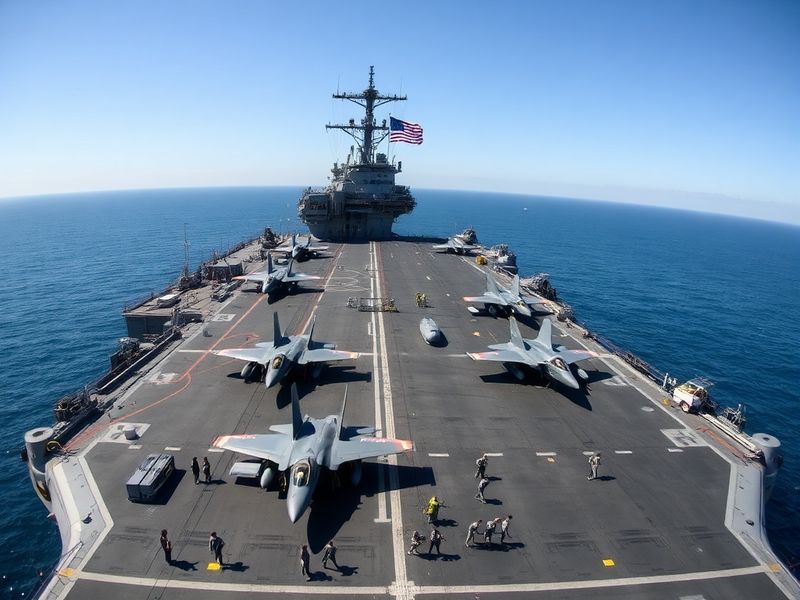
USS Dwight D. Eisenhower: America’s Powerful Nimitz-Class Carrier
“`html
USS Dwight D. Eisenhower: America’s Powerful Nimitz-Class Carrier
The USS Dwight D. Eisenhower (CVN-69) stands as one of the most formidable symbols of American naval power. Commissioned in 1977, this Nimitz-class aircraft carrier has served for nearly five decades, participating in numerous conflicts and global operations. Named after the 34th President of the United States, the carrier embodies both historical legacy and cutting-edge military technology.
As one of 10 Nimitz-class carriers in the U.S. fleet, the Eisenhower represents the backbone of naval aviation. Its nuclear-powered design allows for extended deployments without refueling, while its flight deck accommodates over 60 aircraft. The carrier’s endurance and striking power make it a cornerstone of U.S. defense strategy.
Design and Capabilities
The USS Dwight D. Eisenhower was built by Newport News Shipbuilding, the same yard responsible for all Nimitz-class carriers. At 1,092 feet long and displacing over 100,000 tons, it is one of the largest warships ever constructed. Its nuclear reactor provides virtually unlimited range, allowing it to operate anywhere in the world without logistical constraints.
- Flight Deck: Four steam catapults and four arresting gear cables enable simultaneous aircraft launches and recoveries.
- Armament: Equipped with NATO Sea Sparrow, Rolling Airframe Missiles, and Phalanx CIWS for self-defense.
- Crew and Air Wing: Typically carries around 3,200 sailors and 2,480 air wing personnel, alongside 60+ aircraft.
- Modernization: Recent mid-life refueling and upgrades have extended its service life to at least 2050.
The carrier’s advanced radar and communication systems ensure real-time coordination with allied forces. Its ability to project air power globally without relying on foreign bases underscores its strategic importance. The Eisenhower’s endurance and adaptability make it a critical asset in both combat and humanitarian missions.
Operational History and Missions
The USS Dwight D. Eisenhower has deployed to nearly every major conflict zone since the late 1970s. Its first combat operation came during the Iran-Iraq War, where it supported Operation Earnest Will in the Persian Gulf. The carrier later played a pivotal role in Operation Desert Storm, launching airstrikes against Iraqi forces.
In the 21st century, the Eisenhower continued its global presence. During the War on Terror, it conducted strikes in Afghanistan and Iraq. More recently, it has been active in the Mediterranean and Persian Gulf, countering threats from ISIS and other regional actors.
- 1980s: Deployed to the Mediterranean during the Cold War, reinforcing NATO’s southern flank.
- 1990s: Participated in Desert Storm and later enforced no-fly zones over Iraq.
- 2000s: Supported operations in Afghanistan and Iraq, including the initial invasion of Iraq in 2003.
- 2010s: Conducted counter-piracy operations off Somalia and participated in NATO exercises.
- 2020s: Deployed to the Middle East to deter Iranian aggression and support allies in the region.
The carrier’s ability to rapidly project power has made it a key tool in U.S. foreign policy. Its presence often serves as a deterrent, while its air wing can execute precision strikes when necessary. The Eisenhower’s operational flexibility ensures it remains relevant in an evolving global security landscape.
Modernization and Future Prospects
To maintain its edge, the USS Dwight D. Eisenhower has undergone extensive modernization. In 2021, it completed a three-year refueling and complex overhaul (RCOH), extending its service life by decades. The upgrades included new radar systems, advanced communication networks, and improved crew living conditions.
The Navy has also invested in the carrier’s air wing, integrating fifth-generation F-35C Lightning II stealth fighters. These aircraft enhance the carrier’s strike capabilities, allowing it to dominate contested airspace. Additionally, unmanned systems and AI-driven logistics are being tested to further improve efficiency.
“The Eisenhower remains a linchpin of American naval power. Its ability to adapt to new threats while maintaining its core mission ensures its relevance for decades to come.” — Naval analyst at Dave’s Locker Military Section.
Despite its age, the carrier’s service life is expected to extend beyond 2050, thanks to continuous upgrades. However, the Navy is already planning for its eventual replacement by the Gerald R. Ford-class carriers. Until then, the Eisenhower will remain a dominant force on the high seas.
Legacy and Strategic Importance
The USS Dwight D. Eisenhower is more than just a warship; it is a symbol of American military might and technological prowess. Its namesake, the 34th President, led the country through some of its most challenging periods, including World War II and the Cold War. The carrier carries forward that legacy, ensuring stability in an increasingly unstable world.
Its global deployments demonstrate the U.S. Navy’s commitment to maintaining open sea lanes and deterring aggression. Allies and adversaries alike recognize the Eisenhower’s capabilities, which often shape diplomatic and military strategies. In an era of great power competition, the carrier remains a critical instrument of national power.
For those interested in naval history and technology, the Eisenhower offers a fascinating case study. Its longevity and adaptability provide lessons in both engineering and strategic planning. As the Navy transitions to newer carriers, the Eisenhower’s contributions will not be forgotten.
To explore more about naval operations and military history, visit Dave’s Locker Military Section for in-depth analysis and updates.