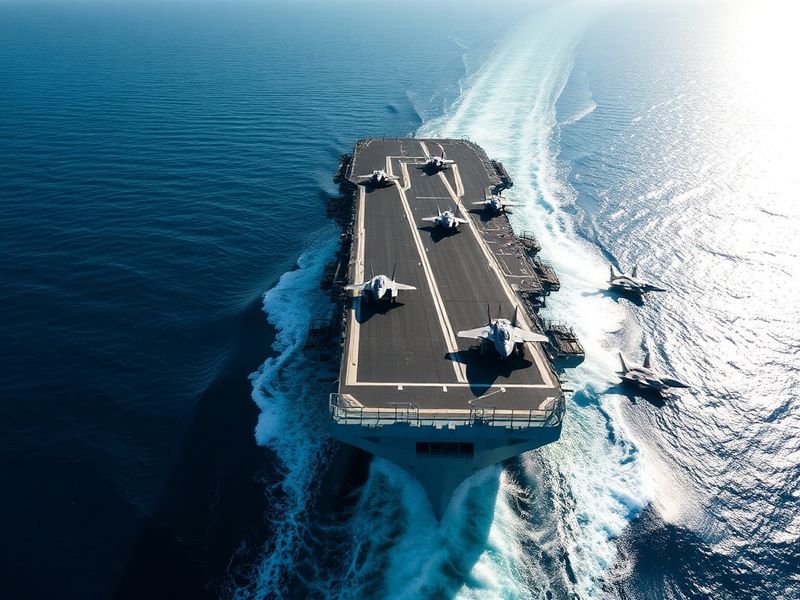
The USS Dwight D. Eisenhower (CVN-69), nicknamed “Ike,” is one of the most recognizable symbols of American naval dominance. Commissioned in 1977, this Nimitz-class aircraft carrier has spent over four decades serving as a mobile airfield, power projection platform, and diplomatic tool for the United States. Its endurance and adaptability reflect both technological advancements and shifting geopolitical realities.
Named after the 34th U.S. president and World War II supreme allied commander, the Eisenhower carries forward a legacy of leadership. Unlike its predecessors, which were powered by conventional steam turbines, the Ike was built from the keel up as a nuclear-powered vessel—a decision that extended its operational range to nearly unlimited distances without refueling. This capability remains a cornerstone of its strategic value.
The Evolution of a Floating City: Design and Capabilities
The Eisenhower was the third ship in the Nimitz-class, following the USS Nimitz and USS Dwight D. Eisenhower. Like its sister ships, it was designed to operate for up to 50 years without a mid-life refueling, thanks to its two Bechtel A1B nuclear reactors. These reactors generate steam to drive four propeller shafts, delivering over 260,000 shaft horsepower and enabling speeds in excess of 30 knots.
At 1,092 feet long and with a full-load displacement of approximately 100,000 tons, the carrier functions as a self-contained city. It houses around 3,200 crew members and an additional 2,400 air wing personnel. The flight deck spans 4.5 acres and features four steam catapults and four arresting wires, allowing for rapid launch and recovery of up to 60 aircraft.
Its air wing typically includes F/A-18E/F Super Hornets, EA-18G Growlers, E-2D Hawkeyes, and MH-60R/S helicopters. In recent years, the Ike has also supported the integration of unmanned systems, including the MQ-25 Stingray aerial refueling drone, marking a transition toward next-generation carrier aviation.
Beyond aviation, the Eisenhower is equipped with advanced radar systems, including the AN/SPY-1D(V) and the new AN/SPY-6, which enhance its ability to detect ballistic missiles and low-flying threats. These systems, combined with the Aegis Combat System, make it a key node in the U.S. Navy’s ballistic missile defense network.
Key Technical Specifications
- Class: Nimitz-class (nuclear-powered aircraft carrier)
- Displacement: 97,000 tons (full load)
- Length: 1,092 feet
- Beam: 252 feet (flight deck), 134 feet (hull)
- Propulsion: Two Bechtel A1B nuclear reactors, four shafts
- Speed: 30+ knots
- Crew: 3,200 ship’s company + 2,400 air wing
- Armament: NATO Sea Sparrow, Rolling Airframe Missiles (RAM), Phalanx CIWS, ESSM
- Radar: AN/SPY-1D(V), AN/SPY-6, AN/SPS-48E, AN/SPS-49(V)5
- Commissioned: October 18, 1977
Operational History and Strategic Role
The Eisenhower has participated in nearly every major U.S. military operation since the late 20th century. During the Cold War, it conducted patrols in the Mediterranean and North Atlantic, serving as a deterrent against Soviet naval expansion. In the 1980s, it supported operations in Lebanon and the Persian Gulf, including during the Iran-Iraq War.
One of its most notable deployments came in 1980 during the failed attempt to rescue American hostages in Iran, known as Operation Eagle Claw. Although the mission was aborted, the Eisenhower’s presence underscored the carrier’s role as a rapid-response asset in crisis zones.
In the 1990s, the Ike played a central role in Operations Desert Shield and Desert Storm, launching thousands of sorties against Iraqi forces. Its sustained operations over Iraq and Kuwait demonstrated the carrier’s endurance and the effectiveness of naval air power in large-scale conflicts.
More recently, the Eisenhower has been active in the Middle East, supporting counter-ISIS operations in Iraq and Syria as part of Combined Joint Task Force – Operation Inherent Resolve. It has also conducted freedom of navigation operations in the South China Sea, asserting U.S. presence amid growing tensions with China.
In 2023, the Eisenhower began a mid-life refueling and complex overhaul (RCOH) at Newport News Shipbuilding, a process expected to take several years. This upgrade will extend its service life into the 2050s, ensuring it remains relevant in an era of hypersonic threats and emerging unmanned technologies.
The Broader Implications of U.S. Carrier Power
The USS Eisenhower is more than a ship—it is a symbol of American maritime strategy and global reach. Aircraft carriers like Ike enable the United States to project power without relying on foreign basing rights, a critical advantage in an era of contested access and anti-access/area denial (A2/AD) environments.
China’s rapid expansion of its own carrier fleet—including the Type 003 Fujian—has intensified competition in the Indo-Pacific. The U.S. Navy currently operates 11 aircraft carriers, with plans to grow the fleet to 12 or more. This numerical advantage, combined with technological superiority in air wings and sensors, reinforces America’s naval dominance.
Yet, the future of aircraft carriers is not without debate. Critics argue that carriers are vulnerable to long-range anti-ship missiles, hypersonic weapons, and swarming drone attacks. Proponents counter that carriers remain indispensable due to their mobility, command-and-control capabilities, and the psychological deterrence they provide.
The Eisenhower’s ongoing modernization reflects this balance between tradition and innovation. By integrating unmanned systems, directed energy weapons, and advanced AI-driven decision tools, the Navy is evolving the carrier concept for the 21st century.
The Carrier in Modern Naval Doctrine
The U.S. Navy’s Technology section often examines how platforms like the Eisenhower integrate with emerging systems. Some key areas of evolution include:
- Unmanned Systems: The MQ-25 Stingray will extend the range of manned aircraft by serving as an aerial refueling tanker, reducing the need for vulnerable tankers.
- Laser Weapons: The Navy is testing solid-state lasers like the HELIOS system, which could complement CIWS for missile defense.
- Distributed Lethality: The Eisenhower’s air wing is increasingly networked with other platforms, enabling coordinated strikes across domains.
- Electromagnetic Aircraft Launch System (EMALS): While not on the Ike (it uses steam catapults), newer carriers like the USS Gerald R. Ford feature EMALS, offering greater efficiency and compatibility with future aircraft.
Conclusion: The Enduring Relevance of the Eisenhower
The USS Dwight D. Eisenhower has stood as a testament to American ingenuity, resilience, and strategic foresight for nearly five decades. From Cold War deterrence to modern expeditionary operations, it has adapted to changing threats while maintaining its core mission: to control the seas and project power when and where needed.
As geopolitical competition intensifies and new technologies emerge, the Eisenhower’s role may evolve, but its importance will not diminish. It remains a cornerstone of naval aviation, a platform for diplomacy, and a deterrent against aggression. In an era where global stability is increasingly uncertain, the Ike stands ready—floating, flexible, and formidable.
For those interested in the intersection of military technology and strategy, the Eisenhower offers a compelling case study. Its history is not just one of steel and steam, but of vision, adaptation, and the enduring power of sea-based air dominance.
Explore more in our News section or delve into Technology coverage for deeper analysis on naval innovation.