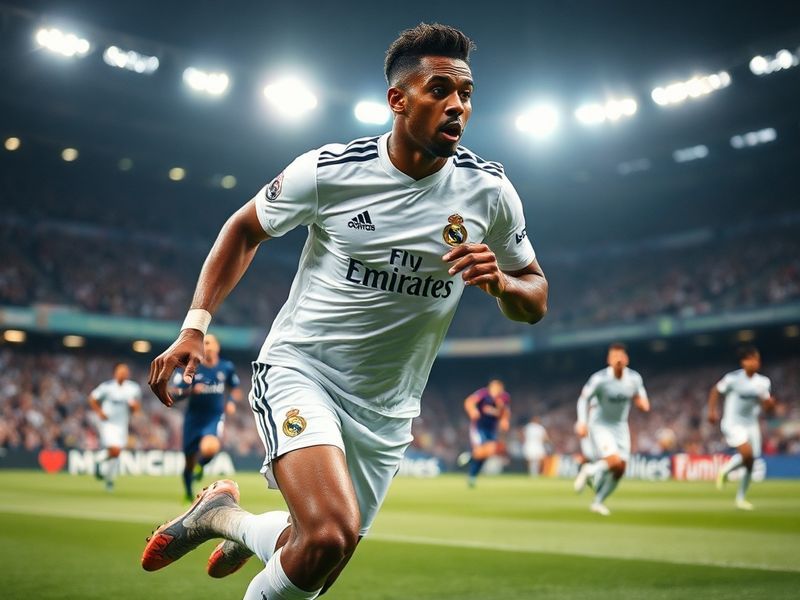
David Alaba: How Versatility Transformed Modern Football
“`html
David Alaba: The Versatile Maestro Redefining Modern Football
David Alaba’s career stands as a testament to adaptability, leadership, and technical brilliance. From his early days as a prodigious teenager at Bayern Munich to his current role as a cornerstone at Real Madrid, Alaba has consistently defied positional expectations while elevating every team he has joined. His journey reflects the evolution of football itself, where versatility is now prized as highly as specialization.
Born on June 24, 1992, in Vienna, Austria, to a Filipino mother and Nigerian father, Alaba’s multicultural background has often been cited as a factor in his open-minded approach to the game. This perspective has allowed him to seamlessly transition between defensive and midfield roles, making him one of the most tactically flexible players of his generation. His story is not just about athletic achievement but also about breaking barriers in a sport that has traditionally favored rigid positional play.
A Career Forged in Germany’s Most Successful Club
Alaba joined Bayern Munich’s youth academy at age 10, quickly rising through the ranks before making his professional debut at just 17 in 2010. His breakthrough came during the 2009–10 season under Louis van Gaal, where he became the youngest player to score in the Bundesliga at 17 years and 253 days. This record stood for nearly a decade, underscoring his early impact.
His versatility was evident early on. Initially deployed as a left-back, Alaba’s intelligence, passing range, and comfort on the ball allowed him to excel in higher positions. Under Pep Guardiola, who arrived in 2013, Alaba’s role expanded further. The Spaniard’s system demanded players who could play multiple roles, and Alaba thrived as a false full-back, inverted winger, and even deep-lying playmaker. During Bayern’s historic treble-winning 2012–13 season, he was a key figure, contributing with goals and assists while forming a dynamic partnership with Franck Ribéry on the left flank.
Over 13 seasons at Bayern, Alaba won 26 trophies, including 10 Bundesliga titles, two Champions League trophies (2013, 2020), and a FIFA Club World Cup. His ability to perform under pressure was particularly evident in the 2019–20 Champions League, where he captained the side to victory despite injuries to key players. This period solidified his reputation as a big-game player and a leader.
The Madrid Reinvention: A New Chapter at the Bernabéu
In 2021, Alaba made a high-profile move to Real Madrid, joining for a reported €50 million. The transition from Bayern to Madrid was not without challenges. While he was a world-class player, Madrid’s expectations are unparalleled, and the pressure to fill the void left by Sergio Ramos was immense. However, Alaba adapted quickly, forming a formidable partnership with Ferland Mendy at left-back and later excelling as a central defender in Carlo Ancelotti’s flexible system.
His impact at Madrid has been multifaceted. Defensively, he brings composure and technical quality rarely seen in modern defenders. His ability to play out from the back and initiate attacks has been crucial in Madrid’s possession-based style. In the 2021–22 season, he played a pivotal role in the club’s La Liga and Champions League double, providing stability at the heart of the defense. His performance in the 2022 Champions League final against Liverpool, where he marshaled the backline and contributed to a clean sheet, was particularly noteworthy.
Off the pitch, Alaba has embraced Madrid’s culture with humility, learning Spanish rapidly and integrating into a dressing room filled with superstars. His leadership style is quiet but effective, earning the respect of teammates like Karim Benzema and Thibaut Courtois. This adaptability has made him a player who transcends traditional roles, much like his mentor, Philipp Lahm, who was instrumental in redefining the full-back position.
International Leadership and Austria’s Golden Era
Alaba has been the captain of the Austrian national team since 2018, leading them to their first major tournament in 20 years: Euro 2024. His influence on the team extends beyond performance; he has been instrumental in fostering a new generation of Austrian talent. Players like Konrad Laimer, Marcel Sabitzer, and Florian Wirtz have thrived under his guidance, reflecting his ability to elevate those around him.
His leadership was on full display during Austria’s impressive Euro 2024 campaign. Despite a tough group stage, Alaba’s tactical awareness and vocal presence in midfield helped Austria progress to the knockout rounds. His performance against France in the Round of 16, where he controlled the tempo and provided a crucial assist, was a masterclass in midfield dominance. This tournament marked a turning point for Austrian football, proving that Alaba’s influence extends far beyond club football.
Alaba’s international career has not been without challenges. Austria failed to qualify for the 2018 and 2022 World Cups, and his own injuries have sometimes derailed campaigns. Yet, his resilience and commitment to the national team have never wavered. His 100th cap, achieved in 2023, was a milestone celebrated across Europe, symbolizing his enduring impact on the game.
The Modern Footballer: Versatility, Intelligence, and Longevity
What sets Alaba apart is not just his technical ability but his understanding of the game. He reads the play with a maturity that belies his age, often anticipating danger before it materializes. His passing accuracy, particularly from deep positions, allows teams to transition smoothly from defense to attack. Defensively, his positioning and one-on-one ability make him a reliable last line of defense.
Alaba’s career also highlights the importance of longevity in modern football. While many players decline after their mid-20s, Alaba has maintained his performance levels into his early 30s. This is a testament to his professionalism, work ethic, and adaptability. His training regimen, which includes extensive focus on recovery and flexibility, has allowed him to avoid the common pitfalls of aging athletes.
His influence extends to the next generation of players. Young defenders and midfielders now aspire to emulate his career path, proving that versatility is a skill to be cultivated rather than a limitation. Clubs across Europe have sought to recruit players with similar profiles, reflecting a broader shift in football tactics toward fluid, interchangeable systems.
Off the Pitch: Activism and Personal Growth
Beyond football, Alaba has used his platform to advocate for social causes. He has been vocal about racial equality, supporting initiatives that promote diversity in football. His multicultural background has made him a natural advocate for inclusion, and he has partnered with organizations like the Fare network to combat discrimination in the sport.
Alaba is also known for his business acumen. He has invested in startups and sustainable projects, reflecting a forward-thinking approach to his post-football career. His partnership with Adidas and other brands has further cemented his status as a global icon, transcending the boundaries of the pitch.
Despite his fame, Alaba maintains a relatively low-key personal life. He is married to Shalimar Heppner, a German model, and the couple has two children. His family life is kept private, allowing him to focus on his career without the distractions that often plague professional athletes.
Conclusion: A Legacy in the Making
David Alaba’s career is a blueprint for modern footballers. His ability to reinvent himself, lead by example, and perform under pressure has set a new standard for versatility and intelligence in the game. Whether as a full-back, midfielder, or center-back, Alaba has consistently delivered performances that transcend his position.
As he enters the latter stages of his career, the question of his legacy looms large. Will he be remembered as one of the greatest players of his generation? The answer may lie in his next challenge: captaining Austria at the 2026 World Cup. If he can guide his nation to a deep run, it will cement his place not just as a club legend but as a global icon of the sport.
For aspiring footballers, Alaba’s career offers a powerful lesson: adaptability is not a weakness but a superpower. In an era where football demands more from its players than ever before, Alaba has shown that the ability to evolve is the key to sustained success.
As football continues to evolve, players like Alaba remind us that the game’s beauty lies in its unpredictability—and its heroes are those who embrace change rather than resist it.
—