Few places on Earth carry the weight of history and natural splendor like Yellowstone National Park. Established in 1872 as the world’s first national park, it set a precedent that would eventually inspire conservation efforts across the globe. Stretching across nearly 3,500 square miles in the northwestern United States, Yellowstone encompasses vast forests, alpine lakes, and geothermal wonders that draw millions of visitors each year.
The park’s significance transcends its borders. It is not merely a destination for outdoor enthusiasts; it is a living testament to humanity’s evolving relationship with nature. From its Indigenous roots to its role in the modern environmental movement, Yellowstone reflects the complexities of preservation, tourism, and cultural identity. Its geysers, hot springs, and wildlife—including bison, wolves, and grizzly bears—have become symbols of untamed wilderness in an increasingly developed world.
The Birth of a Conservation Ideal
The idea of protecting wild spaces for future generations was radical in the 19th century. Before Yellowstone, land was typically viewed through the lens of exploitation—timber, minerals, and hunting grounds. Yet, in 1872, under President Ulysses S. Grant, Congress designated Yellowstone as a public park “for the benefit and enjoyment of the people.” This act laid the foundation for the global national park system, which now spans over 100 countries.
The park’s establishment was not without controversy. Early advocates like naturalist John Muir and geologist Ferdinand Hayden argued passionately for its protection, but skeptics doubted whether such a remote and rugged landscape could ever become a tourist destination. Their persistence paid off. By the early 20th century, railroads and later highways made Yellowstone accessible, turning it into a model for sustainable tourism.
Today, the park’s dual identity—as both a protected ecosystem and a public treasure—continues to shape its management. Balancing visitor access with habitat preservation remains an ongoing challenge, particularly as climate change alters ecosystems and increases visitation. The lessons learned at Yellowstone have influenced conservation strategies worldwide, from Patagonia to the Serengeti.
A Landscape of Fire and Ice
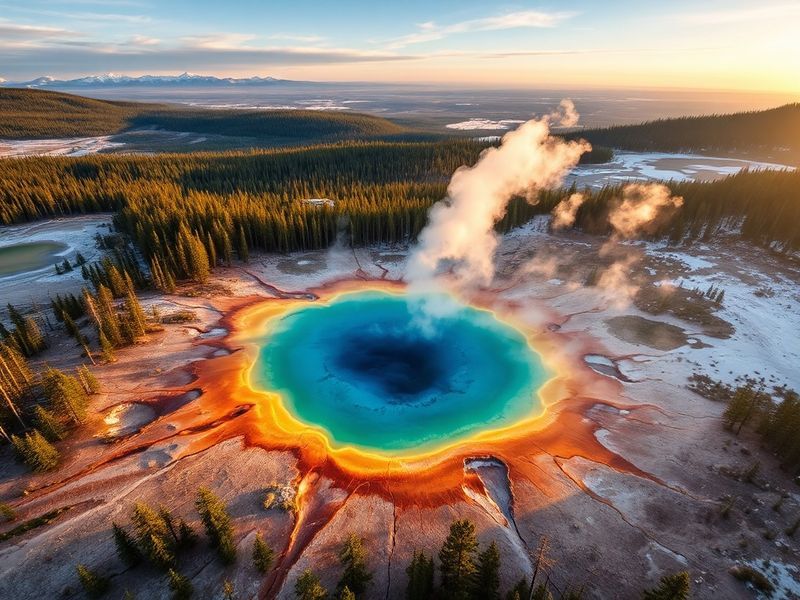
Yellowstone’s geology tells a story of violent upheaval and slow transformation. The park sits atop a supervolcano, one of the largest on Earth, whose last major eruption occurred 640,000 years ago. While dormant, the volcano fuels the park’s iconic geothermal features: over 10,000 hydrothermal phenomena, including more than 500 geysers. Old Faithful, perhaps the most famous, erupts roughly every 90 minutes, drawing crowds that have stood in awe for generations.
Beyond its geothermal activity, Yellowstone is a study in ecological diversity. The park spans multiple climate zones, from the arid sagebrush flats of the north to the alpine tundra of the Absaroka Range. This variety supports over 1,700 species of plants and animals. The Lamar Valley, often called “America’s Serengeti,” hosts one of the largest wild bison herds in the world, while the grizzly bear population has rebounded under federal protection.
Yet, the landscape is also shaped by fire. Wildfires, both natural and human-caused, have played a crucial role in regenerating forests. The massive fires of 1988, which burned nearly a third of the park, were initially seen as a disaster. Over time, however, ecologists recognized their role in creating new habitats. Today, the park’s fire management strategy reflects this understanding, allowing controlled burns to maintain ecological balance.
From Indigenous Stewardship to Modern Preservation
Long before Yellowstone became a national park, it was home to Indigenous peoples. The Shoshone, Crow, Blackfeet, and other tribes had lived in and around the region for thousands of years, relying on its resources for food, medicine, and spiritual connection. Their relationship with the land was one of reciprocity, not conquest. Yet, as European settlers moved westward, Indigenous communities were displaced, their voices largely excluded from early conservation narratives.
Efforts to reckon with this history are ongoing. In recent years, the National Park Service has worked to incorporate Indigenous perspectives into park management through programs like the Yellowstone Tribal Heritage Center. These initiatives aim to restore traditional ecological knowledge and involve Native communities in decision-making. It’s a reminder that conservation is not just about protecting nature—it’s about restoring justice.
The park’s cultural influence extends far beyond its borders. Yellowstone has inspired countless artists, writers, and filmmakers, from painter Thomas Moran to the 1990s TV series Yellowstone, which reimagined the park as a battleground of family drama and land disputes. The park’s mythology has become intertwined with American identity, symbolizing both the beauty and brutality of the frontier.
Preserving Paradise in a Changing World
Yellowstone faces unprecedented challenges in the 21st century. Climate change is altering snowpack patterns, affecting water availability and wildlife migration. Invasive species, like the lake trout in Yellowstone Lake, threaten native fish populations. And surging visitation—over 4 million people annually—puts pressure on infrastructure and ecosystems.
The park’s managers are responding with innovative solutions. Programs like the Yellowstone Pledge encourage visitors to reduce their impact through Leave No Trace principles. Meanwhile, climate adaptation plans aim to protect vulnerable species like the whitebark pine, a keystone species in grizzly bear diets.
For many, Yellowstone represents the last best hope for wilderness on Earth. Its story is one of resilience—of a landscape that has survived volcanic eruptions, glacial advances, and human ambition. It is also a story of human responsibility, a reminder that conservation is not a one-time act but an ongoing commitment.
Whether seen from the boardwalks of Old Faithful or the remote trails of the Thorofare region, Yellowstone invites visitors to witness nature in its most dramatic form. It challenges us to ask not just how we can visit such places, but how we can help preserve them for generations to come.
As the world’s first national park continues to evolve, its legacy remains clear: conservation is not a luxury, but a necessity. And in a time when so many wild places are disappearing, Yellowstone stands as both a monument to the past and a blueprint for the future.