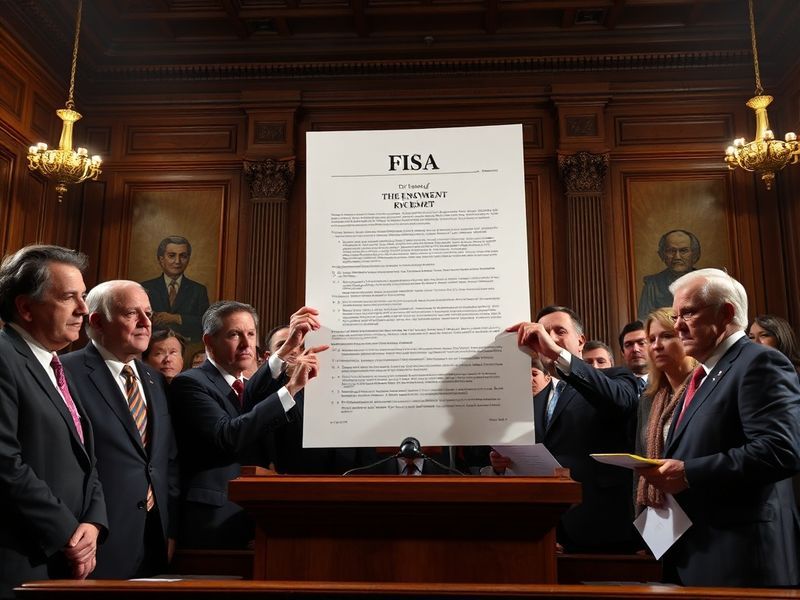
House Republicans Push for Major FISA Reforms Amid Surveillance Debate
“`html
House Republicans Intensify Push for FISA Reforms as Surveillance Debate Heats Up
House Republicans have escalated their scrutiny of the Foreign Intelligence Surveillance Act (FISA) in recent weeks, introducing legislation aimed at tightening oversight of government surveillance programs. The move comes amid growing concerns about the balance between national security and civil liberties, with lawmakers on both sides of the aisle calling for increased transparency and accountability.
Spearheaded by House Judiciary Committee Chairman Jim Jordan and Intelligence Committee Chairman Mike Turner, the proposed reforms seek to address perceived abuses in the FISA process. These include stricter requirements for obtaining surveillance warrants and enhanced penalties for misconduct by intelligence officials.
Key Provisions in the Republican-Led FISA Reform Efforts
The legislation introduced by House Republicans includes several notable provisions designed to overhaul the FISA system. Among the most significant are:
- Enhanced warrant requirements: The bill mandates additional layers of review for surveillance applications targeting Americans or individuals located within the United States. This includes a requirement for approval from a newly created special court panel before warrants can be issued.
- Stricter penalties for misconduct: Intelligence officials found to have willfully provided false information or engaged in unauthorized surveillance face harsher penalties, including potential criminal charges. The reforms also establish a dedicated inspector general to investigate complaints of abuse.
- Transparency mandates: The bill requires the government to publicly disclose aggregate data on the number of FISA applications approved, denied, or modified each year. This data must include breakdowns by type of surveillance and target.
- Sunset provisions: Certain surveillance authorities would be subject to periodic reauthorization by Congress, forcing lawmakers to periodically reassess their necessity and effectiveness.
Proponents of the reforms argue that these changes are long overdue, pointing to past incidents of abuse and overreach as justification for tighter controls. Critics, however, warn that the proposed changes could hamper intelligence agencies’ ability to track threats, particularly from foreign adversaries.
Historical Context: How FISA Has Evolved and Why It’s Back in the Spotlight
Enacted in 1978 in the wake of revelations about domestic spying by intelligence agencies, FISA was designed to provide a legal framework for foreign intelligence surveillance while protecting the rights of Americans. The law established the Foreign Intelligence Surveillance Court (FISC), a secretive judicial body that reviews and approves surveillance warrants.
Over the years, FISA has undergone several amendments to address emerging threats and technological advancements. The most significant of these came in the aftermath of the September 11 attacks, when Congress expanded the government’s surveillance powers through the USA PATRIOT Act. More recent changes, such as the 2015 USA FREEDOM Act, introduced additional transparency measures and ended the NSA’s bulk collection of phone records.
Despite these reforms, concerns about FISA’s effectiveness and potential for abuse have persisted. High-profile controversies, such as the FBI’s reliance on the Steele dossier in obtaining a FISA warrant to surveil former Trump campaign associate Carter Page, have fueled calls for further oversight. These incidents have become a focal point for House Republicans, who argue that the system is riddled with systemic flaws that demand urgent attention.
The Carter Page Controversy and Its Impact on FISA Reforms
The surveillance of Carter Page, a former Trump campaign advisor, has become a lightning rod in the debate over FISA reforms. The FBI obtained four warrants to monitor Page’s communications between 2016 and 2017, relying in part on opposition research compiled by former British intelligence officer Christopher Steele. The warrants were later criticized for relying on unverified and politically motivated information, raising questions about the integrity of the FISA process.
In response to these concerns, the Department of Justice (DOJ) initiated a review of the Page surveillance, which ultimately led to the identification of several errors and omissions in the FBI’s applications. While the DOJ did not find evidence of intentional misconduct, the episode highlighted the need for stronger safeguards within the FISA system. House Republicans have cited these findings as evidence that the current framework is vulnerable to abuse and requires significant reform.
Bipartisan Divisions and the Path Forward for FISA Legislation
The push for FISA reforms has exposed deep divisions between House Republicans and Democrats, as well as within each party. While Republicans broadly support tightening oversight of the surveillance system, Democrats are divided on the best approach. Some, like House Intelligence Committee Ranking Member Adam Schiff, have expressed concerns that the proposed reforms could undermine national security by restricting the government’s ability to track threats.
Meanwhile, progressive Democrats, such as Representatives Rashida Tlaib and Ilhan Omar, have criticized the reforms as insufficient, arguing that they do not go far enough to protect civil liberties. These lawmakers have called for more sweeping changes, including the outright repeal of certain surveillance authorities and the abolition of the FISC.
For their part, House Republicans are pressing ahead with their legislative agenda, hoping to build momentum for their reforms in the Senate. However, the path forward remains uncertain, as any changes to FISA will require approval from both chambers of Congress and the White House. President Biden has yet to take a public stance on the proposed reforms, though administration officials have signaled a willingness to work with lawmakers on enhancing oversight.
What’s Next for FISA and Surveillance Oversight?
As the debate over FISA reforms continues, several key developments are likely to shape the outcome of the legislation. One of the most critical factors will be the findings of ongoing investigations into the FBI’s handling of the Carter Page surveillance. These investigations, led by the DOJ’s Office of Inspector General and the House Judiciary Committee, could provide further evidence of systemic weaknesses in the FISA process.
Additionally, the broader geopolitical landscape will play a role in shaping the debate. The ongoing conflict in Ukraine and rising tensions with China have heightened concerns about the need for robust intelligence capabilities. Lawmakers will need to balance these security imperatives with the public’s demand for greater accountability and transparency.
Regardless of the outcome, the House Republicans’ push for FISA reforms has already succeeded in placing surveillance oversight at the forefront of the national conversation. With public trust in intelligence agencies at a low ebb, the debate over FISA is likely to remain contentious for the foreseeable future. For now, lawmakers on both sides of the aisle will continue to negotiate over the specifics of the legislation, with the goal of striking a balance between security and civil liberties.
For those interested in further analysis of government surveillance and its implications, be sure to explore our News and Analysis sections for ongoing coverage of this and other critical issues.