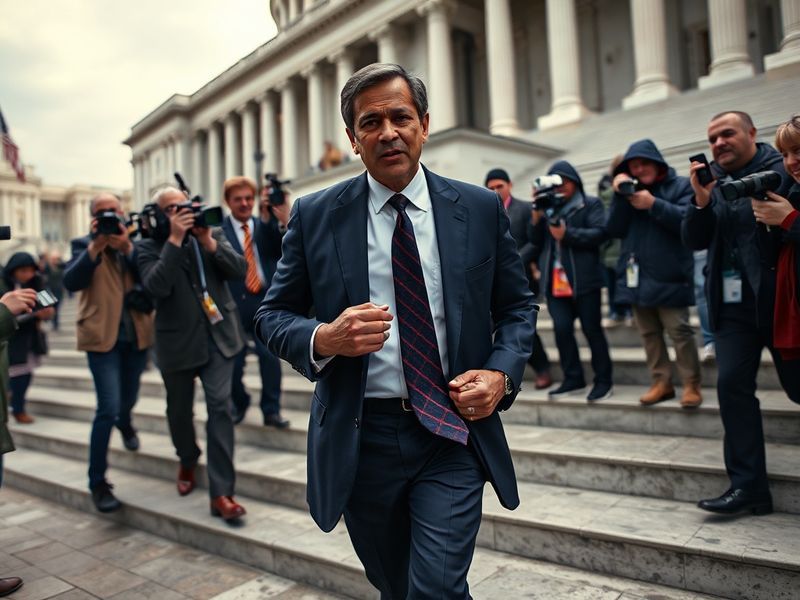
Kash Patel, a former Trump administration official and current political commentator, has carved out a reputation for unpredictable public behavior. His shifts in tone, abrupt social media posts, and occasional contradictions have made him a polarizing figure in American political discourse. While some view his actions as bold truth-telling, others see them as deliberate provocations designed to keep him in the spotlight. His behavior isn’t confined to domestic politics; it has reverberated globally, influencing how allies and adversaries perceive U.S. political dynamics.
From Government to Public Commentary: A Sudden Shift
Patel’s trajectory from a relatively low-profile Capitol Hill staffer to a vocal public figure has been marked by abrupt changes. Initially known for his work in the Trump administration, particularly his role in the Department of Defense, Patel transitioned into media commentary after leaving government service. His appearances on podcasts and news programs often feature sharp critiques of both Democratic and Republican establishments, but his delivery frequently veers into sensationalism.
His willingness to challenge long-standing narratives has earned him a following among conservative audiences. Yet his tendency to make bold claims without immediate substantiation has also drawn criticism. For instance, Patel has repeatedly suggested that federal agencies operate with hidden agendas, yet he has rarely provided concrete evidence to support these assertions. This pattern mirrors a broader trend in modern political discourse, where unsubstantiated claims often spread faster than verifiable facts.
Global Reactions to Patel’s Rhetoric
Patel’s influence extends beyond U.S. borders, particularly in countries where political polarization is already entrenched. In Europe, where far-right movements have gained traction, some see Patel as a kindred spirit—a figure unafraid to challenge mainstream political correctness. His appearances on international media outlets have sparked discussions about the role of populist rhetoric in shaping global politics.
In India, Patel’s comments about U.S.-India relations have drawn attention from both supporters and critics. His praise for India’s government has resonated with some segments of the diaspora, while others argue that his statements oversimplify complex geopolitical issues. Meanwhile, in the Middle East, his criticisms of U.S. foreign policy have been met with a mix of skepticism and cautious approval from regional analysts.
These reactions highlight a growing trend: the globalization of political provocateurs. Just as figures like Steve Bannon and Tucker Carlson have found audiences abroad, Patel’s brand of confrontational commentary has crossed cultural and linguistic barriers. However, his ability to sway international opinion remains uneven, often depending on the audience’s preexisting political leanings.
Social Media as a Stage for Provocation
Patel’s social media presence is a microcosm of his broader public persona. His posts frequently oscillate between policy critiques, personal attacks, and calls for systemic change. This unpredictability has made him a magnet for engagement—his content often generates significant shares, comments, and reactions, even when the substance is debatable.
One notable example is his use of Twitter (now X) to amplify conspiracy-adjacent theories about federal investigations. While some of his followers treat these claims as legitimate exposes, fact-checkers and mainstream journalists have consistently debunked them. Yet the damage isn’t just to Patel’s credibility; it also contributes to a broader erosion of trust in institutions.
This phenomenon isn’t unique to Patel. Across the political spectrum, figures leverage social media to bypass traditional gatekeepers, often prioritizing virality over accuracy. Patel’s approach, however, stands out for its sheer unpredictability. One day he might endorse a bipartisan policy initiative; the next, he’ll denounce the entire political class. Such volatility makes it difficult for observers to pin down his true positions, leaving many to question whether consistency even matters in his worldview.
Cultural Context: The Rise of the Provocateur
Patel’s behavior must be understood within the larger context of today’s media landscape. The decline of local journalism, the rise of partisan news outlets, and the dominance of algorithm-driven social media platforms have created an environment where outrage often trumps nuance. In this ecosystem, figures who thrive on disruption—whether through inflammatory rhetoric or unpredictable behavior—are rewarded with attention.
Patel’s appeal to certain audiences lies in his rejection of political norms. He positions himself as an outsider willing to say what others won’t, a narrative that resonates in an era where many feel disillusioned with traditional institutions. Yet this outsider persona is complicated by his own history in government, where he held significant power. Critics argue that his post-government persona is less about authenticity and more about maintaining relevance in a crowded media landscape.
Globally, similar figures have emerged in other countries, each carving out niches in their respective political ecosystems. From Brazil’s Jair Bolsonaro to the UK’s Nigel Farage, the playbook is familiar: challenge elites, embrace controversy, and let the audience decide what’s true. Patel fits squarely into this mold, though his specific strategies—such as his focus on institutional corruption—set him apart.
Where Does Patel Go From Here?
As Patel continues to navigate the intersection of politics, media, and public opinion, his future trajectory remains uncertain. Some speculate he may run for office, leveraging his name recognition to enter the electoral arena. Others believe he’ll double down on media appearances, monetizing his brand through podcasts, speaking engagements, and exclusive content platforms.
What is clear is that his approach to public discourse isn’t going away. In a media environment where attention is currency, Patel’s willingness to take risks—regardless of the consequences—ensures he’ll remain a fixture in political conversations. Whether that influence translates into lasting change or mere noise depends largely on how audiences choose to engage with his rhetoric.
One thing is certain: Patel’s story reflects broader shifts in how politics is conducted and consumed. The lines between truth and provocation, between insider and outsider, are increasingly blurred. In this environment, figures like Patel thrive not despite the chaos, but because of it.
For more analysis on political figures and their global impact, visit our News and Politics sections.