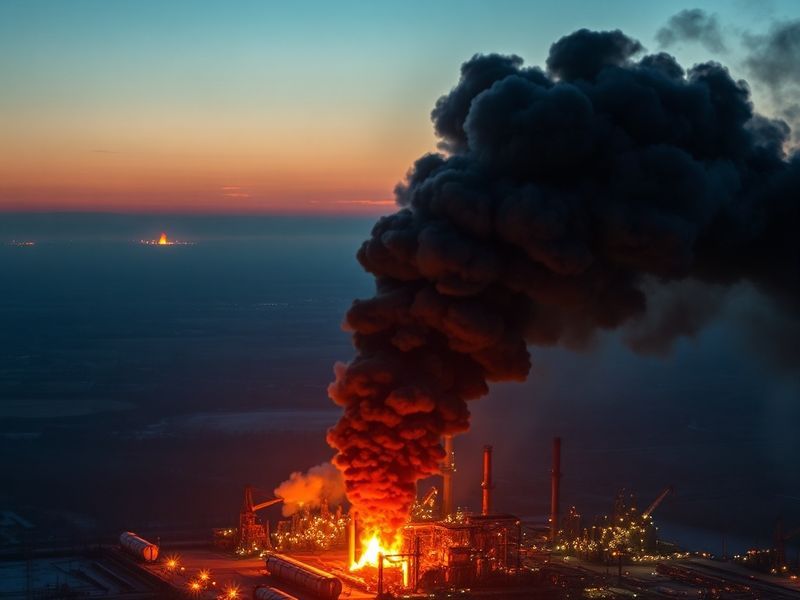
The conflict between Ukraine and Russia has entered a new phase with Ukraine’s recent strikes on Russian oil refineries. These attacks mark a strategic shift in the war, targeting critical infrastructure that fuels Russia’s military and economic operations. The strikes follow months of Ukrainian drone and missile campaigns against Russian energy facilities, but this escalation signals a more direct challenge to Moscow’s war-sustaining capabilities.
Russian officials confirmed attacks on multiple refineries, including facilities in Ryazan, Nizhny Novgorod, and Krasnodar. The Russian Ministry of Defense reported intercepting several Ukrainian drones, though local reports and social media videos suggest more extensive damage than initially acknowledged. The strikes come as Ukraine intensifies its long-range strike capabilities, with drones reportedly traveling up to 600 kilometers to reach targets deep inside Russia.
Why Russia’s Refineries Are Now in the Crosshairs
Russia’s oil refining sector has become a focal point for Ukrainian strikes due to its dual role in the war effort. Refineries produce not only gasoline and diesel for civilian use but also jet fuel for military aircraft and lubricants for armored vehicles. By disrupting these facilities, Ukraine aims to degrade Russia’s logistical capabilities while increasing pressure on the Kremlin to negotiate.
The attacks also target Russia’s economic stability. Oil products account for a significant portion of Russia’s export revenue, and sustained damage to refineries could lead to fuel shortages domestically. This strategy mirrors Ukraine’s earlier strikes on Russian Black Sea ports, which disrupted grain exports and strained Moscow’s economic resilience. The refinery strikes represent a calculated escalation, forcing Russia to divert military resources to protect critical infrastructure.
- Ryazan Refinery: One of Russia’s largest, producing over 17 million tons of oil products annually. Ukrainian strikes reportedly caused fires and halted operations temporarily.
- Nizhny Novgorod Refinery: A key facility in central Russia, supplying fuel to military airbases in the region. Social media footage showed plumes of smoke rising from the complex.
- Krasnodar Refinery: Located near the Ukrainian border, this facility processes crude oil from the Caucasus region. Its proximity makes it vulnerable to repeated attacks.
Ukraine’s Evolving Military Strategy
Ukraine’s ability to strike deep into Russian territory reflects its growing military capabilities and adaptability. The use of domestically produced drones, such as the long-range drone systems developed by Ukrainian engineers, has allowed Kyiv to bypass Russian air defenses and target strategic assets. These drones are often modified commercial models, equipped with precision guidance systems and improvised warheads.
The refinery strikes also highlight Ukraine’s shift from defensive to offensive operations. While earlier attacks focused on repelling Russian advances, these strikes demonstrate Kyiv’s willingness to take the fight to Russia’s home soil. Military analysts suggest this strategy aims to force Russia into a costly defensive posture, straining its already stretched resources. The strikes may also serve as a message to Western allies, showcasing Ukraine’s determination to escalate the conflict if necessary.
However, the strategy carries risks. Russia has vowed to retaliate, and further escalation could provoke a broader conflict. The Kremlin has already responded by tightening security around critical infrastructure and increasing air defense deployments. The international community remains divided on the legality and morality of striking civilian economic targets, with some nations condemning the attacks while others quietly support Ukraine’s right to defend itself.
The Economic and Environmental Fallout
The immediate impact of the strikes includes fuel shortages in several Russian regions. Videos circulating on social media show long lines at gas stations in Moscow and Saint Petersburg, with drivers reporting delays and price hikes. The Russian government has denied any significant shortages but has acknowledged temporary disruptions to fuel distribution networks.
Environmental concerns are also emerging. Refineries produce hazardous byproducts, and fires at these facilities can release toxic chemicals into the air and water. Environmental groups have warned that prolonged attacks could lead to ecological disasters, particularly in densely populated areas. The Krasnodar Refinery, for example, is located near the Black Sea coast, raising fears of marine pollution if containment measures fail.
Economically, the strikes threaten to undermine Russia’s energy sector, which has already been weakened by Western sanctions. The loss of refining capacity could reduce Russia’s ability to export oil products, further isolating its economy. However, Moscow has shown resilience in the past, rerouting exports through alternative markets and investing in new infrastructure to bypass sanctions.
What’s Next for the Conflict?
The coming weeks will be critical in determining the long-term impact of these strikes. If Ukraine continues to target refineries successfully, Russia may be forced to prioritize their protection over other military operations. This could divert troops and resources away from the front lines, creating opportunities for Ukrainian advances.
On the diplomatic front, the strikes could either accelerate peace talks or deepen the stalemate. Ukraine’s President Volodymyr Zelensky has repeatedly stated that military pressure is the only way to force Russia into concessions. Meanwhile, the Kremlin has dismissed the attacks as “terrorism” and vowed to respond with “all necessary measures.”
The international response will also shape the conflict’s trajectory. Western nations have provided Ukraine with advanced weapons systems, but there is growing unease over the potential for escalation. The United States and European Union have urged restraint, emphasizing the need to avoid actions that could lead to a wider war. However, Ukraine’s growing confidence in its military capabilities may make it less receptive to such appeals.
One thing is certain: the strikes on Russian refineries have altered the dynamics of the war. Whether this leads to a breakthrough or further escalation remains to be seen, but one thing is clear—Ukraine is no longer fighting a defensive war. It is waging a war of attrition, and Russia’s energy infrastructure is now firmly in its crosshairs.