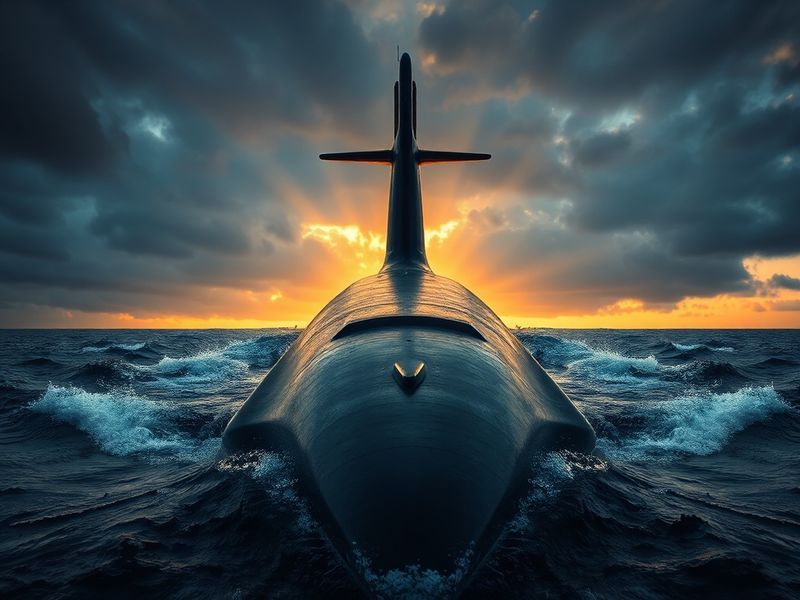
How Nuclear Submarines Shape Global Power and Security
“`html
The Silent Guardians: How Nuclear Submarines Shape Global Power
The ocean floor remains one of the last unexplored frontiers on Earth, yet beneath its depths moves a technology that has redefined military strategy and geopolitical influence. Nuclear submarines, often described as the ultimate stealth weapons, operate with a combination of advanced engineering and operational secrecy that makes them nearly untouchable in modern warfare. Their presence underpins the strategic balance between global powers, serving as both deterrents and tools of quiet coercion.
The Engineering Marvel Behind the Stealth
Unlike conventional diesel-electric submarines, which must surface or snorkel to recharge batteries, nuclear-powered submarines generate their own electricity and oxygen indefinitely. This independence allows them to patrol for months—or even years—without surfacing. The propulsion system relies on a compact nuclear reactor, typically using enriched uranium, which heats water to produce steam that drives turbines. This process eliminates the need for air intake, making the submarine nearly silent underwater.
The reactor’s design emphasizes redundancy and fail-safes. Multiple cooling systems, containment structures, and automated shutdown protocols ensure that even in the event of damage, radiation leaks remain unlikely. Modern nuclear submarines also feature pump-jet propulsors instead of traditional propellers, further reducing noise and making detection extremely difficult. These engineering choices transform the submarine into what strategists call a “boomer”—a vessel capable of launching nuclear missiles from beneath the waves with little warning.
Types of Nuclear Submarines and Their Roles
There are two primary categories of nuclear submarines, each serving distinct strategic purposes:
- Ballistic Missile Submarines (SSBNs): These are the cornerstones of nuclear deterrence. Armed with intercontinental ballistic missiles (ICBMs) carrying multiple warheads, SSBNs patrol designated zones in oceans far from enemy shores. Their anonymity and mobility make them nearly impossible to track, ensuring a second-strike capability that deters large-scale conflict. The United States operates the Ohio-class SSBNs, while Russia fields the Borei-class, and China is expanding its Type 094 fleet.
- Attack Submarines (SSNs): Faster and more maneuverable, SSNs are designed for intelligence gathering, anti-submarine warfare, and precision strikes. They can shadow enemy fleets, conduct reconnaissance, or launch cruise missiles at land targets. Nations like the U.S., UK, France, and Australia rely on SSNs such as the Virginia-class and Astute-class to project power without direct confrontation. India and China are also rapidly expanding their attack submarine fleets.
Geopolitical Chess: The Role of Submarines in Great Power Competition
In the 21st century, nuclear submarines have become central to the strategic calculus of major powers. The United States maintains a fleet of 14 Ohio-class SSBNs, each carrying up to 20 Trident II missiles with a range of over 7,000 miles. This ensures that even if land-based silos are destroyed in a surprise attack, the U.S. retains a devastating counterstrike capability. Russia, facing aging infrastructure and sanctions, has prioritized its Borei-class SSBNs as the backbone of its nuclear triad, alongside bombers and land-based ICBMs.
China’s rapid naval expansion reflects a deliberate shift toward sea-based deterrence. The Type 094 SSBN, though still considered noisy by Western standards, represents Beijing’s ambition to project power across the Pacific and into the Indian Ocean. Meanwhile, France and the United Kingdom maintain continuous at-sea deterrent patrols, ensuring that their nuclear arsenals remain hidden and invulnerable.
This silent competition has intensified in key maritime regions. The South China Sea, Arctic Ocean, and North Atlantic have become high-stakes arenas where submarines play a critical role. In 2022, reports emerged of Chinese submarines shadowing U.S. aircraft carriers in the Pacific, while Russian submarines have been detected near NATO coastlines. Such maneuvers underscore how submarines have evolved from defensive tools into instruments of power projection.
Cultural and Ethical Dimensions of Submarine Warfare
Beyond their military function, nuclear submarines carry profound cultural and ethical weight. They embody the duality of technological progress—advancements that save lives in peacetime can also enable destruction on an unprecedented scale. The idea of a submarine commander alone in the depths, authorized to launch nuclear weapons, has inspired countless works of fiction, from Tom Clancy’s The Hunt for Red October to the BBC’s The Silent Service. These narratives often explore themes of isolation, responsibility, and the moral weight of nuclear command.
Ethically, the existence of SSBNs raises questions about the ethics of deterrence itself. The concept of Mutually Assured Destruction (MAD) assumes that neither side would launch a first strike for fear of retaliation. Critics argue that this doctrine perpetuates a dangerous balance of terror, while proponents claim it has prevented large-scale wars between nuclear powers since 1945. The submarines, as invisible symbols of this doctrine, force societies to confront the paradox of seeking security through the threat of annihilation.
The Human Factor: Crews and Training
Operating a nuclear submarine is one of the most demanding roles in the military. Crews endure months-long patrols in cramped, high-pressure environments, often with limited contact with the outside world. Training for nuclear submarine duty is rigorous, involving nuclear engineering, tactical navigation, and damage control. The U.S. Navy’s “Silent Service” is known for its elite status, with candidates undergoing years of technical and psychological preparation.
Life aboard a submarine is marked by strict routines, shared meals, and communal living. Privacy is minimal, and the constant hum of machinery creates a unique soundscape. Yet, despite these challenges, submariners often describe a deep sense of purpose and camaraderie. The isolation of the deep fosters a culture of self-reliance and discipline that is rare in modern militaries.
Looking Ahead: The Future of Nuclear Submarine Technology
The next generation of nuclear submarines promises even greater stealth, endurance, and firepower. The U.S. Navy’s Columbia-class SSBN, set to replace the Ohio-class in the 2030s, will feature a life-of-the-ship reactor core, eliminating the need for mid-life refueling. This extends patrol durations and reduces operational costs. Meanwhile, Russia is developing the Borei-A class, with improved acoustics and missile payloads, while China’s Type 096 SSBN is expected to enter service by 2030, featuring quieter propulsion and enhanced sensors.
Emerging technologies like artificial intelligence and quantum sensors could revolutionize submarine warfare. AI-driven systems may soon assist in threat detection, navigation, and even autonomous operations. However, these advancements also raise concerns about escalation and the potential for autonomous systems to misinterpret signals in high-stakes environments.
As climate change opens new shipping lanes in the Arctic, nuclear submarines are poised to play an even larger role in securing strategic interests. The melting ice cap creates both opportunities and risks, as nations scramble to assert control over previously inaccessible waters. Submarines, capable of operating beneath the ice, are uniquely suited to monitor these changes and project sovereignty.
Ultimately, nuclear submarines remain one of the most enigmatic and influential technologies of the modern era. They are not merely weapons but symbols of national resolve, technological prowess, and the enduring quest for security in an uncertain world.
Conclusion: The Unseen Force Shaping Our World
Nuclear submarines may never capture the public imagination like aircraft carriers or fighter jets, yet their impact on global security is immeasurable. They operate in the shadows, unseen and unheard, yet their presence shapes alliances, deters aggression, and defines the balance of power. In an era where cyber warfare and drone strikes dominate headlines, the submarine stands as a reminder of the enduring importance of raw, kinetic power.
As technology evolves and geopolitical tensions rise, the role of nuclear submarines will only grow more critical. They are not just tools of war—they are guardians of peace, albeit a fragile one. For those who serve aboard them, they represent duty and sacrifice. For the world, they are a stark reminder of the thin line between security and destruction.